Structera Spend Analytics
Structera Spend Analytics is a self-serve procurement spend classification platform that turns transaction exports into a three-level taxonomy and classified…
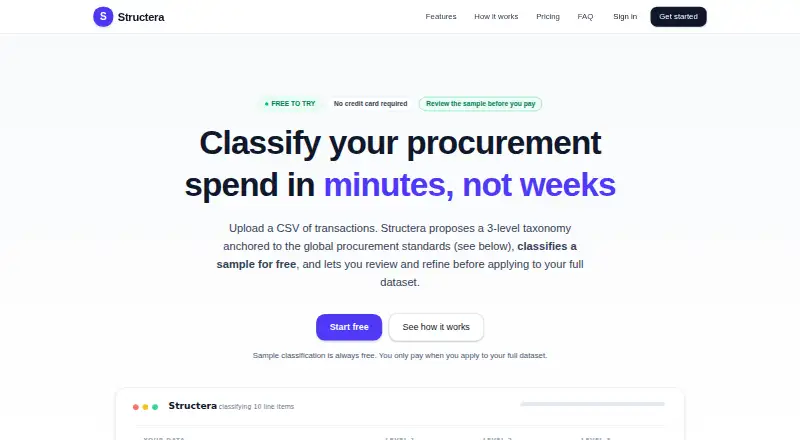
What Structera Spend Analytics is
Structera Spend Analytics is a self-serve procurement spend classification platform that turns transaction exports into a three-level taxonomy and classified dataset. Its taxonomy is anchored to UNSPSC and cross-referenced to SIC, NAICS and NACE. An AI engine classifies transactions, and users can review and correct low-confidence results before applying a validated taxonomy to a full dataset. Corrections are saved in per-supplier memory and applied automatically when the same supplier appears in a later run. A free sample covers about 100 representative rows, with one sample per data type per account. Full dataset classification costs £25, paid once-off minimum, followed by tiered per-row charges; the stated price excludes applicable taxes. Paid exports include an Excel workbook and an insight pack covering category analysis, supplier actions, tail-spend analysis and a quick-wins playbook. The Excel output can be used with BI tools such as Power BI, Tableau and Looker, but dashboards are not bundled. Uploads accept CSV, XLSX or XLS files up to 25 MB. The maker identifies SMEs, finance teams, consultants and consultancies conducting one-off spend reviews as intended users. The web product offers email support and does not provide a contractual uptime guarantee or service-level agreement.
Good
- Free sample classification is available
- AI classifications can be reviewed and corrected
- Supplier corrections carry forward to later runs
- Paid exports include an insight pack
- Excel output works with BI tools
Watch out
- Uploads are limited to 25 MB per file
- Dashboards are not bundled
- No contractual uptime guarantee or SLA
- Full dataset classification has a 25.00 GBP minimum
Who it suits
Structera suits SMEs, finance teams and consultants handling a one-off procurement spend review. It is also aimed at consultancies that need to classify transaction data and export results for BI tools.
Verdict
Structera provides a guided route from transaction export to a reviewed taxonomy, with supplier memory for future runs and paid analysis exports. Consider the upload cap, one-off pricing and lack of bundled dashboards when deciding whether it fits your review.
Plans and prices
From Structera Spend Analytics's own pricing page, checked 9 Oct 2026.
| Plan | Price | What it gives you |
|---|---|---|
| Sample classification | Free | ~100 representative rows · Sample, taxonomy generation, and review · Free sample; one per data type per account (suppliers, materials, services). |
| Full dataset classification | £25, paid once | Up to 25 MB per upload · CSV, XLSX, or XLS · Price excludes applicable taxes · One-off per dataset; GBP 25 minimum, then GBP 20 per 1,000 rows for the first 5,000, GBP 15 per 1,000 for rows 5,001–50,000, and GBP 10 per 1,000 above 50,000. |
The facts
Each one read from Structera Spend Analytics's own pages, with the date it was checked.
What it does
- AI and review
- An AI engine classifies transactions, and low-confidence results can be reviewed and corrected by the user.checked 9 Oct 2026
- Availability
- Structera does not offer a contractual uptime guarantee or service-level agreement.checked 9 Oct 2026
- BI use
- Structera provides Excel output for use with BI tools such as Power BI, Tableau, and Looker; the product does not bundle dashboards.checked 9 Oct 2026
- Classification workflow
- Users can review a free sample, correct classifications, and apply the validated taxonomy to the full dataset for a one-off payment.checked 9 Oct 2026
- Data handling
- Structera says staff cannot view uploaded transaction contents or classified results through its internal tools.checked 9 Oct 2026
- Export and analytics
- Paid exports include an Excel workbook and a procurement insight pack with category analysis, supplier actions, tail-spend analysis, and a quick-wins playbook.checked 9 Oct 2026
- Integrations
- Payments are processed via Stripe; transaction text is sent to Anthropic for AI inference, and Railway provides application and database hosting.checked 9 Oct 2026
- Intended users
- The maker identifies SMEs, finance teams, consultants, and consultancies doing one-off spend reviews as intended users.checked 9 Oct 2026
- Limits
- Uploads are capped at 25 MB per file; the maker says larger datasets can be split or users can ask about a higher limit.checked 9 Oct 2026
- Product
- Structera is a self-serve procurement spend classification platform that turns transaction exports into a three-level spend taxonomy and classified dataset.checked 9 Oct 2026
- Roadmap
- The stated roadmap includes an API for programmatic classification, SSO, UNSPSC code-level export, and deeper SIC, NAICS, and NACE mapping reports.checked 9 Oct 2026
- Security
- The privacy policy describes TLS encryption in transit, bcrypt password hashing, short-lived JWT sessions with idle timeout, role-based access controls, and isolated company workspaces.checked 9 Oct 2026
- Supplier memory
- Corrections are stored in per-supplier memory and apply automatically when the same supplier appears in a future run.checked 9 Oct 2026
- Support
- Support is provided by email, and the maker says its small UK-based team answers support messages itself.checked 9 Oct 2026
- Taxonomy standards
- Taxonomies are anchored to UNSPSC, with SIC, NAICS, and NACE cross-references.checked 9 Oct 2026
The company
- Headquarters
- United Kingdomchecked 28 Sep 2026
The full review of Structera Spend Analytics
Structera Spend Analytics classifies procurement transaction exports into a three-level taxonomy. It is best suited to SMEs, finance teams and consultants handling occasional spend reviews. Its sample-first workflow and per-dataset pricing make it a focused choice for analysis, but not for teams seeking built-in dashboards or guaranteed uptime.
Overview
An AI engine assigns transactions to categories in a taxonomy anchored to UNSPSC, with cross-references to SIC, NAICS and NACE. Users can review a free sample, correct low-confidence classifications and then apply the validated taxonomy to the full dataset. That sequence gives buyers a chance to refine results before paying for full processing, though it still requires human review where classifications are uncertain.
Corrections are retained in supplier-specific memory and applied automatically when the same supplier appears in a future run. This can reduce repeat work across later datasets with familiar suppliers. The product is oriented toward classifying and reviewing datasets, rather than ongoing monitoring: paid outputs are files and analysis, not bundled dashboards.
Key features
Review and supplier memory
The free sample covers about 100 representative rows and includes taxonomy generation and review. Each account can request one sample per data type—suppliers, materials and services—so it provides a useful preview, not unlimited free classification. Correcting uncertain results can improve the current review, while saved supplier corrections help when that supplier recurs.
Analysis and export
Paid exports include an Excel workbook and a procurement insight pack with category analysis, supplier actions, tail-spend analysis and a quick-wins playbook. The Excel output can be used with Power BI, Tableau or Looker, but teams must bring those tools themselves; Structera does not bundle dashboards. That suits buyers who want a classified dataset and guided findings, less so those seeking a live visual analytics environment in one product.
Data handling and service
Payments are processed through Stripe, transaction text is sent to Anthropic for AI inference, and Railway hosts the application and database. The privacy policy describes TLS encryption in transit, bcrypt password hashing, short-lived JWT sessions with idle timeout, role-based access controls and separate company workspaces. Structera says staff cannot view uploaded transaction contents or classified results through its internal tools. Support comes by email from the small UK-based team, but there is no contractual uptime guarantee or service-level agreement—an important limitation for teams that depend on assured availability.
Pricing
The Sample classification plan is free: one sample per data type per account, with about 100 representative rows, taxonomy generation and review. Its caps make it a preview and validation step, rather than a free way to process full datasets.
Full dataset classification costs £25 minimum per dataset, then £20 per 1,000 rows for the first 5,000, £15 per 1,000 rows for rows 5,001–50,000, and £10 per 1,000 rows above 50,000. This one-off structure fits occasional reviews better than recurring per-seat software costs, while larger files still incur usage-based charges. Uploads are limited to 25 MB per file; files can be split or users can ask about a higher limit. CSV, XLSX and XLS are supported, and prices exclude applicable taxes.
A free trial is also offered. The published plans describe a free sample and one-off full-dataset payments, rather than a recurring subscription with seats or renewal terms.
Platforms
Structera is web-based. Its Excel output can be carried into Power BI, Tableau or Looker, but those integrations are through the exported file rather than bundled dashboards.
Who it's for
SMEs and finance teams that need to turn transaction exports into a reviewed taxonomy are the clearest fit, especially when the work is occasional and supplier corrections can be reused. Consultants and consultancies doing one-off spend reviews can also benefit from the sample-to-full-dataset workflow and insight pack. Look elsewhere if the requirement is continuous dashboard reporting, a contractual service-level commitment or a programmatic API today; an API, SSO, UNSPSC code-level export and deeper SIC, NAICS and NACE mapping reports are on the stated roadmap.
Pros and cons
- Pros: A free, limited sample allows taxonomy review and corrections before paying for full processing.
- Pros: Supplier-specific memory carries corrections into future runs, reducing repeat review for recurring suppliers.
- Pros: The paid insight pack combines category, supplier and tail-spend analysis with a quick-wins playbook.
- Cons: Full classification is charged per dataset, with row-based fees above a £25 minimum and applicable taxes excluded.
- Cons: The 25 MB per-file cap can complicate larger uploads, even though splitting files or asking about a higher limit are options.
- Cons: No bundled dashboards, contractual uptime guarantee or service-level agreement limits its fit for teams needing integrated reporting or assured availability.
Alternatives
Spend Analysis Software is the broader category directory for comparing options.
- MacroSpend is worth considering for teams that want a freemium web product with a permanent free tier: it includes 100 AI credits per month, one AI agent, up to 25 vendors and three executive briefs per month. Structera instead centers on one-off dataset classification and a reviewed taxonomy.
- MeRLIN Spend Analytics may suit buyers seeking an API as well as web access; its pricing is custom, with a demo offered.
- Spendata is an option for buyers who need broader platform availability and a 30-day free trial with full access to Spendata Classic; it is paid and has no free plan.
- SpendQube is another paid web and API option, with custom pricing.
- EZ Procurement Spend Analysis is a paid web alternative.
- ProcureSprint PR to PO is a paid web alternative from Mindsprint, headquartered in Singapore with a global workforce of 3,200+ professionals.
- SOURCINGSHARK is another paid web alternative.
- SpendHQ Spend Intelligence is a web and API alternative; buyers can request a demo for pricing.
Verdict
Choose Structera when an SME, finance team or consultant needs a reviewed procurement taxonomy and useful supplier and category analysis from transaction exports without committing to a recurring platform. The free sample, correction workflow and retained supplier memory are its strongest reasons to choose it. Look elsewhere if dashboards, assured uptime or programmatic access are essential, or if the 25 MB upload cap and per-dataset charges do not fit the work.
Getting started
- Visit https://structera.co.uk/.
- Use the free sample for one data type: suppliers, materials, or services.
- Review and correct the sample classifications.
- Upload a CSV, XLSX, or XLS file up to 25 MB for full classification.
- Pay the one-off dataset charge to apply the validated taxonomy and receive the exports.
Limits worth knowing
The free sample is limited to one per data type per account and about 100 representative rows. Full-dataset uploads are capped at 25 MB per file, and classification costs at least £25 per dataset before tiered row charges and applicable taxes.
Questions
Is there a free option?
Yes. A free sample provides about 100 representative rows and is available once per data type per account for suppliers, materials, or services.
How much does full classification cost?
It costs £25 minimum per dataset, then £20 per 1,000 rows for the first 5,000, £15 per 1,000 rows for rows 5,001–50,000, and £10 per 1,000 rows above 50,000. Applicable taxes are excluded.
Which file types can I upload?
Full-dataset uploads accept CSV, XLSX, or XLS files up to 25 MB per file.
What do paid exports include?
They include an Excel workbook and a procurement insight pack with category analysis, supplier actions, tail-spend analysis, and a quick-wins playbook.
Does Structera include dashboards or integrations?
It does not bundle dashboards. Its Excel output can be used with Power BI, Tableau, and Looker.
Who makes Structera and where is it based?
The maker describes its support team as a small UK-based team, and the listed headquarters is in the United Kingdom.
Alternatives to Structera Spend Analytics
- 1

CostBits
Web6.9From €171 a month - 2
MacroSpend
Free planWeb6.6From $39 a month - 3

SpendCraft
WebAPI6.3From $899 a month - 4
Spic&Scan
Web6.2€2,750 one-time - 5

ivoflow Spend Analytics
Self-hosted6.1From €59 a month - 66.1From $639 a month