stress-ng
stress-ng is a free tool for exercising computer hardware and operating system interfaces under load.
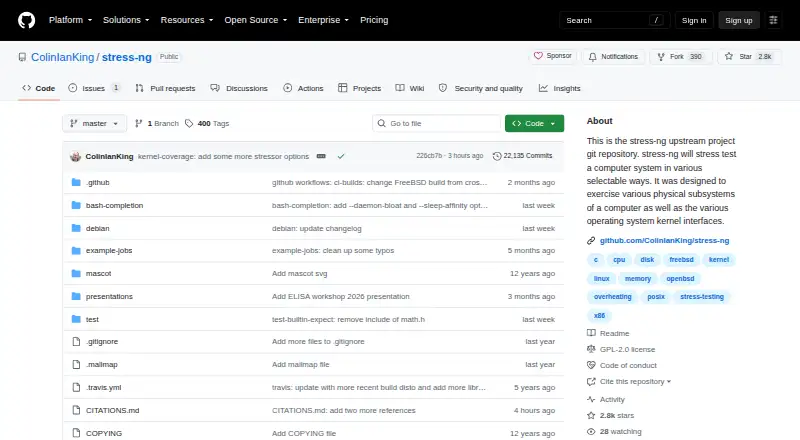
What stress-ng is
stress-ng is a free tool for exercising computer hardware and operating system interfaces under load. Its project lists more than 390 stress tests, including tests for CPU, virtual memory, filesystems, and memory or CPU caches. CPU tests cover floating-point, integer, bit-manipulation, and control-flow operations, and listed architecture coverage includes ARM, x86-64, RISC-V, MIPS, Power, SPARC, and s390x. The project originally aimed to expose hardware problems such as overheating under load and operating system bugs. It can report test throughput to help observe changes across operating system releases or hardware types, but is not intended as a precise benchmark suite. Use requires care: some tests can heat poorly designed hardware or create severe system thrashing that is difficult to stop. On Linux, running as root changes out-of-memory settings so stressors may become unkillable when memory is low. The tool is licensed under GPL-2.0; the project documents Docker snapshots and installation on recent Ubuntu versions through its PPA.
Good
- Free to use under GPL-2.0.
- Lists more than 390 stress tests.
- Covers CPU, memory, filesystem, and cache tests.
- Architecture coverage includes ARM, x86-64, and RISC-V.
Watch out
- Not a precise benchmark suite.
- Some tests may cause hardware to run hot.
- System thrashing may be difficult to stop.
- Root use on Linux can make stressors unkillable under low memory.
Who it suits
stress-ng suits users who need to exercise system components to look for hardware or operating system issues. It can also help observe throughput changes, provided users account for its stated limits and risks.
Verdict
stress-ng offers broad system stress coverage at no charge, with throughput reporting for observing changes. Its potential to overheat hardware or cause difficult-to-stop thrashing calls for cautious use.
Plans and prices
From stress-ng's own pricing page, checked 3 Oct 2026.
| Plan | Price | What it gives you |
|---|---|---|
| Free | Free | stress-ng is free and will always be free |
The facts
Each one read from stress-ng's own pages, with the date it was checked.
What it does
- Architectures
- The README lists test coverage across architectures including ARM, x86-64, RISC-V, MIPS, Power, SPARC, and s390x.checked 3 Oct 2026
- Build dependencies
- The build detects optional library dependencies and can disable functionality when support libraries are missing.checked 3 Oct 2026
- CPU coverage
- CPU stress tests exercise floating point, integer, bit manipulation, and control flow operations.checked 3 Oct 2026
- License
- The repository identifies its license as GPL-2.0.checked 3 Oct 2026
- Packaging
- The README documents running the latest snapshot in a Docker container and installing recent Ubuntu versions from the project’s PPA.checked 3 Oct 2026
- Privileges
- When run as root on Linux, stress-ng adjusts out-of-memory settings so stressors are unkillable in low-memory situations; the README advises judicious use.checked 3 Oct 2026
- Purpose
- stress-ng stress tests computer systems by exercising physical subsystems and operating system kernel interfaces.checked 3 Oct 2026
- Stress tests
- The project lists 390+ stress tests, including 100+ CPU, 60+ virtual memory, 80+ filesystem, and 50+ memory or CPU cache tests.checked 3 Oct 2026
- Support and contributions
- The README invites patches by email or merge requests through the stress-ng GitHub repository.checked 3 Oct 2026
- Throughput metrics
- stress-ng can measure test throughput to observe performance changes across operating system releases or hardware types, but the project says it is not a precise benchmark suite.checked 3 Oct 2026
- Usage caution
- Some tests can make poorly designed hardware run hot and cause excessive system thrashing that may be difficult to stop.checked 3 Oct 2026
- Use cases
- The project says it was originally intended to expose hardware issues such as thermal overruns and operating system bugs that occur under heavy load.checked 3 Oct 2026
Where it runs
- Platforms
- The README lists Linux, Solaris, BSD variants, Minix, Android, MacOS X, Serenity OS, GNU/Hurd, Haiku, WSL, Cygwin, and SunOS/Dilos among supported or tested systems.checked 3 Oct 2026
The full review of stress-ng
Overview
stress-ng is a free utility for loading computer hardware and operating-system interfaces, aimed at administrators and developers investigating behavior under pressure. Its unusually wide range of workloads is useful for broad stress testing, but its throughput figures are not precise benchmark results.
The project began as a way to expose issues such as thermal overruns and operating-system bugs that appear under heavy load. That makes it a better fit for probing system resilience than for comparing performance scores.
Key features
- Extensive workload coverage: More than 390 stress tests include over 100 CPU, 60 virtual-memory, 80 filesystem, and 50 memory or CPU-cache tests. This breadth supports investigations across several system subsystems, though users need a specific question in mind to choose useful workloads.
- Varied CPU operations: CPU stressors exercise floating-point and integer operations, bit manipulation, and control flow, letting users apply different kinds of processor load.
- Throughput reporting: The tool can measure throughput to help observe changes between operating-system releases or hardware types. The project cautions that it is not a precise benchmark suite, so these readings should not be treated as definitive performance rankings.
- Broad architecture coverage: Documented architectures include ARM, x86-64, RISC-V, MIPS, Power, SPARC, and s390x. Packaging guidance includes running a recent snapshot in Docker and installing on recent Ubuntu versions through the project PPA; builds can disable functionality when optional support libraries are absent.
Pricing
Free: free. stress-ng is free and will always be free, with stress testing, memory testing, disk health checks, and diagnostic reports included. There is no paid tier or free trial to weigh against this plan, making it suitable for users who want broad stress workloads without a software charge.
Platforms
stress-ng supports Android, Linux, macOS, self-hosted environments, and Windows. The project also documents Docker use and Ubuntu PPA installation, while optional build dependencies can affect which functionality is enabled in a given build.
Who it's for
System administrators and developers investigating thermal behavior, hardware problems, or operating-system bugs under load are the clearest fit. It is less suitable for users seeking precise benchmark comparisons or a narrowly targeted diagnostic. Caution matters: some tests can make poorly designed hardware run hot or trigger excessive system thrashing that is difficult to stop. On Linux, running as root changes out-of-memory settings so stressors cannot be killed in low-memory situations; that behavior makes judicious use particularly important.
Pros and cons
- Pro: More than 390 workloads span CPU, virtual memory, filesystems, and caches, supporting investigations beyond processor load alone.
- Pro: Throughput measurements can help track changes across operating-system releases or hardware types, even though they are not precision benchmarks.
- Pro: Free availability and support across several platforms lower the barrier to testing varied systems.
- Con: Some workloads can overheat poorly designed hardware or cause hard-to-stop thrashing, so indiscriminate use is risky.
- Con: Root execution on Linux can make stressors unkillable in low-memory situations, reducing the margin for recovery.
- Con: Optional library dependencies may be absent in a build, disabling corresponding functionality.
Alternatives
For dedicated memory testing, MemTest86 offers a free edition with no usage restrictions, while its Pro Download costs $116, paid once and includes free upgrades for 12 months. MemTest86+ is another free, open-source stand-alone memory tester for private or commercial use.
For drive-focused utilities, smartmontools is a free Linux, macOS, and Windows option with smartctl and smartd. Hard Disk Sentinel offers Linux and Windows options, including a limited trial and a free Linux version.
Intel VTune Profiler is a free profiler for Linux, self-hosted environments, and Windows; choose it when profiling rather than applying broad stress workloads is the priority. PC-Doctor Toolbox offers free personal use for up to five systems, with a required Toolbox Remote account and opt-in data sharing.
Blackwire Drive Eraser & Sanitizer is a Windows drive-erasure option with a free personal, noncommercial plan limited to two drives at once. Ultimate Boot CD is a free downloadable ISO image.
Browse the Hardware Diagnostic Software category for more options.
Verdict
Choose stress-ng if you need a free, cross-platform way to investigate system behavior across many hardware and operating-system workloads. Its breadth is the main reason to use it; the risk of overheating or difficult-to-stop thrashing is the reason to look elsewhere when controlled, narrowly focused diagnosis is more important.
Alternatives to stress-ng
- 1
MemTest86
Free planLinuxmacOSSelf-hostedWindows7.5From $76 a year - 2
Hard Disk Sentinel
Free planLinuxWindows6.9$22 one-time - 3
smartmontools
Free planLinuxmacOSWindows6.8Free plan - 4

GSmartControl
Free planLinuxmacOSWindows6.7Free plan - 5

Speccy
Free planWindows6.6$19.95 one-time - 6
Intel VTune Profiler
Free planLinuxSelf-hostedWindows6.5Free plan