STAMM
STAMM is a free, open-source MLOps framework for deploying and maintaining machine-learning soft sensors in industrial processes.
What STAMM is
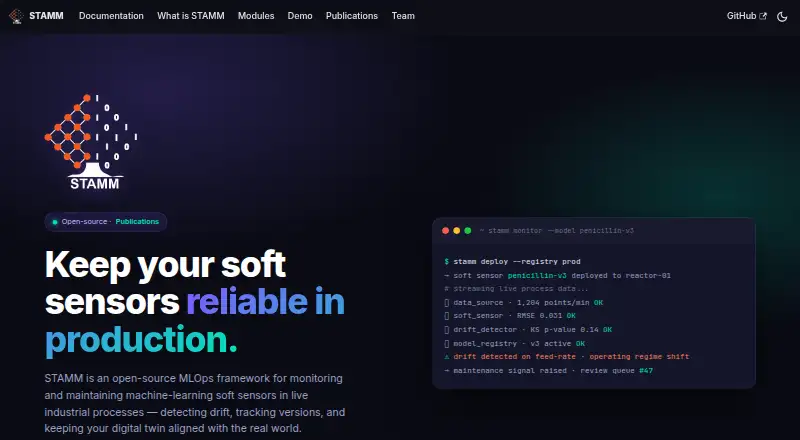
STAMM is a free, open-source MLOps framework for deploying and maintaining machine-learning soft sensors in industrial processes. It monitors live process data for concept drift and changes in operating regimes, and its dashboard shows process measurements, soft-sensor outputs, drift signals, and historical context. The dashboard also supports human-in-the-loop labelling. A model registry records versions, configuration, artifacts, validation results, and metadata. STAMM serves Python and R soft sensors through REST inference; its event-driven orchestrator calls the registry over REST and links predictions to the data snapshot that produced them. A separate drift-detector package provides 10 detectors through a common interface and can be used inside or outside the framework. Data can arrive through equipment REST hooks, MQTT applications, or frameworks such as LEAF. The reference time-series store is InfluxDB, while a PostgreSQL adapter is described as in progress. The reference Docker Compose installation supports Linux, macOS, or Windows with Docker 24 or later; 8 GB RAM or more is recommended. Released under Apache License 2.0, STAMM surfaces when maintenance may be needed but does not prescribe how to rebuild a model.
Good
- Monitors live data for drift and regime changes
- Registry tracks versions and validation results
- Offers 10 drift detectors through a common interface
- Apache License 2.0
Watch out
- PostgreSQL adapter is still in progress
- Recommends at least 8 GB RAM
- Does not prescribe how to rebuild a model
Who it suits
STAMM is intended for process modelers, ML engineers, operators, and project or production managers working with industrial soft sensors. It may suit teams that want drift monitoring and model tracking in live systems.
Verdict
STAMM provides monitoring, registry, and drift-detection tools for industrial soft-sensor workflows. Teams should account for its Docker-based reference deployment and the fact that it flags maintenance needs without specifying a rebuild method.
The facts
Each one read from STAMM's own pages, with the date it was checked.
What it does
- Audience
- The maker identifies process modelers, ML engineers, operators, and project or production managers as intended users.checked 4 Oct 2026
- Dashboard
- The dashboard shows live measurements, soft-sensor outputs, drift signals, and historical context, and supports human-in-the-loop labelling.checked 7 Oct 2026
- Data storage
- The reference time-series store uses InfluxDB; a PostgreSQL adapter is described as in progress.checked 7 Oct 2026
- Demo
- The reference demo applies STAMM to an industrial-scale penicillin fermentation simulator and includes a curated dataset, Node-RED bioreactor, and working model registry.checked 7 Oct 2026
- Deployment
- It integrates existing soft sensors into live systems alongside physical instruments without requiring rewrites.checked 7 Oct 2026
- Deployment requirements
- The documented Docker Compose installation supports Linux, macOS, or Windows with Docker 24 or later; 8 GB RAM or more is recommended.checked 4 Oct 2026
- Drift detection
- It detects regime shifts and concept drift, including through a Python package with 10 detectors behind a single API.checked 7 Oct 2026
- Drift detectors
- The drift detector package provides 10 detectors through a common interface and can be used inside or outside STAMM.checked 4 Oct 2026
- Installation
- The reference deployment uses Docker Compose and lists Linux, macOS, or Windows with Docker 24 or later and Docker Compose as requirements.checked 7 Oct 2026
- Integrations
- The workflow orchestrator calls the model registry over REST, and the project describes data ingestion through equipment REST hooks, MQTT applications, or frameworks such as LEAF.checked 7 Oct 2026
- Intended users
- The site identifies process modelers, ML engineers, operators, and project leaders or process and production managers as intended users.checked 7 Oct 2026
- Language support
- The maker describes support for Python and R soft sensors, served through REST inference.checked 4 Oct 2026
- License
- STAMM is released under the Apache License 2.0.checked 7 Oct 2026
- Model registry
- The registry tracks model versions, configuration, artifacts, validation results, and metadata; it supports Python and R models and REST inference.checked 7 Oct 2026
- Notable limitation
- STAMM surfaces when maintenance may be needed but does not prescribe how the model should be rebuilt.checked 7 Oct 2026
- Purpose
- STAMM is an open-source MLOps framework for deploying, monitoring, and maintaining machine-learning soft sensors in industrial processes.checked 7 Oct 2026
- Real-time monitoring
- It monitors live process data and detects concept drift and changes in operating regimes.checked 4 Oct 2026
- Security and compliance
- The project describes a FAIR-aligned YAML metadata schema for soft-sensor models that can link to FAIRDOM-SEEK catalogues such as the IBISBA Knowledge Hub.checked 7 Oct 2026
- Support
- The project page lists David Camilo Corrales at INRAE, Toulouse Biotechnology Institute, as a contact.checked 7 Oct 2026
- Workflow
- The event-driven orchestrator calls the model registry over REST and links predictions to the data snapshot that produced them.checked 4 Oct 2026
Alternatives to STAMM
- 1

Opik
Free planOpen sourceWebAPILinuxmacOS8.4From $19 a month - 2

Evidently AI
Free planOpen sourceWebAPILinuxmacOS8.3From $80 a month - 3

Deepchecks
Free planOpen sourceWebAPILinuxmacOS8.1Free plan - 4

NannyML
Free planOpen sourceWebAPILinuxSelf-hosted7.9From $99 a month - 5

SUPERWISE
Free planWebAPIExtensionLinux7.8From $9 a month - 6

Galileo
Free planWebAPISelf-hosted6.9From $100 a month