StackBuilder
StackBuilder is a Windows logistics optimization tool for planning how articles fit into cases, boxes onto pallets, and pallets into trucks.
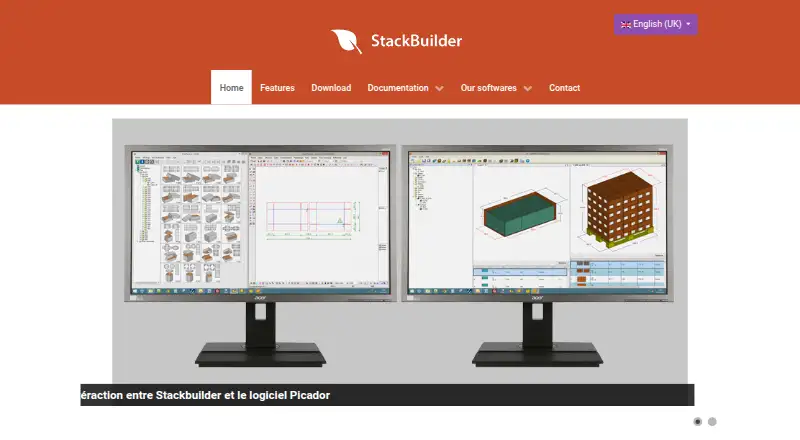
What StackBuilder is
StackBuilder is a Windows logistics optimization tool for planning how articles fit into cases, boxes onto pallets, and pallets into trucks. It supports homogeneous packing and palletizing analyses for boxes, cylinders, and bundles, with beta support for heterogeneous analyses. Users can add packaging details such as interlayers, gaps, corners, films, and labels. The free account includes Excel mass calculations limited to the first 5 rows; Premium adds manual box positioning, horizontal cylinder palletization and truck loading, half- and quarter-pallet analyses, and searches for box groupings and stacks. Premium also provides packing, palletizing, and truck-loading reports, XML or CSV robot exports, and a shared item database. StackBuilder integrates with TreeDiM’s Picador and PLM Pack packaging-system design software. It addresses homogeneous stacking problems involving one item and does not create solutions by turning items to fill leftover space. It runs on 64-bit Windows 10 and 11; Mac use through a Windows emulator is possible but not guaranteed. Pricing starts with a free account; Premium, 1 user, 1 year is €360.00 per year.
Good
- Analyzes cases, pallets, and truck loading.
- Supports boxes, cylinders, and bundles.
- Premium exports robot files as XML or CSV.
- Premium includes technical assistance during business hours.
Watch out
- Free Excel mass calculations process only the first 5 rows.
- Premium, 1 user, 1 year costs €360.00 per year.
- Homogeneous stacking uses one item and does not turn items to fill space.
- Mac emulator operation is not guaranteed.
Who it suits
StackBuilder suits logistics and packaging teams planning packing, palletizing, or truck loading. It may also suit users who need robot exports or shared item databases, provided they work on a supported Windows setup.
Verdict
StackBuilder covers multiple stages of packaging and logistics planning, with Premium adding reports, robot export, and database sharing. Check the one-item homogeneous stacking limit and Windows requirements against your workflow before choosing it.
Plans and prices
From StackBuilder's own pricing page, checked 11 Oct 2026.
| Plan | Price | What it gives you |
|---|---|---|
| Free account | Free | Excel mass calculation processes only the first 5 rows · no premium features listed |
| Premium, 1 user, 1 year | €360 a year | 1 user · subscription for Premium functionalities · 1 year |
| Premium, 1 user, 2 years | €540 a year | 1 user · subscription for Premium functionalities · 2 years |
| Premium, 5 users, 1 year | €600 a year | 5 users · subscription for Premium functionalities · 1 year |
| Premium, 1 user, 3 years | €750 a year | 1 user · subscription for Premium functionalities · 3 years |
| Premium, 5 users, 2 years | €900 a year | 5 users · subscription for Premium functionalities · 2 years |
| Premium, 5 users, 3 years | €1,260 a year | 5 users · subscription for Premium functionalities · 3 years |
The facts
Each one read from StackBuilder's own pages, with the date it was checked.
The company
- Company location
- TreeDiM lists its address as 1 Boulevard Heurteloup, 37000 Tours, France.checked 11 Oct 2026
- Headquarters
- Tours, Francechecked 28 Sep 2026
What it does
- Database sharing
- Premium supports saving items in a database and sharing that database between users.checked 11 Oct 2026
- Important limit
- The FAQ says StackBuilder solves homogeneous stacking problems involving one item and does not create solutions using turned items to fill remaining space.checked 11 Oct 2026
- Integrations
- TreeDiM says StackBuilder is fully integrated with its Picador and PLM Pack software for packaging-system design.checked 11 Oct 2026
- Packaging components
- Users can create pallet interlayers, gaps, corners, films, and labels.checked 11 Oct 2026
- Pack and palletize
- It supports homogeneous packing and palletizing analyses for boxes, cylinders, and bundles, plus beta heterogeneous analyses.checked 11 Oct 2026
- Premium functions
- Premium adds manual box positioning, horizontal cylinder palletization and truck loading, half and quarter pallet analyses, and searches for optimal box groupings and stacks.checked 11 Oct 2026
- Purpose
- StackBuilder designs and optimizes article-to-case packing, box-to-pallet palletizing, and pallet-to-truck loading.checked 11 Oct 2026
- Reporting
- Premium can generate packing, palletizing, or truck-loading reports, while the features page lists report formats including DOC, ODT, and HTML.checked 11 Oct 2026
- Robot export
- Premium can export to palletizing robots using XML or CSV files.checked 11 Oct 2026
- Security and data
- The sale terms say client information remains confidential and TreeDiM will not disclose or resell personal data, subject to stated storage and preservation exceptions.checked 11 Oct 2026
- Support
- Premium subscriptions include email or phone technical assistance during TreeDiM business hours and secure remote troubleshooting assistance.checked 11 Oct 2026
- Who it serves
- TreeDiM describes StackBuilder as a logistics optimization module for packaging and palletization workflows.checked 11 Oct 2026
Where it runs
- Platform requirements
- The software runs on 64-bit Windows 10 and 11 PCs; Mac operation through a Windows emulator is possible but not guaranteed by TreeDiM.checked 11 Oct 2026
The full review of StackBuilder
StackBuilder is a Windows logistics-optimization tool for teams that design packaging, pallet loads, and truck loads. It suits packaging engineers and operations groups that need analysis plus downstream reports or robot files. Its strongest case is a workflow spanning article-to-case packing through palletizing and loading, while its one-item homogeneous-stacking rule narrows some mixed-load scenarios.
Overview
StackBuilder covers three connected jobs: packing articles into cases, palletizing boxes, and loading pallets into trucks. It analyzes boxes, cylinders, and bundles in homogeneous configurations, with beta support for heterogeneous analyses. Weight constraints are supported, so a geometrically efficient arrangement can also be checked against load limits.
The software is aimed at logistics optimization and packaging-system design rather than casual load visualization. Integration with TreeDiM's Picador and PLM Pack connects StackBuilder to broader packaging workflows, which is useful when pallet decisions must reflect the way a packaging system is designed.
Key features
Packing, palletizing, and loading
Users can analyze article-to-case packing, box-to-pallet palletizing, and pallet-to-truck loading in one product. Homogeneous analyses cover boxes, cylinders, and bundles; heterogeneous analysis is available in beta, so it is better treated as an emerging capability than the foundation of a critical mixed-load process.
Packaging details and Premium controls
StackBuilder models pallet interlayers, gaps, corners, films, and labels, allowing a plan to include practical packaging components instead of only cargo dimensions. Premium adds manual box positioning, horizontal-cylinder palletization and truck loading, half- and quarter-pallet analyses, and searches for suitable box groupings and stacks. Those additions matter when standard automatic arrangements do not match a real handling rule or available pallet size.
Outputs and collaboration
Premium generates packing, palletizing, and truck-loading reports, with formats including DOC, ODT, and HTML. It can export XML or CSV files for palletizing robots and lets users save items in a database shared between users. These functions make the paid tier more suitable for repeatable operational handoffs than the free account.
A key constraint is structural: the FAQ describes solutions for homogeneous stacking involving one item and says the software does not create solutions that turn items to fill remaining space. That can leave usable volume unfilled when orientation changes or mixed item strategies are essential.
Pricing
StackBuilder uses a freemium model. The Free account costs 0.00 EUR permanently, but Excel mass-calculation processes only the first five rows and no Premium functions are included. It is a sensible way to assess the basic workflow, not a full reporting or automation tier.
- Premium, 1 user, 1 year: €360 a year, billed for one year.
- Premium, 1 user, 2 years: €540 a year, billed for two years.
- Premium, 1 user, 3 years: €750 a year, billed for three years.
- Premium, 5 users, 1 year: €600 a year, billed for one year.
- Premium, 5 users, 2 years: €900 a year, billed for two years.
- Premium, 5 users, 3 years: €1,260 a year, billed for three years.
Every Premium option is a subscription to Premium functionalities, with the stated one- or five-user seat count. Multi-year terms reduce the effective annual cost for one user compared with the one-year option, while the five-user plans fit shared teams. Premium also includes email or phone technical assistance during TreeDiM business hours and secure remote troubleshooting.
Platforms
StackBuilder runs on 64-bit Windows 10 and Windows 11 PCs. Mac use through a Windows emulator is possible but is not guaranteed, so organizations needing dependable native macOS operation should look elsewhere.
Who it's for
Choose StackBuilder if your work links packaging construction, pallet patterns, truck loading, and production handoff. Premium is the appropriate tier for teams needing reports, robot export, shared databases, manual placement, or nonstandard pallet analyses. The free account fits an initial evaluation or small-scale spreadsheet calculation within its five-row cap.
It is a weaker fit for operations built around mixed items that must be rotated to close gaps, or for buyers whose primary requirement is a browser, Android, or iOS tool. TreeDiM states that client information remains confidential and is not disclosed or resold, subject to storage and preservation exceptions.
Pros and cons
- Pros: one workflow spans case packing, palletizing, and truck loading; weight constraints accompany spatial planning; Premium provides DOC, ODT, and HTML reports; XML/CSV robot export supports automation; shared databases and Picador/PLM Pack integration support coordinated packaging teams.
- Cons: the free account stops Excel mass calculation after five rows and excludes Premium features; Premium is required for reports, robot export, sharing, and advanced analyses; homogeneous one-item stacking does not turn items to fill leftover space; Mac support through an emulator is not guaranteed; heterogeneous analysis is beta.
Alternatives
For a wider directory of load-planning choices, see Load Planning Software.
- LOP is preferable for Android, iOS, or web access and a permanent free tier, though its free plan is limited to three plans per month, one container, 20 items, one seat, and no exports.
- CargoLoader3D suits mobile users wanting manual placement, priority groups, and detailed reporting in its lifetime-free plan.
- Goodloading is a better platform fit for API, Linux, macOS, or web deployments; its free tier covers default load and cargo-space dimensions but excludes palletization, oval loads, and axle loads.
- ALPHA LOADING fits browser-based education or discovery use.
- Kubova is worth choosing when a web UI with 50 packs and 20 PDF reports per month is enough, with Pro at $29 a month.
- LoadingMCP offers a browser-based 3D planner and compliance verdict without login or a card on its free plan.
- LoadOptimizer.ai targets AI optimization, starting at €39.99 a month for Standard and €99.99 a month for Pro with REST API access.
- Loggy is a web alternative with 3D visualization, loading statistics, and browser-memory project saves.
Verdict
StackBuilder is a strong choice for Windows-based packaging and logistics teams that need a connected planning chain and Premium outputs such as reports, robot files, and shared data. Choose it when those workflow integrations outweigh the subscription cost and homogeneous-stacking constraint; look elsewhere if you require guaranteed Mac or mobile access, or mixed-item orientation to maximize every remaining space.