
Sphinx
Sphinx is a free Python application for building technical documentation from structured text.
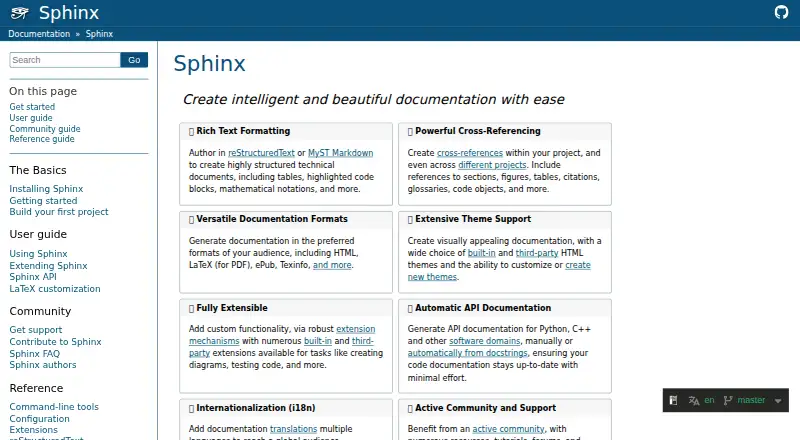
What Sphinx is
Sphinx is a free Python application for building technical documentation from structured text. Authors can write in reStructuredText or MyST Markdown; Markdown requires the separately installed MyST-Parser. Its builders generate HTML, LaTeX for PDF, ePub, manual pages, Texinfo and plain text. References can connect sections, figures, tables, citations, glossaries and code objects within a project or across projects. The autodoc extension imports modules and includes material from their docstrings, while built-in and third-party extensions add options such as diagrams, API documentation and code testing. Sphinx also includes integrations for GitHub Pages publishing, Graphviz graphs and intersphinx links, plus gettext-based translation tools and full-text search. Install it through PyPI, Conda, platform package managers, Docker or source; deployment options include documentation services, code-hosting pages and self-hosted servers. The code is released under the two-clause BSD license, and the project is community supported.
Good
- Builds HTML, PDF-oriented LaTeX, ePub and other formats.
- Links references across projects.
- Autodoc can include module docstrings.
- Offers themes and extensible integrations.
- Free under the two-clause BSD license.
Watch out
- Markdown requires a separate MyST-Parser installation.
- Web Support has had limited adoption and development.
Who it suits
Sphinx suits technical writers and development teams maintaining structured documentation, especially when they need multiple output formats, cross-project references or API documentation drawn from docstrings.
Verdict
Sphinx provides a broad documentation workflow for teams comfortable with a Python application and structured authoring. Its extensive output and linking options are balanced by the extra Markdown parser requirement and the limited development of Web Support.
Plans and prices
From Sphinx's own pricing page, checked 30 Sep 2026.
| Plan | Price | What it gives you |
|---|---|---|
| Sphinx open-source software | Free | BSD 2-Clause license · install locally or self-host |
The facts
Each one read from Sphinx's own pages, with the date it was checked.
What it does
- API documentation
- The autodoc extension imports documented modules and includes documentation from their docstrings.checked 30 Sep 2026
- Authoring
- Documentation can be authored in reStructuredText or MyST Markdown.checked 30 Sep 2026
- Cross-references
- Sphinx supports references within a project and across different projects, including references to sections, figures, tables, citations, glossaries, and code objects.checked 30 Sep 2026
- Deployment integrations
- The documentation lists Read the Docs, GitHub Pages, GitLab Pages, Netlify and self-hosted servers as deployment options.checked 30 Sep 2026
- Docker
- Official Docker images include sphinxdoc/sphinx for standard use and sphinxdoc/sphinx-latexpdf for LaTeX PDF builds.checked 30 Sep 2026
- Extensions
- Sphinx provides extension mechanisms and built-in and third-party extensions for tasks such as diagrams and code testing.checked 30 Sep 2026
- Installation
- Sphinx is a Python application installable through PyPI, Conda, Linux package managers, Homebrew or MacPorts, Chocolatey, Docker, or from source.checked 30 Sep 2026
- Integrations
- Built-in extensions include GitHub Pages publishing, Graphviz graphs, and intersphinx links to other projects’ documentation.checked 30 Sep 2026
- Internationalization
- Sphinx supports translating documentation into multiple languages.checked 30 Sep 2026
- License
- The project states that its code is released under the two-clause BSD license.checked 30 Sep 2026
- License and warranty
- Sphinx code is released under the two-clause BSD license, with warranty disclaimers in the license text.checked 30 Sep 2026
- Output formats
- Sphinx generates HTML, LaTeX for PDF, ePub, Texinfo and other documentation formats.checked 30 Sep 2026
- Project audience
- The documentation describes Sphinx as community supported and welcomes contributions from anyone.checked 30 Sep 2026
- Purpose
- Sphinx generates technical documentation from structured text.checked 30 Sep 2026
- Support
- The project directs users to Stack Overflow, GitHub Discussions, GitHub Issues, or the sphinx-users mailing list for questions and problem reports.checked 30 Sep 2026
- Support model
- Sphinx is community supported and welcomes contributions from anybody, with tutorials, forums, examples and contributor resources.checked 30 Sep 2026
- Themes
- Sphinx includes built-in and third-party HTML themes and supports custom themes.checked 30 Sep 2026
- Themes and extensions
- Sphinx supports built-in and third-party themes and extensions, including extensions for diagrams, doctests, API documentation, and links to other projects’ documentation.checked 30 Sep 2026
- Web API
- Sphinx provides a Python API for integrating documentation into web applications, but its Web Support feature has had limited adoption and development.checked 30 Sep 2026
The company
- Founded
- 2007checked 23 Sep 2026
Money
- Free plan
- Yeschecked 20 Sep 2026
The full review of Sphinx
Sphinx is a documentation generator for people who maintain technical content as structured text alongside software. It suits teams that need cross-linked documentation, several output formats, or Python API material drawn from code. It is a strong fit for a build-oriented workflow, but less compelling if you want Markdown support without an extra dependency or a mature web API.
Overview
The project has been community-supported since 2007 and is released under the two-clause BSD license. Sphinx turns structured text into documentation and offers a broad build pipeline, from HTML sites to ePub and LaTeX output for PDF. Its extensibility and project-to-project references make it more than a simple page generator, though the setup is best suited to teams comfortable installing and maintaining a Python application.
Key features
Authoring and output
Authors can work in reStructuredText or MyST Markdown. Markdown requires the separately installed MyST-Parser, an additional dependency to account for when standardizing an authoring environment. Built-in builders produce HTML, LaTeX for PDF, ePub, manual pages, Texinfo, and plain text. That range is useful when documentation must serve readers in more than a browser; projects that only need a straightforward web editor may not benefit from the broader build options.
References and API material
Sphinx can link to sections, figures, tables, citations, glossaries, and code objects within a project or across projects. This helps teams keep related technical material navigable as it spans repositories or documentation sets. Its autodoc extension imports Python modules and incorporates their docstrings, a practical choice when API documentation should stay close to the code. The trade-off is that this particular API workflow is oriented around Python modules.
Themes, extensions, and publishing
Built-in, third-party, and custom HTML themes let teams shape the rendered site. Extensions cover needs such as diagrams, doctests, and API documentation; built-in options include Graphviz graphs, GitHub Pages publishing, and intersphinx links to other projects. Read the Docs, GitHub Pages, GitLab Pages, Netlify, and self-hosted servers are among the deployment options. The extension model provides room to adapt Sphinx, but teams should expect a configurable documentation build rather than a narrowly packaged publishing service.
Search and localization
Full-text search is supported, and gettext catalogs provide a route for translating documents. These capabilities suit substantial documentation sets and multilingual projects without requiring a separate authoring format for each language.
Pricing
Sphinx open-source software: free. The plan uses the BSD 2-Clause license and can be installed locally or self-hosted. There are no paid tiers or seat and quota limits in this plan; teams do take responsibility for installation and their own hosting or publishing workflow. This is the natural fit for individuals and organizations comfortable managing a documentation build themselves.
Platforms
Sphinx is available for Linux, macOS, and Windows, as well as through API, web, and self-hosted use. It is a Python application installable through PyPI, Conda, Linux package managers, Homebrew or MacPorts, Chocolatey, Docker, or from source. Official Docker images cover standard builds and LaTeX PDF builds. Sphinx also provides a Python API for integrating documentation into web applications, although its Web Support feature has seen limited adoption and development, so it is not the strongest reason to choose the project.
Who it's for
Sphinx is best for software teams that want documentation built from structured source, need cross-project references or multiple output formats, or want Python docstrings included in API documentation. Its community support, tutorials, forums, examples, and contributor resources suit teams willing to rely on an open-source project and participate in its ecosystem. It is a poorer fit for users seeking a polished web-first documentation service, especially if they expect Markdown parsing to work without extra installation.
Pros and cons
- Pros: Broad built-in output choices, from HTML and ePub to LaTeX for PDF and manual pages, serve documentation beyond websites.
- Pros: Cross-project references and intersphinx links help connect documentation maintained across projects.
- Pros: The autodoc extension can pull documentation from Python module docstrings, keeping API material close to code.
- Pros: Free, locally installable or self-hosted software avoids per-seat plan costs.
- Cons: Markdown requires the separately installed MyST-Parser, adding setup and dependency maintenance.
- Cons: The Python application and configurable build workflow demand more technical ownership than a hosted authoring service.
- Cons: Limited adoption and development of Web Support make Sphinx a less assured choice for web-application integration.
Alternatives
- Mintlify is worth considering for teams that prefer a web editor and authentication: its free Starter plan includes five editor seats, a custom domain, MCP server, and API playground.
- Dokiel suits users looking for a free open-source Scenari publishing chain, installed on desktop or SCENARIchain.
- GitBook is a web-based option for individuals; its free plan includes one user, unlimited page views, and ten GitBook Agent messages per week.
- DocFX is another free static-site generator, but requires .NET SDK 8.0 or higher.
- Paligo is a paid alternative for teams seeking per-author licensing; its Business plan starts at $15,000 a year and includes two authors and two languages.
- Docsie offers a free knowledge base plan with 25,000 AI credits, a custom domain, search, versioning, unlimited viewers, and no expiry.
- Fumadocs is an open-source, community-powered documentation framework.
- MkDocs is another free option for documentation generation.
- For more options, browse Technical Documentation Software, Developer Documentation Software, Documentation Generators, and Knowledge base software.
Verdict
Choose Sphinx if your team wants a free, extensible documentation build with strong cross-referencing and output beyond the web, especially for Python API material. Its main advantage is that breadth without a license charge; look elsewhere if you want a web-first authoring product or a simpler Markdown setup that does not depend on a separate parser.
Getting started
- Install Sphinx through PyPI, Conda, a package manager, Docker, or source
- Choose reStructuredText or install MyST-Parser for MyST Markdown
- Create structured documentation source files
- Select builders, themes, and extensions for the desired outputs
- Build documentation as HTML, PDF, ePub, manual pages, Texinfo, or plain text
- Deploy through Read the Docs, GitHub Pages, GitLab Pages, Netlify, or a self-hosted server
Limits worth knowing
MyST Markdown is unavailable until MyST-Parser is installed separately. Sphinx's Web Support feature has limited adoption and development.
Questions
Does Sphinx cost anything?
Sphinx is free open-source software. The listed plan is free under the BSD 2-Clause license.
Which authoring formats are supported?
Sphinx supports reStructuredText and MyST Markdown. MyST Markdown requires the separately installed MyST-Parser.
What outputs can Sphinx build?
Built-in builders produce HTML, LaTeX for PDF, ePub, manual pages, Texinfo, and plain text.
Where can Sphinx documentation be deployed?
Listed deployment options include Read the Docs, GitHub Pages, GitLab Pages, Netlify, and self-hosted servers.
What license covers Sphinx?
The code is released under the two-clause BSD license, whose text includes warranty disclaimers.
How is Sphinx supported?
Sphinx is community supported. Users can seek help through Stack Overflow, GitHub Discussions, GitHub Issues, or the sphinx-users mailing list.
Alternatives to Sphinx
- 1

Scalar
Free planOpen sourceWebAPILinuxmacOS8.4From $150 a month - 2

Redocly
WebAPIExtension7.0From $10 a month - 3

Asciidoctor
Free planWebAPIExtensionLinux6.9Free plan - 4
JSON Schema for Humans
Free planLinuxmacOSSelf-hostedWindows6.5Free plan - 5
StepShot
Free planmacOS6.5CN¥269 one-time - 6
TypeDoc
Free planAPILinuxSelf-hosted6.5Free plan