
Asciidoctor
Asciidoctor is a free, open-source text processor and publishing toolchain for turning AsciiDoc files or strings into formats including HTML5, DocBook, PDF, …
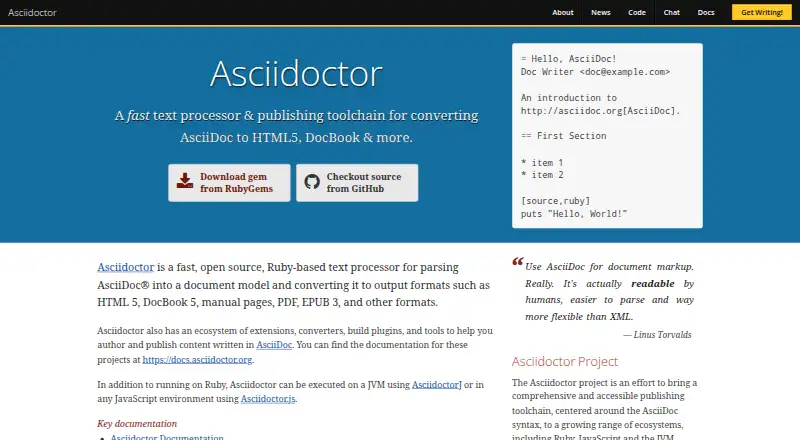
What Asciidoctor is
Asciidoctor is a free, open-source text processor and publishing toolchain for turning AsciiDoc files or strings into formats including HTML5, DocBook, PDF, EPUB 3, and manual pages. Its core includes HTML5, DocBook 5, and man-page converters; PDF and EPUB 3 conversion comes through separate gems. Users can process documents with a command-line interface or Ruby API. It runs with Ruby, on the JVM through AsciidoctorJ, or in JavaScript environments through Asciidoctor.js, and supports Linux, macOS, and Windows. Its wider ecosystem includes Maven and Gradle plugins, editor and browser extensions, and diagram tools. Default HTML output includes a stylesheet and integrations such as Font Awesome, highlight.js, Rouge, Pygments, and MathJax. The project is distributed as a RubyGem, Docker image, Linux packages, and macOS packages. It is licensed under MIT. Security modes include SECURE, SAFE, SERVER, and UNSAFE; safe modes do not sanitize generated output or provide a comprehensive security framework.
Good
- Core converters cover HTML5, DocBook 5, and man pages
- Runs on Ruby, the JVM, and JavaScript
- Available for Linux, macOS, and Windows
- Includes Maven and Gradle integrations
Watch out
- PDF and EPUB 3 converters require separate gems
- Safe modes do not sanitize generated output
- CLI defaults to UNSAFE mode
Who it suits
Asciidoctor suits writers and developers publishing AsciiDoc across different formats and runtimes. Its command-line, API, and build-tool integrations also fit documentation workflows that use Ruby, Java, or JavaScript.
Verdict
Asciidoctor offers multiple runtimes, interfaces, and output formats for AsciiDoc publishing. Note that PDF and EPUB 3 conversion uses separate gems, and safe modes are not a full security framework.
Plans and prices
From Asciidoctor's own pricing page, checked 4 Oct 2026.
| Plan | Price | What it gives you |
|---|---|---|
| Asciidoctor | Free | Open source under the MIT license · Core converters include HTML 5, DocBook 5 and man pages; PDF and EPUB 3 use separate gems |
The facts
Each one read from Asciidoctor's own pages, with the date it was checked.
What it does
- API and safety
- The Ruby API documentation says its default safe mode is :secure.checked 3 Oct 2026
- Build integrations
- The project provides plugins that integrate Asciidoctor with Apache Maven, Gradle and Javadoc builds.checked 4 Oct 2026
- Built-in converters
- The core processor includes built-in converters for HTML5, DocBook 5, and man pages; PDF and EPUB 3 converters are provided by separate gems.checked 3 Oct 2026
- Distribution
- Asciidoctor is distributed as a Ruby gem, Docker image, Linux packages, and macOS packages through Homebrew and MacPorts.checked 4 Oct 2026
- Editor integrations
- Asciidoctor.js powers AsciiDoc preview extensions for Chrome, Atom, Brackets and other web-based tools.checked 4 Oct 2026
- HTML features
- Its default HTML experience includes a stylesheet and integrations for Font Awesome, highlight.js, Rouge, Pygments, and MathJax.checked 3 Oct 2026
- HTML integrations
- Its default HTML output includes Font Awesome, highlight.js, Rouge, Pygments and MathJax integrations.checked 4 Oct 2026
- Integrations
- The project ecosystem includes Maven and Gradle plugins, browser extensions, an IntelliJ plugin, and tools such as Asciidoctor Diagram.checked 3 Oct 2026
- Intended users
- The project describes its toolchain as serving people who write and publish AsciiDoc content across platforms and runtimes.checked 4 Oct 2026
- Interfaces
- The processor provides a command line interface and a Ruby API for processing documents.checked 4 Oct 2026
- License
- The processor is open source software available under the MIT license.checked 4 Oct 2026
- Operating systems
- The project says Asciidoctor works on Linux, macOS and Windows.checked 4 Oct 2026
- Output formats
- The core processor includes HTML 5, DocBook 5 and man page converters; PDF and EPUB 3 converters are provided separately.checked 4 Oct 2026
- Purpose
- Asciidoctor parses AsciiDoc source and converts it into publishable formats such as HTML 5 and PDF.checked 4 Oct 2026
- Requirements
- The documented Ruby implementations are CRuby 2.3–3.3, JRuby 9.1–9.4, and TruffleRuby (GraalVM).checked 3 Oct 2026
- Runtime options
- Asciidoctor can run using Ruby, a JVM through AsciidoctorJ, or JavaScript through Asciidoctor.js.checked 4 Oct 2026
- Runtimes
- Asciidoctor runs on Ruby, on the JVM through AsciidoctorJ, and in JavaScript environments through Asciidoctor.js.checked 3 Oct 2026
- Security limitation
- The project states that safe modes do not sanitize generated output and are not a comprehensive security framework.checked 4 Oct 2026
- Security modes
- Asciidoctor offers UNSAFE, SAFE, SERVER and SECURE modes, with SECURE as the default for the API and UNSAFE as the default for the CLI.checked 4 Oct 2026
- Support
- The documentation directs users seeking real-time community support to the project chat’s #users stream.checked 4 Oct 2026
The company
- Founded
- 2012checked 28 Sep 2026
The full review of Asciidoctor
Asciidoctor is an open-source processor and publishing toolchain for turning AsciiDoc into documentation and publication formats. It is best suited to writers and development teams that want AsciiDoc to fit Ruby, JVM, or JavaScript workflows. Its range of runtimes and converters is compelling, but PDF and EPUB publishing requires separate components.
Overview
Asciidoctor accepts AsciiDoc files and strings through a command-line interface or Ruby API. Its core converts documents to HTML5, DocBook 5, and man pages; PDF and EPUB 3 conversion come from separate gems. That makes it a flexible foundation for documentation pipelines, while adding a setup step for teams that publish books or need those formats.
Distribution options include a RubyGem, Docker image, packages for numerous Linux distributions, and macOS packages through Homebrew and MacPorts. The MIT license permits use as open-source software, and CI/CD integration makes it a fit for automated publishing workflows. Community chat, documentation, GitHub repositories, and issue trackers are project support resources.
Key features
Formats and presentation
The default HTML output includes a stylesheet and integrations for Font Awesome, highlight.js, Rouge, Pygments, and MathJax. These give teams options for icons, code highlighting, and mathematical content in their rendered documentation. The core converter set is useful for web and reference publishing, but PDF and EPUB 3 are not part of that built-in set.
Runtimes and integrations
Asciidoctor runs on Ruby, through AsciidoctorJ on the JVM, and through Asciidoctor.js in JavaScript environments. Maven and Gradle plugins connect it to common build workflows, with Javadoc integration also supported. Browser preview extensions powered by Asciidoctor.js cover Chrome, Atom, Brackets, and other web-based tools; an IntelliJ plugin and Asciidoctor Diagram extend the wider ecosystem. This breadth helps teams incorporate AsciiDoc into existing environments rather than adopt a single prescribed editor or runtime.
Security and requirements
Security modes include UNSAFE, SAFE, SERVER, and SECURE. SECURE is the Ruby API default, while the command-line interface defaults to UNSAFE. Safe modes do not sanitize generated output and are not a comprehensive security framework, so generated content should not be treated as safe for untrusted input merely because a safe mode is enabled.
Documented Ruby implementations are CRuby 2.3–3.3, JRuby 9.1–9.4, and TruffleRuby (GraalVM). Asciidoctor also works on Linux, macOS, and Windows, and its runtime options add JVM and JavaScript environments for teams working outside a Ruby-only setup.
Pricing
Asciidoctor is free: its plan costs nothing and is open source under the MIT License. The plan includes the core HTML5, DocBook 5, and man page converters. There is no free trial because the software is free to use. Teams needing PDF or EPUB 3 conversion must add the separate gems; the core plan itself does not include those converters.
Platforms
Asciidoctor supports Linux, macOS, and Windows, with distribution options including Linux packages and macOS package managers. It is also available as a Docker image and offers API, web, extension, and self-hosted contexts. Ruby, JVM, and JavaScript runtime choices give developers several ways to connect it to their toolchains.
Who it's for
Asciidoctor suits technical writers and development teams standardizing on AsciiDoc who need multiple output formats, build integration, or flexibility across Ruby, JVM, and JavaScript. It is a particularly strong fit for automated documentation pipelines and teams that can manage converter dependencies. Readers looking for PDF or EPUB conversion bundled into the core, or a security boundary for processing untrusted content, should consider those limitations before choosing it.
Pros and cons
Pros
- Multiple runtimes: Ruby, JVM, and JavaScript options let teams match Asciidoctor to different development environments.
- Useful built-in output: HTML5, DocBook 5, and man page converters cover web documentation and reference publishing without separate format gems.
- Build and editor ecosystem: Maven, Gradle, Javadoc, browser previews, and an IntelliJ plugin make it easier to integrate AsciiDoc into existing workflows.
- Free under MIT: The open-source license and zero-cost plan make it accessible for individual and team use.
Cons
- Extra converters for books: PDF and EPUB 3 require separate gems, adding setup beyond the core processor.
- Safe modes have limits: They do not sanitize output or provide a comprehensive security framework.
- CLI default is UNSAFE: Teams processing untrusted input need to account for that default and the limits of safe modes.
Alternatives
Compare documentation generators if you want to consider a broader set of tools.
Scalar is worth considering when API documentation is the priority: its free plan includes up to 3 APIs, 1 SDK with up to 25 endpoints, 1 editor seat, and 50 Agent Scalar credits. Its Pro plan is $150 a month, billed $125/.
Sphinx is a free, BSD 2-Clause-licensed option that can be installed locally or self-hosted. Kotlin/JS is a free Kotlin compiler target for JavaScript configured with the Kotlin Multiplatform Gradle plugin, making it the relevant alternative when that is the target workflow.
mdBook is a free, open-source option under MPL-2.0 for readers considering another documentation tool. DocFX is a free open-source static site generator for teams with .NET SDK 8.0 or higher. Doxygen is a free, GPL-licensed option with Windows, Linux, and macOS downloads.
MkDocs and Stoplight Elements are also alternatives to consider.
Verdict
Choose Asciidoctor if you want a free, MIT-licensed AsciiDoc publishing toolchain that can span Ruby, JVM, and JavaScript and connect to established build workflows. Its strongest case is that breadth paired with capable core converters. Look elsewhere if bundled PDF or EPUB conversion is essential, or if you need safe modes to serve as a complete security framework.
Getting started
- Visit the Asciidoctor website.
- Choose a distribution such as the RubyGem, Docker image, Linux package, or macOS package.
- Select a runtime: Ruby, the JVM through AsciidoctorJ, or JavaScript through Asciidoctor.js.
- Process AsciiDoc files or strings through the command-line interface or Ruby API.
- Use a Maven or Gradle plugin if integrating it with a build.
Limits worth knowing
The core converter set covers HTML5, DocBook 5, and man pages; PDF and EPUB 3 require separate gems. Safe modes do not sanitize generated output or provide a comprehensive security framework.
Questions
Does Asciidoctor cost anything?
No. Asciidoctor is free and open source under the MIT License.
Which formats can it produce?
Core converters handle HTML5, DocBook 5, and man pages. PDF and EPUB 3 converters are provided by separate gems.
Which operating systems and runtimes does it support?
It works on Linux, macOS, and Windows. It runs with Ruby, the JVM through AsciidoctorJ, and JavaScript through Asciidoctor.js.
Can it be used in build workflows?
Yes. The project provides plugins for Apache Maven, Gradle, and Javadoc builds.
What interfaces does it provide?
It has a command-line interface and a Ruby API for processing documents.
What security modes does it use?
It offers UNSAFE, SAFE, SERVER, and SECURE modes. The API defaults to SECURE and the CLI to UNSAFE; safe modes do not sanitize generated output.
Alternatives to Asciidoctor
- 1

Scalar
Free planOpen sourceWebAPILinuxmacOS8.4From $150 a month - 2

Redocly
WebAPIExtension7.0From $10 a month - 3

Sphinx
Free planWebAPILinuxmacOS7.0Free plan - 4
JSON Schema for Humans
Free planLinuxmacOSSelf-hostedWindows6.5Free plan - 5
StepShot
Free planmacOS6.5CN¥269 one-time - 6
TypeDoc
Free planAPILinuxSelf-hosted6.5Free plan