
Paligo
Paligo is a cloud-based component content management system for creating, organizing, translating, and publishing technical documentation and other knowledge…
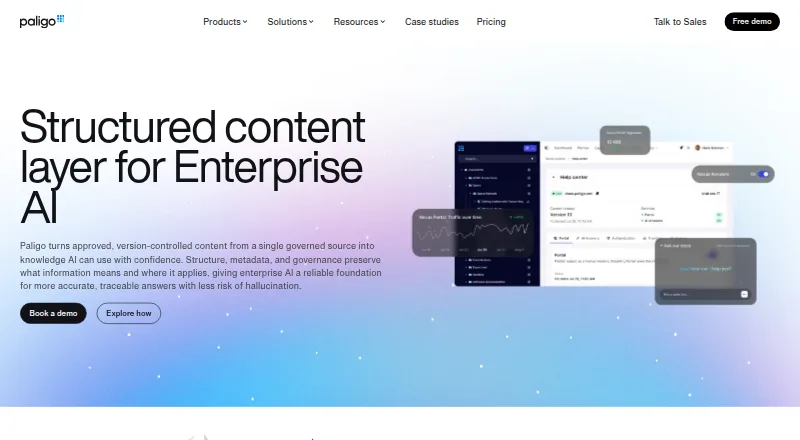
What Paligo is
Paligo is a cloud-based component content management system for creating, organizing, translating, and publishing technical documentation and other knowledge content. Its structured authoring tools support topic-based writing, content reuse, variables, version branching, revision history, and workflow management. Teams can publish to PDF, HTML5, eLearning, and GitHub Flavored Markdown. Paligo serves organizations in software, manufacturing, and regulated industries that manage technical documentation, policies, procedures, and knowledge assets. It provides a REST API for connecting external applications and automating tasks, along with listed integrations including Zendesk, Freshdesk, GitHub, GitLab, Amazon S3, Slack, Salesforce, ServiceNow, and Phrase; some may require a separate subscription. A free trial is available, but there is no free plan. Paligo states that its information security management system is certified to ISO 27001:2022, and that service data is encrypted at rest with AES-256 and in transit with TLS. Business includes standard support; Enterprise offers priority support and guaranteed SLAs.
Good
- Supports content reuse and version branching
- Publishes to PDF, HTML5, eLearning, and Markdown
- REST API supports integration and automation
- Free trial is available
- Data encryption at rest and in transit
Watch out
- No free plan
- Business includes two authors and two languages
- Some integrations may require a separate subscription
Who it suits
Paligo is for organizations managing technical documents, policies, procedures, or other knowledge content, particularly in software, manufacturing, and regulated industries. It may suit teams needing structured authoring, translation, workflow management, and multiple publishing formats.
Verdict
Paligo combines structured documentation authoring with translation, workflow, and publishing tools for organizational content teams. Its starting Business price and included author and language limits are important considerations.
Plans and prices
From Paligo's own pricing page, checked 14 Oct 2026.
| Plan | Price | What it gives you |
|---|---|---|
| Business | $15,000 a year | 2 authors · 2 languages · up to 10 contributors or reviewers total · 10 GB storage per author · standard support · Annual subscription, per-author licensing |
| Nexus Portal | $5,000 | Faceted search · analytics · one-click publishing · custom domain · multiple portals · automatic scaling · free trial · Annual subscription, tiered by monthly requests volume |
| Nexus Portal free tier | Free | Limited monthly requests |
| Nexus Answers | $6,000 a year | Grounded answers with citations · branded widget · embeds including Zendesk · AI analytics · free trial · Priced per answer with volume tiers |
| Nexus Answers free tier | Free | Limited volume of answers |
| Enterprise | Priced on request | Up to 8 authors · unlimited contributors · unlimited languages · at least 500 GB storage · SSO · advanced permissions · SLA and priority support · Custom annual subscription |
The facts
Each one read from Paligo's own pages, with the date it was checked.
What it does
- AI data use
- Paligo states that customer data, AI inputs, and AI outputs are not used to train third-party AI models.checked 29 Sep 2026
- API
- Paligo offers a REST API for connecting external applications and automating tasks.checked 29 Sep 2026
- API authentication
- API keys are created in My Profile by administrators, and each external application needs its own key.checked 14 Oct 2026
- API documentation depth
- The API documentation describes folders, documents, images, publishing settings, productions, imports and key-management procedures, but names no SDK.checked 14 Oct 2026
- Audience
- Paligo says it serves organizations in software, manufacturing, and regulated industries, including companies managing technical documentation, policies, procedures, and knowledge content.checked 29 Sep 2026
- Authentication
- Multi-factor authentication is available to all users; Enterprise supports centrally enforced MFA and SAML 2.0 single sign-on.checked 29 Sep 2026
- Collaboration
- Authors, contributors and reviewers work through role-based workflows, assignments, comments and review interfaces.checked 14 Oct 2026
- Content reuse
- Topics, publications, text fragments, list items, variables, images and conditional content can be reused across outputs.checked 14 Oct 2026
- Custom domain
- Yeschecked 20 Sep 2026
- Encryption
- The service states that communications and stored data use AES-256 encryption with TLS 1.2 for transit.checked 14 Oct 2026
- Enterprise integrations
- Salesforce, ServiceNow, Fluid Topics, Coveo, Zoomin and MathType are listed as Enterprise-only integrations.checked 14 Oct 2026
- Hosting and encryption
- Paligo says its services run on AWS data centers in the United States, Japan, or the European Union, and that service data is encrypted at rest with AES-256 and in transit with TLS.checked 29 Sep 2026
- Hosting locality
- Paligo runs on AWS and offers data-locality choices in the United States, Japan and the European Union.checked 14 Oct 2026
- Incident support
- Enterprise urgent incidents target a two-hour response, high-priority incidents four hours, and include a 24/7 emergency phone number.checked 14 Oct 2026
- Installation model
- Paligo is presented as a cloud SaaS product that requires no local installation or deployment.checked 14 Oct 2026
- Integration limit
- Paligo documentation states a 500 MB upper upload-file limit for upload integrations, except GitHub, which has a 100 MB limit; the general limit can be raised on request.checked 29 Sep 2026
- Integrations
- Official integrations include Zendesk, Freshdesk, GitHub, GitLab, Bitbucket, Azure Repos, Amazon S3, Algolia, Phrase, Slack, Microsoft Teams and many others.checked 14 Oct 2026
- Licence
- Paligo's legal terms describe an online CCMS SaaS and exclude Paligo source code and internal technical solutions from customer data export.checked 14 Oct 2026
The company
- Company profile
- LinkedIn lists Paligo as a privately held software-development company headquartered in Solna, Stockholm, with 51–200 employees and a 2015 founding year.checked 14 Oct 2026
- Company scale in 2023
- The April 2023 press release reported more than 100 employees, 450-plus enterprise and mid-market customers, and offices in Sweden, Ireland and the United States.checked 14 Oct 2026
- Founded
- 2015checked 28 Sep 2026
- Funding and ownership
- A dated press release says GRO invested $29 million in April 2023, became a minority investor, and Alfvén & Didrikson followed on its investment.checked 14 Oct 2026
- Headquarters
- Solna, Swedenchecked 28 Sep 2026
Money
- Free plan
- Nochecked 20 Sep 2026
The full review of Paligo
Paligo is a cloud-based component content management system for organizations producing substantial technical, policy, or knowledge content. It suits structured documentation teams that need reuse, controlled workflows, translation, and multiple publishing outputs; smaller teams should weigh its substantial starting commitment carefully.
Overview
Paligo organizes documentation as reusable topics rather than isolated documents. Authors can apply variables, maintain version branches, review revision history, and move work through managed workflows. That approach is valuable when the same material appears in many manuals, procedures, or knowledge resources, because changes can be coordinated instead of copied by hand. It is less compelling for occasional authors or teams with a small, mostly static document set.
Publishing covers PDF, HTML5, eLearning, and GitHub Flavored Markdown, so one source can serve print-style documents, web content, training material, and developer-oriented repositories. Private documentation, documentation versioning, full-text search, and reader analytics extend the system beyond authoring into ongoing content management.
Key features
Paligo’s REST API connects external applications and supports task automation. Listed integrations include Zendesk, Freshdesk, GitHub, GitLab, Amazon S3, Slack, Salesforce, ServiceNow, and Phrase. Some integrations may require a separate subscription, so organizations should account for that alongside the core license. Upload integrations allow files up to 500 MB, except GitHub uploads, which have a 100 MB limit; the general ceiling can be raised on request.
Security controls are substantial for an organizational CCMS. Paligo states that its information security management system is certified to ISO 27001:2022. Services run in AWS data centers in the United States, Japan, or the European Union, with AES-256 encryption at rest and TLS in transit. Multi-factor authentication is available to every user. Enterprise adds centrally enforced MFA and SAML 2.0 single sign-on. Paligo also states that customer data, AI inputs, and AI outputs are not used to train third-party AI models.
Pricing
Business costs $15,000 a year on an annual subscription with per-author licensing. It includes two authors and two languages, 10 GB of storage per author, up to 10 contributors or reviewers in total, and standard support. This is the practical entry point for a focused documentation team, but the included author and language allowances are narrow for a growing international operation; additional requirements may make the real cost higher.
Enterprise uses custom pricing and includes eight authors, unlimited languages, unlimited contributors, and 500 GB of starting storage. It is the more natural fit for larger or multilingual organizations that need broad participation and centrally enforced authentication, as well as priority support and guaranteed service-level agreements. Paligo states target response times of two hours for urgent issues and four hours for high-priority issues.
Nexus Portal starts at $5,000 a year, billed annually and tiered by monthly request volume. It requires an active Paligo CCMS subscription. A free tier is available with limited monthly requests, useful for evaluating a portal before committing, but not for high-volume delivery.
Nexus Answers starts at $6,000 a year, billed annually and priced per answer with volume-based rates. It can be used with or without Nexus Portal, and its free tier allows a limited answer volume. These products address delivery and answer experiences rather than replacing the core CCMS subscription.
There is no free Paligo plan, although a free trial is offered. The annual Business commitment and per-author model make Paligo a budget decision for teams, not a casual tool purchase.
Platforms
Paligo is delivered through the web and an API. It supports a custom domain, which helps organizations present published content under their own web address.
Who it's for
Paligo is aimed at organizations in software, manufacturing, and regulated industries managing technical documentation, policies, procedures, and knowledge content. It is a strong match for teams that need structured reuse, translation, controlled reviews, analytics, and several output formats. A small team seeking a low-cost help authoring tool, or a company needing only occasional single-format documents, should look elsewhere.
Pros and cons
- Pros: Component reuse, variables, branching, revision history, and workflows support consistent large-scale documentation.
- Pros: PDF, HTML5, eLearning, and GitHub Flavored Markdown publishing covers varied delivery channels.
- Pros: REST API, broad integrations, private documentation, search, versioning, and reader analytics support connected content operations.
- Pros: ISO 27001:2022 certification, regional AWS hosting, encryption, and universal MFA address enterprise governance needs.
- Cons: Business starts at $15,000 a year and includes only two authors and two languages, limiting its appeal for smaller or expanding teams.
- Cons: Enterprise pricing is custom, while some integrations can require separate subscriptions, making total budgeting less predictable.
- Cons: Upload limits of 500 MB generally and 100 MB for GitHub may constrain unusually large integration payloads.
Alternatives
Help Authoring Tools and Technical Documentation Software directories are useful for comparing Paligo with tools in the same categories. For broader knowledge-base products, see Knowledge base software.
XMLmind XML Editor is a freemium option with a free Personal Edition and Linux, macOS, web, and Windows support; choose it when a lower-cost XML editing workflow matters more than Paligo’s managed CCMS scope.
Dokiel is free and open-source, with desktop or SCENARIchain installation, making it preferable when avoiding subscription fees is the priority.
HelpNDoc offers a free personal-use edition and Windows support; it fits personal documentation work that does not require commercial use.
Dr.Explain has a free Windows plan restricted to 20 topics and a $290.00 USD-per-year five-user Business Temporary plan, suiting smaller Windows teams with bounded authoring needs.
Creo is a paid cross-platform product with web, desktop, iOS, and Android support; consider it when those client platforms are more important than a documentation-focused CCMS.
Heretto is a paid CCMS with API and dynamic delivery capabilities, making it an alternative for teams comparing structured content platforms.
QuarkXPress is a paid, cross-platform publishing application with a free trial; choose it for broader page-layout publishing rather than Paligo’s component workflow.
DITA Exchange is a paid option available through API, self-hosted, web, and Windows deployments.
Verdict
Choose Paligo if your organization needs reusable, governed documentation with translation, integrations, analytics, and multiple publishing targets, and can support a $15,000.00 USD annual starting commitment. Look elsewhere if you have a small authoring team, limited language needs, or a preference for free or low-cost desktop tools; Paligo’s structure and licensing are designed for sustained organizational content operations.
Alternatives to Paligo
- 1
Dokiel
Free planOpen sourceWebLinuxmacOSSelf-hosted8.1From €420 a year - 2
HelpNDoc
Free planAPISelf-hostedWindows7.4€99 one-time - 3
XMLmind XML Editor
Free planWebLinuxmacOSWindows7.1$195 one-time - 4
Dr.Explain
Free planWindows7.0From $290 a year - 5

Heretto
WebAPILinuxmacOS6.7 - 6

MadCap Flare
WebWindows6.7