Sonobuoy
Sonobuoy is a free diagnostic tool for inspecting Kubernetes cluster state using non-destructive configuration tests.
What Sonobuoy is
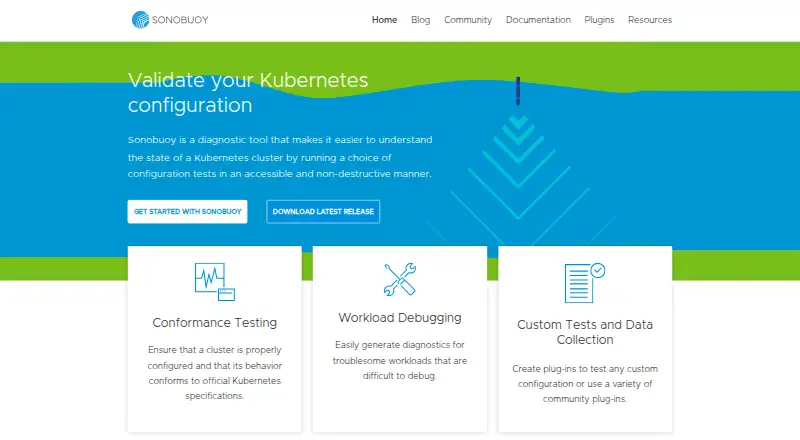
Sonobuoy is a free diagnostic tool for inspecting Kubernetes cluster state using non-destructive configuration tests. It checks whether a cluster conforms to official Kubernetes specifications and can produce diagnostics for troublesome workloads. Users can create plugins for custom tests and data collection. Its default plugins run Kubernetes end-to-end tests and gather systemd logs; community plugins include checks for CIS Benchmarks, RBAC permissions, cluster inventory, and security visibility. Sonobuoy is cluster agnostic and officially supports the latest three minor Kubernetes versions. Version 0.20 and later supports Kubernetes 1.17 or later. It can run end-to-end tests with custom registries in air-gapped deployments. Running it requires an active Kubernetes cluster and an admin kubeconfig; installation is available through binary releases or Homebrew on macOS. Sonobuoy is open source, with community support through GitHub. The project warns that its defaults are not secure by default and require explicit hardening configuration. On Docker Desktop Kubernetes, some logging and retrieval commands may fail, and the systemd-logs plugin may hang.
Good
- Runs non-destructive configuration tests.
- Supports custom plugins for tests and data collection.
- Can test air-gapped deployments using custom registries.
- Open source with community support through GitHub.
Watch out
- Requires an active Kubernetes cluster and admin kubeconfig.
- Default settings require explicit security hardening.
- Docker Desktop Kubernetes has documented logging and retrieval issues.
Who it suits
Sonobuoy suits Kubernetes operators who need conformance checks, workload diagnostics, or custom configuration tests. It requires an active cluster and an admin kubeconfig, and its defaults need explicit hardening.
Verdict
Sonobuoy provides cluster diagnostics, conformance testing, and plugin-based checks at no cost. Plan for the required cluster access and hardening, and note the reported Docker Desktop limitations.
The facts
Each one read from Sonobuoy's own pages, with the date it was checked.
Where it runs
- Air-gapped operation
- It supports end-to-end testing with custom registries in air-gapped deployments.checked 30 Sep 2026
- Air-gapped use
- It supports end-to-end tests with custom registries in air-gapped deployments.checked 1 Oct 2026
What it does
- Built-in plugins
- The default plugins are Kubernetes end-to-end tests and systemd log gathering.checked 30 Sep 2026
- CIS benchmarks
- The CIS Benchmarks plugin uses kube-bench and runs checks on master and worker nodes.checked 1 Oct 2026
- Cluster support
- Sonobuoy runs on any Kubernetes cluster and officially supports the latest three Kubernetes minor versions.checked 1 Oct 2026
- Community plugins
- Listed plugins include CIS Benchmarks, Kube-hunter, Who-can, Cluster-Inventory, and Reliability Scanner.checked 30 Sep 2026
- Community support
- Community support is provided through the Sonobuoy GitHub project, including GitHub issues.checked 1 Oct 2026
- Conformance testing
- It tests whether a cluster conforms to official Kubernetes specifications.checked 1 Oct 2026
- Custom testing
- Users can create plugins to test custom configurations or use community plugins.checked 1 Oct 2026
- Docker dependency
- The sonobuoy images subcommand requires Docker to be installed.checked 1 Oct 2026
- Docker Desktop limitation
- The documentation reports that kubectl logs, sonobuoy logs, and sonobuoy retrieve may fail and the systemd-logs plugin may hang on Docker Desktop Kubernetes.checked 30 Sep 2026
- End-to-end tests
- The end-to-end plugin runs tests maintained by the upstream Kubernetes community.checked 1 Oct 2026
- Host logs
- The systemd-logs plugin gathers host log information by chrooting into the node filesystem and running journalctl.checked 1 Oct 2026
- Installation
- Installation is available through binary releases or Homebrew on macOS.checked 30 Sep 2026
- Integrations
- The documentation references AWS Quickstart, KinD, kubectl, Docker, and Docker Hub workflows.checked 30 Sep 2026
- Kubernetes versions
- Starting with version 0.20, Sonobuoy supports Kubernetes 1.17 or later.checked 30 Sep 2026
- Open source
- Sonobuoy is released as open source software.checked 1 Oct 2026
- Prerequisites
- Running Sonobuoy requires access to an up-and-running Kubernetes cluster and an admin kubeconfig.checked 1 Oct 2026
- Purpose
- Sonobuoy is a diagnostic tool for understanding Kubernetes cluster state by running configuration tests in an accessible, non-destructive way.checked 1 Oct 2026
- RBAC reporting
- The Who-can plugin reports which subjects have RBAC permissions to perform actions against cluster resources.checked 1 Oct 2026
- Security defaults
- The project states that Sonobuoy's default settings are not secure by default and require explicit hardening configuration.checked 30 Sep 2026
- Security support
- Only the most recent Sonobuoy version is supported for conformance tests on the latest Kubernetes version and two prior versions.checked 30 Sep 2026
- Security visibility
- The Kube-hunter plugin runs Aqua Security’s kube-hunter to increase visibility of security issues in Kubernetes environments.checked 1 Oct 2026
- Support channel
- The Sonobuoy community Slack channel has over 300 members.checked 1 Oct 2026
The full review of Sonobuoy
Sonobuoy is a local diagnostic and conformance-testing tool for Kubernetes clusters, aimed at operators who need to check cluster behavior or investigate workloads. Its combination of upstream end-to-end tests and extensible plugins makes it a focused choice for Kubernetes-specific checks.
Overview
Sonobuoy runs accessible, non-destructive configuration tests to help explain a cluster’s state. It can check whether a cluster conforms to official Kubernetes specifications, gather diagnostics for troublesome workloads, and collect custom data through user-created plugins. It is cluster agnostic and supports the latest three minor Kubernetes versions.
This is an open-source project with community support through GitHub and a Slack channel. That model suits teams comfortable working with project documentation and community channels; it is not a substitute for a commercial support arrangement.
Key features
Conformance and diagnostics
The Kubernetes end-to-end plugin runs tests maintained by the upstream Kubernetes community, giving operators a direct way to assess conformance. The systemd-logs plugin gathers host logs by entering the node filesystem and running journalctl, which can help investigate system-level issues but requires access to node data.
Extensible checks
Users can build plugins for their own configuration checks and data collection. Community plugins broaden the options: CIS Benchmarks uses kube-bench to check master and worker nodes; Kube-hunter increases visibility into security issues; and Who-can reports which subjects have RBAC permissions for cluster actions. Cluster-Inventory and Reliability Scanner are also listed. These extensions make Sonobuoy useful beyond its built-in tests, though the checks depend on choosing and running the relevant plugins.
Deployment and version fit
Sonobuoy supports end-to-end tests with custom registries in air-gapped deployments, a meaningful advantage for isolated environments. Starting with Sonobuoy 0.20, Kubernetes 1.17 or later is supported; conformance testing on the latest Kubernetes version and the two preceding versions requires the most recent Sonobuoy release. Running it requires an active cluster and an admin kubeconfig, so it is not a lightweight option for readers without administrative cluster access.
Pricing
Sonobuoy is open source and free, with no paid plan described. That makes it practical to adopt for cluster checks without a software license charge, while support comes through the community rather than a paid service tier.
Platforms
Sonobuoy supports Linux, macOS, Windows, and self-hosted use. Installation is available through binary releases or Homebrew on macOS. Its documentation references workflows involving AWS, KinD, kubectl, Docker, and Docker Hub. The images subcommand requires Docker, so that operation adds a local dependency.
Docker Desktop Kubernetes has reported limitations: kubectl logs, sonobuoy logs, and sonobuoy retrieve may fail, and the systemd-logs plugin may hang. Teams relying on Docker Desktop should account for these issues before making it their primary test environment.
Who it's for
Sonobuoy is best suited to Kubernetes operators and platform teams that need conformance checks, workload diagnostics, or targeted cluster data collection, especially where custom plugins or air-gapped testing matter. It is a weaker fit for users who lack an admin kubeconfig, need formal vendor support, or expect secure defaults without additional configuration.
Pros and cons
Pros
- Free and open source: Cluster checks do not require a software license purchase.
- Useful Kubernetes coverage: Upstream end-to-end tests and host-log gathering address both conformance and troubleshooting.
- Customizable: User-created and community plugins extend testing to compliance, security visibility, and RBAC reporting.
- Air-gapped support: Custom registries enable end-to-end testing in isolated deployments.
Cons
- Elevated access required: An active cluster and admin kubeconfig are prerequisites, limiting use where cluster access is restricted.
- Hardening is on the operator: The project says default settings are not secure by default and require explicit hardening.
- Docker Desktop caveats: Several logging and retrieval commands may fail, and a built-in plugin may hang in that environment.
- Community-led support: Help is available through GitHub and Slack, not a described commercial support channel.
Alternatives
Conftest is a free, open-source alternative for readers seeking a policy-testing tool across Linux, macOS, and Windows rather than Sonobuoy’s Kubernetes cluster diagnostics.
AWS CloudFormation is worth considering for infrastructure provisioning workflows; the service itself is free, but underlying AWS resources are billed at their own rates.
Test Kitchen is another free, open-source option for readers who want an environment-testing workflow available on Linux, macOS, and Windows.
cfn-lint is a free MIT-0 licensed option for validating CloudFormation templates, with Python 3.10–3.14 supported.
Chef InSpec may suit readers who need its free tier for non-production workloads and personal, non-commercial use, or want to evaluate its 30-day trial.
Cinc Auditor offers a free distribution of Chef InSpec, though it comes without formal warranties or support.
OpenSCAP is a free choice for readers seeking open-source tools under the OpenSCAP umbrella.
TFLint is a free, open-source command-line Terraform linter for readers focused on Terraform rather than Kubernetes clusters.
Browse more options in Infrastructure Testing Tools.
Verdict
Choose Sonobuoy if you operate Kubernetes and need free, extensible conformance checks or diagnostics, particularly in air-gapped environments. Its strongest reason to choose is the combination of upstream tests and plugin-based checks; look elsewhere if you cannot provide admin cluster access, need formal support, or rely on Docker Desktop without accepting its reported logging limitations.
Alternatives to Sonobuoy
- 1
Chef InSpec
Free planOpen sourceAPILinuxmacOSSelf-hosted8.0From $59 a year - 2

AWS CloudFormation
Free planiOSWebAPILinux7.7Free plan - 3

CIS-CAT Pro Assessor
Free planAPILinuxmacOSSelf-hosted7.7From $2,400 a year - 4
Test Kitchen
Free planOpen sourceAPILinuxmacOSSelf-hosted7.2Free plan - 5
kube-score
Free planWebLinuxmacOSSelf-hosted7.0Free plan - 6
Conftest
Free planLinuxmacOSWindows6.8Free plan