
smry
smry is an AI reading workspace that summarizes articles, organizes them, and answers questions with the relevant passage.
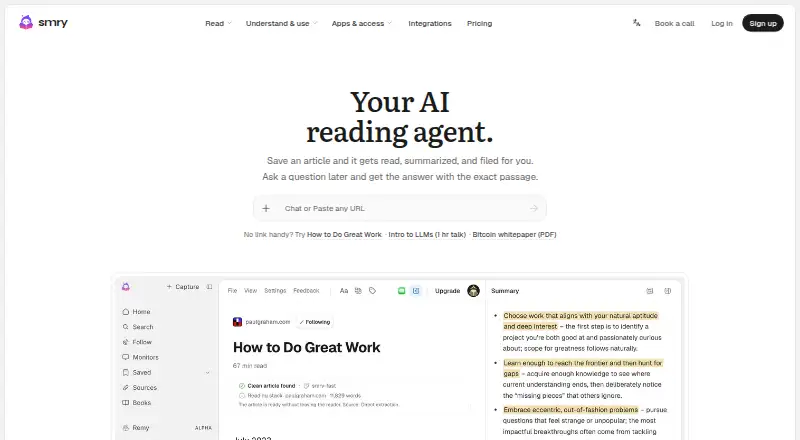
What smry is
smry is an AI reading workspace that summarizes articles, organizes them, and answers questions with the relevant passage. It includes a clean reader, source-grounded summaries and answers, highlights, notes, audio, and a searchable library. Users can follow RSS and Atom feeds, podcasts, YouTube channels, Reddit communities, X accounts, creator transcripts, and selected webpage monitors. Supported material includes YouTube videos, PDFs, EPUBs, documents, spreadsheets, presentations, text, Markdown, and subtitle files. Listed connections include Readwise Reader, Matter, Notion, Pocket, Safari Reading List, and others; highlights can be exported in formats such as Markdown and JSON. Signed-in accounts, including Free, receive a personal Developer API and Streamable HTTP MCP server, with higher limits on Patron and Pro. Free is free and lists 100 feeds and 3 webpage monitors, among other limits. Patron costs $6 a month and Pro costs $80 a month. The site says its dedicated desktop app is coming soon; native iOS and Android apps are not currently shipped.
Good
- Summarizes and answers using source passages.
- Supports feeds, podcasts, videos, and documents.
- Includes a searchable library, notes, and highlights.
- Free accounts receive a Developer API and MCP server.
- Highlights export to Markdown and JSON.
Watch out
- Free plan has 100 feeds and 3 webpage monitors.
- Native iOS and Android apps are not shipped.
- Desktop app is described as coming soon.
Who it suits
smry suits individuals and small teams who follow multiple publications or work with agents. It may also fit readers who want to organize varied documents, query source passages, and export highlights to other tools.
Verdict
smry combines reading, research organization, and source-linked answers across many content types. Consider its feed and monitor limits, and its lack of shipped native mobile apps, when choosing a plan or workflow.
Plans and prices
From smry's own pricing page, checked 3 Oct 2026.
| Plan | Price | What it gives you |
|---|---|---|
| Free | Free | 20 summaries/day · 20 article chats/day · audio for 1 article/day with 2 voices · 100 feeds · 3 webpage monitors · 50 offline-ready article bodies |
| Patron | $6 a month | 1,000 feeds · 10 webpage monitors · 10 GB private file storage · 7-day no-card trial · 30-day money-back guarantee · $6 monthly |
| Patron | $36 a year | 1,000 feeds · 10 webpage monitors · 10 GB private file storage · 7-day no-card trial · 30-day money-back guarantee · $36 yearly ($3/month equivalent) |
| Pro | $80 a month | 25,000 feeds · 100 webpage monitors · 1,000 feed folders · 20 active API keys · 100 GB private file storage · $80/mo |
| Pro | $768 a year | 25,000 feeds · 100 webpage monitors · 1,000 feed folders · 20 active API keys · 100 GB private file storage · $768/yr |
The facts
Each one read from smry's own pages, with the date it was checked.
What it does
- API and agents
- Signed-in accounts, including Free, get a personal Developer API and Streamable HTTP MCP server, with higher limits on Patron and Pro.checked 3 Oct 2026
- Exports
- Highlights can be exported in formats for Notion, Obsidian, Readwise, Zotero, Tana, Workflowy, Roam Research, Anki, Markdown, and JSON.checked 3 Oct 2026
- Feeds
- Users can follow RSS and Atom feeds, podcasts, YouTube channels, Reddit communities, X accounts, creator transcripts, and selected webpage monitors.checked 3 Oct 2026
- Integrations
- The integrations page lists Readwise Reader, Matter, keep.md, Raindrop.io, Instapaper, Notion, GitHub Stars, Pocket, and Safari Reading List connections.checked 3 Oct 2026
- Intended users
- The homepage describes smry as a reading workspace for individuals and small teams, including people following many publications and using agents.checked 3 Oct 2026
- Notable limits
- Free includes 100 feeds and 3 webpage monitors, while Patron includes 1,000 feeds and 10 monitors and Pro includes 25,000 feeds and 100 monitors.checked 3 Oct 2026
- Privacy
- The privacy policy says smry does not sell personal information to third parties and shares data with third-party services as needed to operate the service.checked 3 Oct 2026
- Product
- smry describes itself as an AI reading agent that reads, summarizes, and files articles, then answers questions with the exact passage.checked 3 Oct 2026
- Reading and research
- It provides a clean reader, source-grounded summaries and answers, highlights, notes, audio, and searchable library.checked 3 Oct 2026
- Security
- The privacy policy says smry implements reasonable technical and organizational measures to protect information, while stating it cannot guarantee absolute security.checked 3 Oct 2026
- Support
- The site offers a product call with someone from the product team, held by Google Meet on weekdays from 12–4 PM Pacific with at least 48 hours’ notice.checked 3 Oct 2026
- Supported content
- Users can read YouTube videos, PDFs, EPUBs, documents, spreadsheets, presentations, text, Markdown, and subtitle files.checked 3 Oct 2026
Where it runs
- Native apps
- The site says its dedicated desktop app is coming soon and native iOS and Android apps are not currently shipped.checked 3 Oct 2026
- Platforms
- The responsive web app works in computer, phone, and tablet browsers; Chrome, Firefox, Edge, and Opera extensions and an iOS Shortcut are listed.checked 3 Oct 2026
The full review of smry
smry is an AI reading workspace for people who collect articles, feeds, and research material and want answers tied to the original passage. It suits heavy readers, small teams, and agent-oriented workflows better than occasional summarization. The main trade-off is that its broad feed and research system comes with plan limits and no shipped native mobile apps.
Overview
smry combines a clean reader with source-grounded summaries, passage-linked answers, highlights, notes, audio, and a searchable library. That combination matters when a compressed summary is only the starting point: answers that point to the exact passage provide a practical way to verify context. Readers who only need a quick recap of an article may find the wider workspace unnecessary, but people building a persistent reading habit get a more complete system for collecting and revisiting material.
Key features
Feeds and content coverage
The service can follow RSS and Atom feeds, podcasts, YouTube channels, Reddit communities, X accounts, creator transcripts, and selected webpage monitors. It also reads YouTube videos, PDFs, EPUBs, documents, spreadsheets, presentations, text, Markdown, and subtitle files. This breadth makes smry useful for a mixed research queue rather than a tool restricted to web pages. Capacity is plan-dependent, so large monitoring projects need a paid tier.
Research workflow
Highlights, notes, audio, and full-text search support both quick consumption and later reference. Connections include Readwise Reader, Matter, keep.md, Raindrop.io, Instapaper, Notion, GitHub Stars, Pocket, and Safari Reading List. Highlights can be exported for Notion, Obsidian, Readwise, Zotero, Tana, Workflowy, Roam Research, Anki, Markdown, and JSON, giving researchers ways to continue work in their preferred system. Document upload, webpage summaries, and transcript summaries extend the same workflow beyond saved links.
API, agents, and privacy
Every signed-in account, including Free, receives a personal Developer API and Streamable HTTP MCP server; Patron and Pro raise the limits. That makes smry a plausible source layer for agent workflows, not just a standalone reader. Its privacy policy says it does not sell personal information and shares data with third-party services when needed to run the service. It describes reasonable technical and organizational safeguards while acknowledging that absolute security cannot be guaranteed.
Pricing
The Free plan costs nothing and includes 20 summaries per day, 20 article chats per day, audio for one article per day with two voices, 100 feeds, three webpage monitors, and 50 offline-ready article bodies. It is a useful way to assess the reading and question-answering workflow, but the daily quotas and small monitoring allowance constrain sustained research.
Patron costs $6 a month, billed $6 monthly. It raises capacity to 1,000 feeds and 10 webpage monitors, adds 10 GB of private file storage, and includes a 7-day no-card trial plus a 30-day money-back guarantee. This is the sensible tier for an individual following many publications who needs more room than Free without the scale of a team or automation-heavy operation.
Pro costs $80 a month, billed $80/mo. It supports 25,000 feeds, 100 webpage monitors, 1,000 feed folders, 20 active API keys, and 100 GB of private file storage. The jump in price is justified mainly for organizations or advanced agent setups that need very high feed capacity, structured folders, multiple keys, and substantial private storage. A free plan and a 7-day trial lower the barrier to comparing limits before committing.
Platforms
smry is offered through a web experience, browser extension, and iOS access. The dedicated desktop app is coming soon, while native iOS and Android apps are not currently shipped. Readers who want a dedicated phone or desktop application should therefore weigh the web and extension workflow carefully.
Who it's for
smry is best for individuals and small teams tracking many publications, mixing media types, and preserving research for later use. It is particularly suitable for readers who want passage-grounded answers, extensive export choices, or API and MCP access for agents. It is less compelling for someone seeking only occasional summaries or a fully native mobile-and-desktop app.
Pros and cons
- Pros: Passage-linked answers keep summaries verifiable; support for feeds, videos, office-style documents, and subtitle files covers varied research; broad export and integration choices reduce lock-in; Free accounts still receive API and MCP access.
- Cons: Free quotas are modest for intensive reading; monitor and feed ceilings vary sharply by plan; Pro is expensive for individuals; native iOS and Android apps are not shipped, and the desktop app is still forthcoming.
Alternatives
Browse the AI Summarizers list when you want to compare the category broadly. Choose QuillBot instead for a wider device footprint and paraphrasing-focused tools. Lemora is a better fit if tutor chats and uploads are your priority. Pick AskSia for step-by-step problem solving and photo input. Briefy suits users who prefer a credit-based summarizer with an annual Premium option. Summify is aimed at analysis, learning cards, and quizzes. Grasp is an alternative for extension, macOS, and web use with daily runs and lookup limits. Scholarcy is focused on article summaries and flashcard exports. SciSummary is the more specialized choice for paper analysis through web and API access.
Verdict
Choose smry if you want one searchable, source-aware workspace for feeds, documents, highlights, exports, and agent access. Patron is the strongest fit for most serious individual readers, while Pro targets unusually large monitoring and API needs. Look elsewhere if native apps, simple one-off summaries, or a lower-cost specialist tool matter more than an integrated research system.
Alternatives to smry
- 1
QuillBot
Free planAndroidiOSWebExtension8.3Free plan - 2
Eightify
AndroidiOSWebExtension7.7From $59.99 a year - 3
Podwise
AndroidiOSWebAPI7.6From $70.80 a year - 4
Scholarcy
Free planWebAPIExtension7.5From $90 a year - 5
SciSummary
Free planWebAPIExtension7.4From $48 a year - 6
TLDR This
Free planWebAPIExtension7.4From $4 a month