SimpleCov
SimpleCov measures Ruby code coverage using Ruby’s built-in Coverage library.
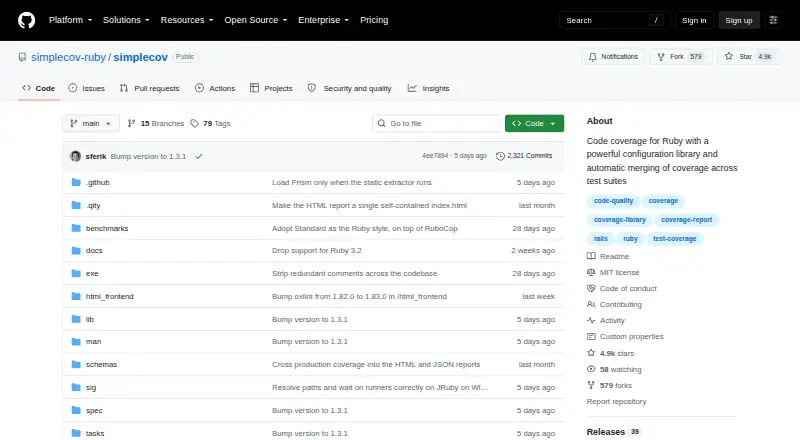
What SimpleCov is
SimpleCov measures Ruby code coverage using Ruby’s built-in Coverage library. It can produce HTML and JSON reports, merge results from multiple test suites, and track line, branch, method, oneshot-line, and eval coverage. Configuration includes filters, groups, profiles, and thresholds. Optional test tracking links covered lines to RSpec examples or Minitest tests, while oneshot coverage can record which code production use reaches. Its command line includes report viewing, test selection, patch coverage, history, status, and badge commands. The Rails profile can add ERB, Haml, and Slim templates to reports. SimpleCov can also calculate coverage for changed lines and enforce a minimum threshold. The project says it is built in CI on Ruby 3.2+ and JRuby 10+, with line coverage only on JRuby. To track application files, SimpleCov must start before application code is required. It is free and MIT licensed.
Good
- Free and MIT licensed
- HTML and JSON reports
- Supports line and branch coverage
- Can gate changed-line coverage
Watch out
- Must start before application code is required
- JRuby supports line coverage only
Who it suits
SimpleCov suits Ruby developers who need coverage reports, thresholds, or a view of which tests cover particular lines. Its Rails profile may also suit projects that include ERB, Haml, or Slim templates.
Verdict
SimpleCov offers configurable Ruby coverage reporting, test mapping, and change-coverage gates. Account for its startup requirement and JRuby coverage limitation when setting it up.
Plans and prices
From SimpleCov's own pricing page, checked 30 Sep 2026.
| Plan | Price | What it gives you |
|---|---|---|
| SimpleCov | Free | Ruby code coverage · MIT licensed |
The facts
Each one read from SimpleCov's own pages, with the date it was checked.
What it does
- Change coverage
- The CLI can calculate coverage for changed lines and use a minimum threshold as a gate.checked 30 Sep 2026
- CLI
- The command line includes report viewing, test selection, patch coverage, history, status, and badge commands.checked 30 Sep 2026
- Compatibility
- The project says it is built in CI on Ruby 3.2+ and JRuby 10+; JRuby supports line coverage only.checked 30 Sep 2026
- Configuration
- Configuration supports filters, groups, profiles, line and branch coverage, and coverage thresholds.checked 30 Sep 2026
- Integrations
- The README points to open source formatter and integration plugins, editor integrations, and hosted commercial services.checked 30 Sep 2026
- License
- The repository identifies SimpleCov as MIT licensed.checked 30 Sep 2026
- Production usage
- Oneshot coverage can record production code usage for identifying code that tests or live traffic do not touch.checked 30 Sep 2026
- Purpose
- SimpleCov analyzes Ruby code coverage using Ruby’s built-in Coverage library.checked 30 Sep 2026
- Reports
- It includes HTML and JSON formatters and can merge coverage results across test suites.checked 30 Sep 2026
- Security and compliance
- The repository page shows a Security and quality section but states no security certification or compliance standard in the README.checked 30 Sep 2026
- Setup constraint
- SimpleCov must start before application code is required to track those files.checked 30 Sep 2026
- Support
- The project directs users to its issue tracker for code and bug reports and its Google Groups mailing list for discussion and announcements.checked 30 Sep 2026
- View templates
- With the Rails profile, it can include ERB, Haml, and Slim templates in coverage reports.checked 30 Sep 2026
Where it runs
- Test mapping
- Opt-in test tracking can show which RSpec examples or Minitest tests cover a line.checked 30 Sep 2026
The full review of SimpleCov
Overview
SimpleCov is a free Ruby coverage analyzer built on Ruby’s native Coverage library. It is a strong fit for Ruby developers and teams that want detailed, configurable reporting and enforceable coverage checks without a subscription. The main practical catch is startup ordering: SimpleCov must begin before application code is required, or those files will not be tracked.
Because it works inside the Ruby test workflow, SimpleCov suits projects that want coverage data close to their existing test commands rather than a separate hosted dashboard. It is less suitable when one tool must cover several programming languages or when JRuby branch coverage is essential.
Key features
Reports are available in HTML and JSON, and results can be merged across test suites. Filters, groups, and profiles let teams organize reports around the files and components they actually maintain. Coverage types include line, branch, method, oneshot-line, and eval coverage, giving teams more than a single percentage to monitor.
Thresholds for line and branch coverage provide a minimum standard for a project. The CLI can calculate coverage for changed lines and apply a minimum threshold as a gate, which is particularly useful for preventing new patches from lowering quality even when a legacy codebase has uneven overall coverage.
Opt-in test tracking connects covered lines to individual RSpec examples or Minitest tests. That mapping can shorten the search for missing or redundant tests, although teams must choose to enable the tracking rather than receiving it automatically. Oneshot coverage records production code usage, helping identify code that is missed both by tests and by live traffic.
Rails projects get a dedicated profile that can include ERB, Haml, and Slim templates in coverage reports. Command-line functions include report viewing, test selection, patch coverage, history, status, and badge generation. Open-source formatter and integration plugins, editor integrations, and hosted commercial services can extend the workflow, while the core remains focused on Ruby.
Compatibility includes projects built in CI on Ruby 3.2 and newer and JRuby 10 and newer. JRuby supports line coverage only, so teams depending on branch or other coverage types should account for that limitation. The project is MIT licensed. Code and bug reports are directed to its issue tracker, while discussion and announcements use a Google Groups mailing list.
Pricing
SimpleCov — free. The sole plan is free, MIT licensed, and has no trial or renewal decision. It covers Ruby line, branch, method, oneshot-line, and eval coverage, with HTML and JSON reports, historical trends, and coverage gates. There are no paid tiers, seat charges, or stated usage quotas to weigh against the free plan, making it suitable for individual projects, open-source maintainers, and teams that can operate coverage in their own Ruby tooling.
The trade-off is scope rather than price. This is a Ruby-focused library, not a multi-language coverage service, and JRuby users receive line coverage only. Teams wanting hosted commercial reporting or broader language support should consider an alternative instead of expecting a higher SimpleCov tier.
Platforms
SimpleCov supports Linux, macOS, Windows, and web-based workflows. It is a Ruby tool, so the operating-system listing describes where the development or CI workflow can run rather than adding support for other programming languages. The web platform is relevant when reports are consumed through web-oriented integrations or hosted services around the tool.
Who it's for
Choose SimpleCov for Ruby applications whose maintainers want configurable local reports, historical tracking, and enforceable coverage standards without licensing cost. It is especially useful for teams combining broad project thresholds with changed-line gates, Rails teams that need template coverage, and developers who want test-to-line mapping or production-usage signals.
Look elsewhere if your codebase spans languages, if you require JRuby branch coverage, or if you want a managed service as the primary reporting environment. The early-start requirement also deserves attention in applications with complex load order.
Pros and cons
- Pros: Free MIT-licensed distribution avoids plan and seat costs.
- Pros: HTML and JSON output, mergeable suites, profiles, filters, and groups support tailored reporting.
- Pros: Line and branch thresholds plus changed-line gates turn coverage into an enforceable review rule.
- Pros: Test mapping, oneshot production usage, Rails template coverage, trends, and badge commands cover distinct maintenance needs.
- Cons: Startup must occur before application code is required, so setup mistakes can silently omit files.
- Cons: JRuby is limited to line coverage.
- Cons: Ruby-only scope makes it a poor fit for mixed-language coverage programs.
Alternatives
See the Test Coverage Tools directory for a broader comparison.
Coveralls is the better choice when you want freemium hosted reporting and a free offering for open-source and public repositories, with API and self-hosted platform options.
Pick gcov for compiled code instrumented with GCC; it requires GCC compilation and coverage instrumentation rather than Ruby’s runtime library.
OpenClover suits users wanting a free tool with no license tiers, keys, or usage limits.
Choose ReportGenerator when a freemium model, a 10-day full-access trial, or paid individual features match your reporting needs.
BullseyeCoverage is an option for teams evaluating a paid coverage product through its temporary, fully functional evaluation license.
cargo-llvm-cov is the relevant free, open-source alternative for Rust projects.
Coverage.py is the natural choice for Python coverage, with open-source use and an enterprise subscription through Tidelift.
LLVM llvm-cov provides an open-source LLVM coverage tool with no stated paid plans or usage limits.
Verdict
SimpleCov is an excellent default for Ruby teams that want deep, configurable coverage analysis and practical gates at no cost. Its strongest reason to choose it is the combination of report control, test and production mapping, and changed-line enforcement. Look elsewhere when you need multi-language coverage, JRuby branch metrics, or a hosted service to replace local setup.
Alternatives to SimpleCov
- 1

Codecov
Free planOpen sourceWebAPIExtensionLinux8.0From $5 a month - 2
Avidemux
Free planOpen sourceWebLinuxmacOSWindows7.3Free plan - 3
Coverage.py
Free planOpen sourceAPILinuxmacOSSelf-hosted7.3Free plan - 4

Coveralls
Free planWebAPILinuxSelf-hosted6.8From $10 a month - 5
ReportGenerator
Free planLinuxmacOSWindows6.8$79 one-time - 6
gcov
Free planLinuxmacOSWindows6.5Free plan