ReportGenerator
ReportGenerator is a command-line tool that converts code coverage reports into readable outputs and visualizes covered source lines.
What ReportGenerator is
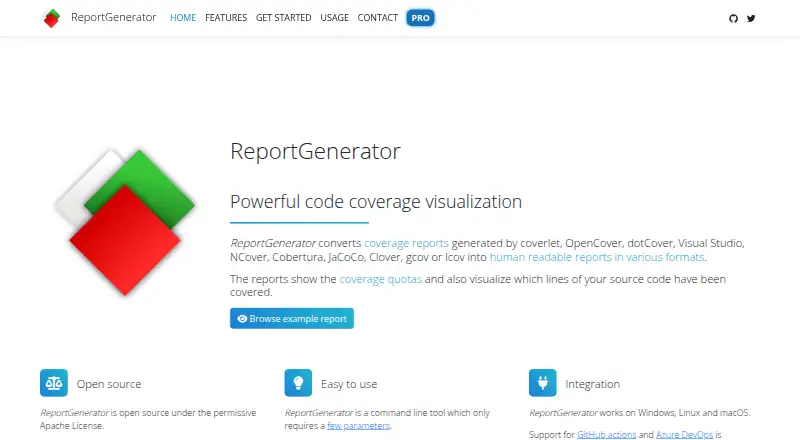
ReportGenerator is a command-line tool that converts code coverage reports into readable outputs and visualizes covered source lines. It accepts reports from formats and tools including coverlet, OpenCover, dotCover, Visual Studio, NCover, Cobertura, JaCoCo, Clover, gcov, and lcov. Reports can show line and branch coverage; method coverage is a PRO feature. A chart tracks coverage history, and the summary table supports filtering and sorting. Risk hotspot analysis can use cyclomatic complexity, NPath complexity, and CRAP score when those values are available, with configurable warning thresholds. Output options include HTML, Clover, Cobertura, OpenCover, SonarQube, lcov, XML, Markdown, JSON, CSV, and text, among others. The maker states that GitHub Actions and Azure DevOps are supported. The tool runs on Windows, Linux, and macOS. The open-source project uses the Apache License; basic features are free, while additional features require PRO. A 10-day free trial provides full access. Listed lifetime licenses cost $79, paid once for an individual, $249, paid once for up to 10 developers, and $599, paid once for unlimited developers.
Good
- Runs on Windows, Linux, and macOS
- Accepts reports from a broad range of coverage tools
- Tracks coverage history over time
- Supports GitHub Actions and Azure DevOps
- Open-source project with free basic features
Watch out
- Method coverage requires PRO
- Command-line use requires parameters
- Risk hotspot metrics depend on values being available
Who it suits
ReportGenerator suits developers and teams who want to produce readable coverage reports from supported tools and formats. Its command-line interface and build-system integrations fit workflows using GitHub Actions or Azure DevOps.
Verdict
ReportGenerator offers a broad set of report inputs and outputs, with free basic use and paid PRO features. Check whether the coverage features you need, especially method coverage, require a license.
Plans and prices
From ReportGenerator's own pricing page, checked 2 Oct 2026.
| Plan | Price | What it gives you |
|---|---|---|
| Free | Free | Open source · basic features |
| Free Trial | Free | Get full access · 10 day trial period |
| Individual | $79, paid once | Per developer license · Lifetime license |
| Team | $249, paid once | Up to 10 developers · Lifetime license |
| Enterprise | $599, paid once | Unlimited developers · Lifetime license |
The facts
Each one read from ReportGenerator's own pages, with the date it was checked.
What it does
- Command line
- ReportGenerator is a command-line tool that requires only a few parameters.checked 2 Oct 2026
- Coverage views
- Reports include line and branch coverage visualization, while method coverage is a PRO feature.checked 2 Oct 2026
- History and overview
- The coverage history chart tracks coverage over time, and the summary table has filtering and sorting options.checked 2 Oct 2026
- Input formats
- It accepts reports from coverlet, OpenCover, dotCover, Visual Studio, NCover, Cobertura, JaCoCo, Clover, gcov, and lcov.checked 2 Oct 2026
- Integrations
- The maker states that GitHub Actions and Azure DevOps are supported.checked 2 Oct 2026
- License activation
- A license can be applied with the -license command-line parameter or the REPORTGENERATOR_LICENSE environment variable.checked 2 Oct 2026
- License limits
- For purchased licenses, the developer count refers to people using reports generated by ReportGenerator, whether on their device or a central build server.checked 2 Oct 2026
- Open source and license
- The project is open source under the Apache License and is free to use, with additional features requiring PRO.checked 2 Oct 2026
- Output formats
- Available report outputs include HTML, Clover, Cobertura, OpenCover, SonarQube, lcov, TeamCity summary, XML, Markdown, JSON, CSV, and text formats.checked 2 Oct 2026
- Purpose
- ReportGenerator converts code coverage reports into human-readable reports in multiple formats and visualizes covered source lines.checked 2 Oct 2026
- Risk hotspots
- Risk hotspot analysis uses cyclomatic complexity, NPath complexity, and CRAP score when available, with configurable warning thresholds.checked 2 Oct 2026
- Security
- The opened maker pages do not state security certifications or compliance claims.checked 2 Oct 2026
- Support
- The maker invites users with issues to get in touch, and Paddle handles customer service inquiries and returns for orders.checked 2 Oct 2026
The company
- Founded
- 2009checked 28 Sep 2026
Where it runs
- Platform support
- ReportGenerator works on Windows, Linux, and macOS.checked 2 Oct 2026
The full review of ReportGenerator
Overview
ReportGenerator is a command-line utility for turning code coverage reports into readable views and outputs for other tools. It suits developers and teams combining coverage data from different sources; its key trade-off is that some coverage capabilities, including method coverage, require PRO.
Open source under the Apache License and in development since 2009, it runs on Windows, Linux, and macOS. The command line takes only a few parameters, making it a focused reporting step rather than a hosted coverage service.
Key features
ReportGenerator accepts reports from coverlet, OpenCover, dotCover, Visual Studio, NCover, Cobertura, JaCoCo, Clover, gcov, and lcov. That breadth makes it useful when a team needs to bring reports from different coverage tools into a shared reporting workflow. It supports .NET, Java, and Node.js.
Line and branch coverage are visualized in reports, while method coverage is a PRO feature. Historical charts show coverage trends, and a filterable, sortable summary table helps narrow attention to relevant results. Coverage gates can support teams applying coverage criteria in their workflows.
Risk hotspot analysis uses cyclomatic complexity, NPath complexity, and CRAP score when those measures are available, with configurable warning thresholds. The maker also states that GitHub Actions and Azure DevOps are supported.
Outputs include HTML for reading coverage, plus formats such as Clover, Cobertura, OpenCover, SonarQube, lcov, TeamCity summary, XML, Markdown, JSON, CSV, and text. This range helps teams pass results to different tools without limiting the utility to a single report format.
Pricing
The project is free to use under the Apache License, with basic features in the Free plan. A 10-day trial costs nothing and provides full access, useful for evaluating paid capabilities before buying.
Paid licenses are lifetime purchases: Individual costs $79, paid once for one developer, Team costs $249, paid once for up to 10 developers, and Enterprise costs $599, paid once for unlimited developers. The developer count covers people using reports generated by ReportGenerator, whether on their own device or a central build server. The free tier keeps basic reporting available, but method coverage and other PRO features call for a paid license. License activation uses the -license command-line parameter or the REPORTGENERATOR_LICENSE environment variable.
Platforms
ReportGenerator runs on Windows, Linux, and macOS. Its command-line design makes it suited to developer and build workflows across those systems.
Who it's for
Choose ReportGenerator if you need to consolidate coverage reports from multiple tools, generate several output formats, or track trends and risk hotspots in a developer workflow. It is less suitable if you want a hosted reporting service or need method coverage without purchasing PRO.
Pros and cons
- Broad input support: It accepts reports from ten named coverage tools, useful for teams with mixed reporting sources.
- Flexible outputs: HTML and numerous machine-readable formats help serve both people and downstream tools.
- Useful trend and risk views: Historical charts, coverage gates, and configurable hotspot thresholds add context beyond a single coverage snapshot.
- PRO boundary: Method coverage is paid, so teams needing that view should budget for a license rather than assume the free tier covers it.
- Developer-oriented workflow: A command-line tool is a practical fit for build and developer processes, but not a substitute for a hosted reporting service.
Alternatives
For a hosted or self-hosted option with a free plan, consider Coveralls; it is always free for open-source and public repositories. Choose gcov if you want a free option and compile with GCC using coverage instrumentation. OpenClover is another free choice, with no license tiers, keys, or usage limits.
For Ruby coverage, SimpleCov is free and MIT licensed. For Rust coverage, consider cargo-llvm-cov, which is free and open source under Apache-2.0 or MIT. Coverage.py is a free open-source Python coverage tool, with an enterprise subscription available through Tidelift. For an open-source LLVM tool with no paid plans or usage limits stated, see LLVM llvm-cov; Microsoft Code Coverage is a free, closed-source option.
Browse the Test Coverage Tools category for more options.
Verdict
ReportGenerator is a strong fit for developers and teams that need a free, cross-platform command-line reporting step across varied coverage sources and output formats. Its main draw is breadth paired with trend and hotspot views; look elsewhere if you need a hosted service, or choose a paid license if method coverage is essential.
Alternatives to ReportGenerator
- 1

Codecov
Free planOpen sourceWebAPIExtensionLinux8.0From $5 a month - 2
Avidemux
Free planOpen sourceWebLinuxmacOSWindows7.3Free plan - 3
Coverage.py
Free planOpen sourceAPILinuxmacOSSelf-hosted7.3Free plan - 4

Coveralls
Free planWebAPILinuxSelf-hosted6.8From $10 a month - 5
gcov
Free planLinuxmacOSWindows6.5Free plan - 6
OpenClover
Free planWebLinuxmacOSWindows6.4Free plan