OpenClover
OpenClover is a free, open-source code coverage tool for Java, Groovy, and AspectJ.
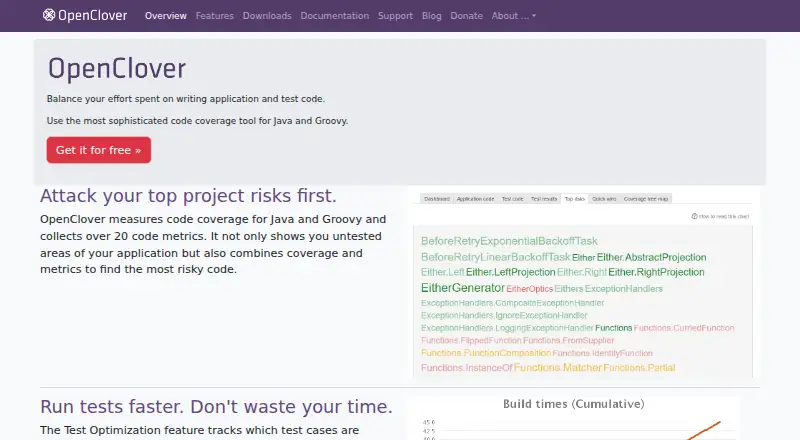
What OpenClover is
OpenClover is a free, open-source code coverage tool for Java, Groovy, and AspectJ. It measures coverage globally, per test, or across distributed tests, using method, statement, and branch metrics. Developers can use more than 20 built-in code metrics or add custom ones. Reports are available in HTML, XML, PDF, JSON, and text formats, and coverage scope can be narrowed using paths, classes, methods, code blocks, statements, complexity, and inline comments. For test optimization, it can identify tests to rerun for modified classes, run failing tests first, or randomize test order. Integrations include build tools, CI systems, IDEs, and issue trackers such as Ant, Maven, Gradle, Jenkins, Eclipse, IntelliJ IDEA, Sonar, and JIRA. Dedicated test support covers JUnit 3 and 4, TestNG, and Spock. Version 5.1.x supports JRE or JDK 8 through 25 and Groovy 3.x, 4.x, and 5.x. The software is Apache 2.0 licensed and free forever, with no license tiers, keys, or usage limits.
Good
- Tracks global, per-test, and distributed per-test coverage
- Offers more than 20 built-in code metrics
- Generates HTML, XML, PDF, JSON, and text reports
- Free forever with no usage limits
Watch out
- Groovy is unsupported in Eclipse and IntelliJ IDEA integrations
- Community support typically responds within a few days
Who it suits
OpenClover suits developers working with Java, Groovy, or AspectJ who want coverage metrics and test rerun selection. Teams using its Eclipse or IntelliJ IDEA integrations should note that Groovy is not supported there.
Verdict
OpenClover combines detailed coverage reporting with test-selection features and integrations across build, CI, IDE, and issue-tracking tools. Its free license has no usage limits, though Groovy has an IDE integration limitation.
Plans and prices
From OpenClover's own pricing page, checked 1 Oct 2026.
| Plan | Price | What it gives you |
|---|---|---|
| OpenClover | Free | no license tiers · no license keys · no usage limits · forever |
The facts
Each one read from OpenClover's own pages, with the date it was checked.
What it does
- Code metrics
- It includes over 20 built-in code metrics and supports custom metrics.checked 1 Oct 2026
- Coverage types
- It tracks global, per-test and distributed per-test coverage with method, statement and branch metrics.checked 1 Oct 2026
- Data filtering
- Coverage scope can be filtered by paths, classes, methods, code blocks, statements, complexity and inline comments.checked 1 Oct 2026
- IDE limitation
- Groovy is not supported in the Eclipse and IntelliJ IDEA integrations.checked 1 Oct 2026
- Integrations
- Integrations include Ant, Maven, Gradle, Grails, Griffon, Jenkins, Bamboo, Eclipse, IntelliJ IDEA, Sonar and JIRA.checked 1 Oct 2026
- License
- OpenClover software is licensed under Apache 2.0.checked 1 Oct 2026
- Project status
- OpenClover is maintained by volunteers and has been free and open-source since 2017.checked 1 Oct 2026
- Purpose
- OpenClover is a code coverage tool for Java, Groovy and AspectJ.checked 1 Oct 2026
- Report formats
- Reports can be generated as HTML, XML, PDF, JSON and TEXT.checked 1 Oct 2026
- Runtime support
- OpenClover 5.1.x supports JRE or JDK 8 through 25 and Groovy 3.x, 4.x and 5.x.checked 1 Oct 2026
- Supported operating systems
- Supported operating systems are Microsoft Windows, Linux and Apple Mac OS X.checked 1 Oct 2026
- Technical support
- Community support typically responds within a few days through documentation, forums and the issue tracker.checked 1 Oct 2026
- Test frameworks
- Dedicated test support covers JUnit 3 and 4, TestNG and Spock.checked 1 Oct 2026
- Test optimization
- It identifies tests to rerun for modified classes and can run failing tests first or randomize test order.checked 1 Oct 2026
The company
- Founded
- 2017checked 28 Sep 2026
The full review of OpenClover
OpenClover is a code coverage tool for Java, Groovy and AspectJ projects. It suits teams that want detailed coverage analysis integrated with builds and tests. It is a capable no-cost choice, but Groovy users should account for its IDE integration gap.
Overview
OpenClover measures global, per-test and distributed per-test coverage, with method, statement and branch metrics. Historical trends and coverage gates help teams monitor results over time and apply coverage criteria. More than 20 built-in code metrics, alongside support for custom metrics, add ways to examine code beyond which lines tests exercise.
Its scope filters range from paths and classes to methods, code blocks, statements, complexity and inline comments. That granularity is useful when teams need to focus analysis on selected code; it is more than a minimal coverage utility requires. OpenClover has been free and open-source since 2017 under the Apache 2.0 license, and is maintained by volunteers.
For more options, see our Test Coverage Tools directory.
Key features
Build, test and reporting workflows
Integrations include Ant, Maven, Gradle, Grails and Griffon, plus Jenkins, Bamboo, Eclipse, IntelliJ IDEA, Sonar and JIRA. Dedicated test support covers JUnit 3 and 4, TestNG and Spock. This breadth suits projects that want coverage within established build, CI, IDE and issue-tracking workflows. The important exception is Groovy: it is not supported in the Eclipse or IntelliJ IDEA integrations.
Reports can be generated as HTML, XML, PDF, JSON or TEXT, so teams can choose a format suited to reading or downstream processing. OpenClover can identify tests to rerun after classes change, run failing tests first, or randomize test order. Those options make it relevant not only for reporting coverage but also for shaping test runs.
Pricing
OpenClover — free, billed forever
The single plan has no license tiers, license keys or usage limits. It includes the same coverage, metrics, integrations and test-selection capabilities described above without a paid tier to unlock. There are no seat, quota or trial constraints attached to the plan. Teams should weigh the zero license cost against volunteer maintenance and community support, which typically responds within a few days through documentation, forums and the issue tracker.
Platforms
OpenClover supports Windows, Linux and Apple Mac OS X. The directory categorizes it for Linux, macOS, web and Windows. Version 5.1.x supports JRE or JDK 8 through 25 and Groovy 3.x, 4.x and 5.x, giving Java and Groovy projects a defined runtime range to consider.
Who it's for
OpenClover is a strong fit for Java, Groovy and AspectJ teams that value per-test coverage, detailed filtering, multiple report formats and test-selection controls, especially when their builds already use its supported tools. It is less suitable for teams that require Groovy support inside Eclipse or IntelliJ IDEA, or that need a different language ecosystem. Volunteer maintenance and community-based support may also be a drawback for organizations that require a formal support arrangement.
Pros and cons
- Pros: No usage limits or license tiers, making the tool available without a usage-based ceiling.
- Pros: Global, per-test and distributed coverage, historical trends and coverage gates provide several ways to assess and track test coverage.
- Pros: Test-selection controls and integrations across build, CI, IDE and issue-tracking tools can fit into existing workflows.
- Cons: Groovy is unsupported in the Eclipse and IntelliJ IDEA integrations, limiting IDE workflows for those projects.
- Cons: Support is community-based and the project is volunteer-maintained, rather than backed by a stated formal support offering.
Alternatives
Choose Coveralls if you need a freemium option that states it is always free for open-source and public repositories. ReportGenerator is another freemium alternative, with a free tier described as basic features for open source and paid Individual pricing. For Ruby projects, SimpleCov is a free, MIT-licensed code coverage option. Coverage.py is the free, open-source option among these alternatives for Python coverage.
Microsoft Code Coverage is a free alternative. Coverlet is a free, MIT-licensed option for modern .NET SDK-style projects. gofmt is a free command-line tool included with Go installations. Codecov is a freemium alternative with a free Developer plan.
Verdict
Choose OpenClover if you work in Java, Groovy or AspectJ and want detailed coverage, flexible reports and test-selection features without license or usage limits. Its integrations and metric depth are compelling for teams that need more than a basic coverage summary. Look elsewhere if Groovy IDE integration is essential, or if volunteer maintenance and community support do not meet your needs.
Getting started
- Visit the OpenClover website.
- Choose a supported operating system: Windows, Linux or macOS.
- Use a supported JRE or JDK version, from 8 through 25 for OpenClover 5.1.x.
- Connect it with a listed build tool, IDE or CI integration.
- Select a supported test framework and configure coverage reporting.
Questions
How much does OpenClover cost?
The OpenClover plan is free, billed forever. It has no license tiers, license keys or usage limits.
Which languages does it support?
OpenClover supports Java, Groovy and AspectJ.
Which operating systems are supported?
Supported operating systems are Microsoft Windows, Linux and Apple Mac OS X.
What test frameworks have dedicated support?
Dedicated support covers JUnit 3 and 4, TestNG and Spock.
Is OpenClover open source?
Yes. It is licensed under Apache 2.0 and has been free and open-source since 2017.
What are the runtime requirements for version 5.1.x?
It supports JRE or JDK 8 through 25, and Groovy 3.x, 4.x and 5.x.
Alternatives to OpenClover
- 1

Codecov
Free planOpen sourceWebAPIExtensionLinux8.0From $5 a month - 2
Avidemux
Free planOpen sourceWebLinuxmacOSWindows7.3Free plan - 3
Coverage.py
Free planOpen sourceAPILinuxmacOSSelf-hosted7.3Free plan - 4

Coveralls
Free planWebAPILinuxSelf-hosted6.8From $10 a month - 5
ReportGenerator
Free planLinuxmacOSWindows6.8$79 one-time - 6
gcov
Free planLinuxmacOSWindows6.5Free plan