
Coveralls
Coveralls analyzes software test coverage so teams can identify code that tests do not cover.
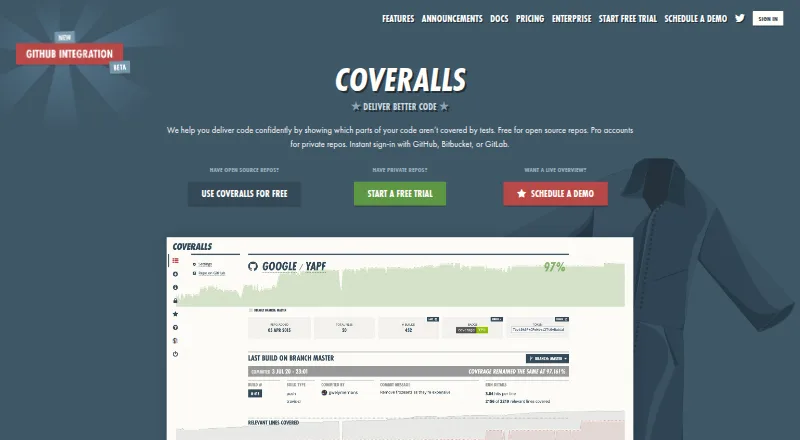
What Coveralls is
Coveralls analyzes software test coverage so teams can identify code that tests do not cover. Its dashboard shows project coverage percentages and how they change over time, while repository views drill down through sub-projects and files to individual lines. Build history tracks coverage for builds across branches, including pull requests. Coveralls can add summarized coverage reports to pull requests and send status updates that apply coverage criteria to merge decisions. Notifications can go to Slack or webhooks. It supports line and branch coverage, and lists languages including C/C++, Go, Java, JavaScript, .NET, PHP, Python, Ruby and Scala. Integrations include a GitHub Action, a CircleCI Orb and more than 30 community-created options; Coveralls says it works with any CI service. Open-source and public repositories are free. The Starter plan is $10/mo for one private repository and has a 30-day free trial. A self-hosted enterprise installation can run within existing security controls without outbound network access.
Good
- Coverage views reach individual code lines.
- Build history includes branches and pull requests.
- Coverage criteria can inform merge status.
- Notifications can go to Slack or webhooks.
- Self-hosted enterprise deployment is available.
Watch out
- Starter covers one private repository.
- Detailed file coverage retention is limited to 12 months for paid repositories.
- Support add-on costs $200/month.
Who it suits
Coveralls suits development teams that want coverage details by file and line, historical trends, and pull-request checks. Its free open-source option may suit maintainers of public projects; private repositories have paid plans starting at $10/mo.
Verdict
Coveralls brings coverage summaries, build history, and pull-request reporting into one workflow. Teams should check repository limits, retention terms, and plan costs against their needs.
Plans and prices
From Coveralls's own pricing page, checked 28 Sep 2026.
| Plan | Price | What it gives you |
|---|---|---|
| Open Source | Free | Free for open-source projects |
| Starter | $10 a month | 1 private repo · 30-day free trial · $10/mo |
| Usage add-on | $30 a month | +3,000 uploads/mo · priority processing · repo scoped · combines with any Cloud Plan · $30/mo |
| Enterprise Cloud | $35 a month | Unlimited orgs, repos, and users · secure private infrastructure · guaranteed performance · premium support · 40-seat minimum ($1,400/mo) · $35/user/mo |
| Org | $50 a month | 10 private repos · unlimited users · $50/mo |
| Org+ | $100 a month | 20 private repos · unlimited users · $100/mo |
| Pro | $200 a month | 40 private repos · unlimited users · $200/mo |
| Support add-on | $200 a month | Premium support · priority response · live chat · combines with any Cloud Plan · $200/mo |
| Unlimited | $400 a month | Unlimited private repos · unlimited users · $400/mo |
| Cloud Premium | $800 a month | Unlimited private repos · premium support · custom SLA terms · multi-org billing · $800.00/mo |
The facts
Each one read from Coveralls's own pages, with the date it was checked.
What it does
- API
- The API can add repositories programmatically and return statistics on recent builds.checked 28 Sep 2026
- Build history
- Build history shows coverage changes for each build across branches, including pull requests.checked 28 Sep 2026
- Coverage dashboard
- The dashboard summarizes projects' current coverage percentages and graphs changes over time.checked 28 Sep 2026
- Coverage detail
- Repository pages show aggregate coverage down to sub-project, file, and individual code line.checked 28 Sep 2026
- Data retention
- The cloud terms specify detailed file coverage retention of 12 months for paid repositories and six months for public repositories, while aggregated build-level coverage is retained indefinitely.checked 28 Sep 2026
- Enterprise security
- The Enterprise security page says its on-premises installation runs within the customer's existing security controls and can operate without outbound network access.checked 28 Sep 2026
- Integrations
- Coveralls says it works with any CI service and offers over 30 community-created integrations plus a GitHub Action and CircleCI Orb.checked 28 Sep 2026
- Notifications
- Coverage change notifications can be sent to Slack or to webhooks.checked 28 Sep 2026
- Open source
- Coveralls states that it is always free for open-source and public repositories.checked 28 Sep 2026
- Privacy and security
- The cloud terms state that Coveralls reads code through the SCM OAuth token, does not store or cache private code, and accesses repositories on a read-only basis for coverage analysis.checked 28 Sep 2026
- Pull requests
- Coveralls posts summarized coverage reports in pull requests and can send status updates that allow or block merges based on coverage criteria.checked 28 Sep 2026
- Purpose
- Coveralls analyzes test coverage to show which parts of code are not covered by tests.checked 28 Sep 2026
- Source languages
- The homepage lists integration packages for languages including C/C++, Go, Java, JavaScript, .NET, PHP, Python, Ruby, Scala, and others.checked 28 Sep 2026
- Support
- The pricing page offers a $200/month Support add-on with premium support, priority response, and live chat.checked 28 Sep 2026
The company
- Founded
- 2011checked 23 Sep 2026
- Maker and location
- The About page identifies Coveralls, Inc. as the operator and describes it as based in Venice, California.checked 28 Sep 2026
The full review of Coveralls
Overview
Coveralls analyzes test coverage and turns it into project summaries, build history, and pull-request reports for software teams. It is best suited to teams that want coverage visible across CI builds and branches, with checks that can influence merges. The trade-off is a tiered cloud price tied to private-repository counts, with higher-capacity and enterprise options for larger organizations.
Key features
The dashboard tracks project coverage percentages and changes over time, while repository views can drill from aggregate results through sub-projects and files to individual lines. That combination helps teams spot both broad trends and uncovered code without relying on a single headline percentage. Coveralls handles line and branch coverage, and supports report formats including LCOV, SimpleCov, Cobertura, JaCoCo, Gcov, Clover XML, and Pytest-Cov.
Build history records coverage across builds and branches, including pull requests. Pull-request summaries and annotations make changes visible in code review, and coverage criteria can be used to allow or block merges. Teams can also send coverage-change notifications to Slack or webhooks. These features make Coveralls more useful as part of a review workflow than as a standalone report viewer.
Coveralls says it works with any CI service and offers more than 30 community integrations, along with a GitHub Action and CircleCI Orb. Supported languages include .NET, C/C++, Go, Java, JavaScript, PHP, Python, Ruby, Scala, and others. Its API can add repositories and return recent-build statistics, which may suit teams automating repository management or reporting.
For cloud use, Coveralls says it reads code through an SCM OAuth token, accesses repositories read-only, and does not store or cache private code. Detailed file coverage is retained for 12 months on paid repositories and six months on public repositories; aggregated build-level coverage remains indefinitely. Enterprise on-premises installations can run inside a customer's existing security controls and without outbound network access.
Pricing
The Open Source plan is free for open-source projects. Coveralls also says open-source and public repositories are always free, making it a straightforward fit for public work. For private repositories, the Starter plan costs $10 a month, billed $10/mo, for one private repository and includes a 30-day free trial. That is the lowest-cost entry, but its single-repository cap is restrictive for teams with multiple private projects.
The Org plan is $50 a month, billed $50/mo, for 10 private repositories and unlimited users; Org+ is $100 a month, billed $100/mo, for 20 private repositories and unlimited users. Pro costs $200 a month, billed $200/mo, for 40 private repositories and unlimited users. Unlimited costs $400 a month, billed $400/mo, for unlimited private repositories and users. The step-up is chiefly repository capacity, so teams should match the tier to the number of private repositories they need to cover.
A Usage add-on costs $30 a month, billed $30/mo, and adds 3,000 uploads per month with priority processing; it is repository-scoped and combines with any Cloud Plan. The Support add-on costs $200 a month, billed $200/mo, for premium support, priority response, and live chat, and also combines with any Cloud Plan. These add-ons can raise the cost substantially, so they make most sense when upload volume or support response is a real operational requirement.
Cloud Premium costs $800 a month, billed $800.00/mo, for unlimited private repositories, premium support, custom SLA terms, and multi-organization billing. Enterprise Cloud is $35 a month, billed $35/user/mo, with unlimited organizations, repositories, and users, secure private infrastructure, guaranteed performance, and premium support; it requires at least 40 seats, or $1,400/mo. That minimum makes it an enterprise-scale commitment rather than an upgrade for a small team. The pricing page also offers a $200/month Support add-on.
Platforms
Coveralls supports API, Linux, self-hosted, and web use. The self-hosted option is especially relevant to organizations that need coverage analysis to operate inside their own security controls; the cloud option offers repository access through SCM OAuth with read-only analysis.
Who it's for
Coveralls is a strong fit for teams that want coverage trends, pull-request reporting, and merge gates integrated into CI, especially when they manage several private repositories or public open-source projects. Public projects can use it without a subscription, while private teams can scale from a single-repository Starter plan through organization and enterprise tiers. It is less compelling for a private project that needs only a local coverage report, or for teams unwilling to pay according to repository capacity and add-ons.
Pros and cons
- Pros: Pull-request summaries, annotations, and coverage gates bring results into code review, where teams can act on them.
- Pros: History across branches plus file- and line-level detail serves both trend monitoring and targeted investigation.
- Pros: Public and open-source repositories are free, and the cloud service offers broad CI, language, and report-format support.
- Cons: The $10/mo Starter plan covers only one private repository, so even small multi-project teams need a higher tier.
- Cons: Upload and premium-support needs carry separate monthly add-on costs, while Enterprise Cloud has a 40-seat minimum.
- Cons: Detailed file coverage has finite retention—12 months for paid repositories and six months for public repositories—even though aggregate build coverage is retained indefinitely.
Alternatives
Codecov is worth comparing if its free Developer plan's allowance of up to 250 private-repository uploads and unlimited public repositories suits your use; it also has a maximum of one user for open-source use, or unlimited users for private use. For a free tool with no license tiers, keys, or usage limits, choose OpenClover. ReportGenerator is another freemium option, with a 10-day full-access trial and a free plan for basic features.
For a free, Ruby-specific coverage tool, consider SimpleCov. Python teams looking for an open-source coverage tool can consider Coverage.py. Coverlet is a free alternative for modern .NET SDK-style projects. Go users who need a command-line formatter included with their Go installation can choose gofmt. gcovr is another free option for Linux, macOS, and Windows.
See the Test Coverage Tools category for more options.
Verdict
Choose Coveralls if your team wants coverage to inform pull-request review and merge decisions, with build trends and code-level detail alongside those checks. Its free public-project support and CI breadth are clear strengths, but private teams should account for repository caps, add-ons, and retention before committing. Teams needing only a free local tool, or a small private team with several repositories, may find a simpler alternative a better fit.
Getting started
- Visit https://coveralls.io/.
- Choose the cloud service or a self-hosted option.
- Use the free option for an open-source or public repository, or select a paid plan.
- Connect a repository through an available CI integration or listed language package.
- Use the dashboard and pull-request reporting to review coverage.
Limits worth knowing
The free option is for open-source and public repositories. Starter is $10/mo for one private repository and includes a 30-day trial. Detailed file coverage is retained for 12 months on paid repositories and six months on public repositories; aggregated build-level coverage is retained indefinitely.
Questions
Is Coveralls free?
Coveralls states that it is always free for open-source and public repositories. Starter is a paid option at $10/mo for one private repository.
What platforms does it support?
The listed platforms are API, Linux, self-hosted, and web.
What does the Starter plan include?
Starter costs $10/mo and includes one private repository and a 30-day free trial.
Can Coveralls run on-premises?
Yes. Its enterprise self-hosted installation runs within the customer's existing security controls and can operate without outbound network access.
What integrations are available?
Coveralls says it works with any CI service and offers over 30 community-created integrations, a GitHub Action, and a CircleCI Orb.
How does Coveralls handle private code?
Its cloud terms say it reads code through the SCM OAuth token, does not store or cache private code, and accesses repositories read-only for coverage analysis.
Alternatives to Coveralls
- 1

Codecov
Free planOpen sourceWebAPIExtensionLinux8.0From $5 a month - 2
Avidemux
Free planOpen sourceWebLinuxmacOSWindows7.3Free plan - 3
Coverage.py
Free planOpen sourceAPILinuxmacOSSelf-hosted7.3Free plan - 4
ReportGenerator
Free planLinuxmacOSWindows6.8$79 one-time - 5
gcov
Free planLinuxmacOSWindows6.5Free plan - 6
OpenClover
Free planWebLinuxmacOSWindows6.4Free plan