Signal Loom
Signal Loom is a free, open-source local skill package for turning research materials into evidence-traceable infographics.
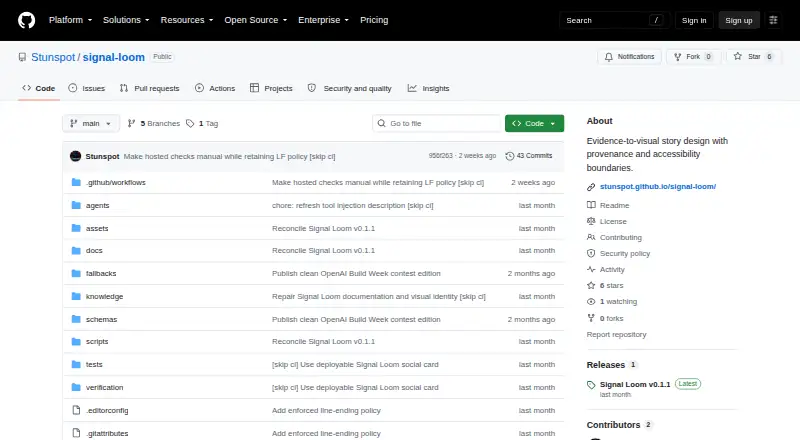
What Signal Loom is
Signal Loom is a free, open-source local skill package for turning research materials into evidence-traceable infographics. It is designed for reports, research notes, datasets, interviews, and existing infographics, with the user supplying an intended audience and purpose. Its default result is a semantic, responsive web infographic; an approved story can be reconstructed for carousels or other requested formats. Each project is saved as a Loomfile folder with evidence, claims, story, visual plan, infographic, review records, and checkpoints. The workflow runs through ORIENT, SHAPE, PLAN, BUILD, FINISH, DISTRIBUTE, and VERIFY. Signal Loom supports Codex and Claude Code, and installation involves cloning the repository into the host's personal skills directory. Its Python tools use the standard library, make no network calls, and include no telemetry; Loomfiles stay where they are created. The AI host may transmit prompts and files under its own configuration and terms. Signal Loom does not independently establish whether claims are true, update facts without authorization, approve work, or publish artifacts. Static checks can catch defined structural defects, but cannot prove factual accuracy, real-world accessibility, security, or professional fitness.
Good
- Creates responsive web infographics by default.
- Keeps evidence, claims, and review records in Loomfiles.
- Local Python tools make no network calls or telemetry.
- Can reconstruct approved stories for other formats.
Watch out
- Requires cloning the repository into a host skills directory.
- Does not independently verify claims or refresh facts.
- Does not publish artifacts on its own.
- Static checks cannot establish security or factual accuracy.
Who it suits
It suits people building infographics from research, reports, datasets, interviews, or existing visuals who want evidence and project decisions recorded in a Loomfile. It is intended for users working in Codex or Claude Code.
Verdict
Signal Loom provides a structured local workflow for turning supplied evidence into infographics, with project records that can be resumed. Users remain responsible for verifying claims, approving work, and deciding whether to publish.
Plans and prices
From Signal Loom's own pricing page, checked 10 Oct 2026.
| Plan | Price | What it gives you |
|---|---|---|
| Signal Loom | Free | Open-source MIT-licensed skill package; no hosted service or paid plans stated |
The facts
Each one read from Signal Loom's own pages, with the date it was checked.
What it does
- AI host privacy
- The configured AI host may transmit prompts and files according to its own configuration and terms.checked 10 Oct 2026
- Audience and inputs
- It is designed for work based on reports, research notes, datasets, interviews, or existing infographics, with an intended audience and purpose supplied by the user.checked 10 Oct 2026
- Evidence limits
- Signal Loom does not invent missing evidence or independently establish whether a claim is true.checked 10 Oct 2026
- Host integrations
- Signal Loom supports Codex and Claude Code as host environments.checked 4 Oct 2026
- Installation
- The project instructs users to clone the complete repository into the host's personal skills directory.checked 4 Oct 2026
- Local operation
- The included Python tools use the standard library, make no network calls, and include no telemetry; Loomfiles stay where users create them.checked 10 Oct 2026
- No autonomous publication
- Signal Loom does not independently establish whether claims are true, refresh current facts without authorization, approve its own work, or publish artifacts on its own.checked 4 Oct 2026
- Output
- Its default output is a semantic, responsive web infographic, with other formats available when requested.checked 10 Oct 2026
- Project format
- It produces a Loomfile project folder containing evidence, claims, story, visual plan, infographic, review records, and checkpoints.checked 4 Oct 2026
- Project records
- It creates a resumable Loomfile containing source evidence, claims, story, visual plan, infographic, review records, and checkpoints.checked 10 Oct 2026
- Publication boundary
- It does not publish anything on its own, and built, reviewed, approved for export, and published are distinct states.checked 10 Oct 2026
- Purpose
- Signal Loom turns research, reports, notes, and data into evidence-traceable infographics.checked 10 Oct 2026
- Security limits
- The HTML inspector is not a sanitizer, and the packager does not scan file contents for secrets.checked 10 Oct 2026
- Security scope
- Signal Loom is a local skill package, not a hosted service, and it does not collect telemetry or publish artifacts.checked 4 Oct 2026
- Supported hosts
- The repository documents installation for Codex and Claude Code.checked 10 Oct 2026
- Validation limits
- Static validation can catch defined structural defects but cannot prove factual accuracy, accessible real-world use, security, or professional fitness.checked 4 Oct 2026
- Vulnerability reporting
- The security policy says no response-time or embargo guarantee is promised for vulnerability reports.checked 10 Oct 2026
- Workflow
- Its documented workflow is ORIENT, SHAPE, PLAN, BUILD, FINISH, DISTRIBUTE, and VERIFY.checked 10 Oct 2026
The company
- Maker
- The GitHub maker profile identifies Sam “stunspot” Walker as a prompt engineer and AI systems designer based in Illinois, USA.checked 10 Oct 2026
Alternatives to Signal Loom
- 1

Visme
Free planAndroidiOSWebAPI8.4From $12.25 a month - 2

Infogram
Free planAndroidiOSWebAPI8.1From $19 a month - 3
Animaker
Free planAndroidiOSWebAPI7.8From $15 a month - 4
Drawtify
Free planWebAPImacOSWindows7.8From $99.99 a year - 5

Piktochart
Free planWeb7.5From $39 a year - 6

GetInfographic
Free planWebAPIExtension7.4From $9 a month