
Shuffle
Shuffle is a security operations platform for incident response across cloud, on-premises, and hybrid infrastructure.
What Shuffle is
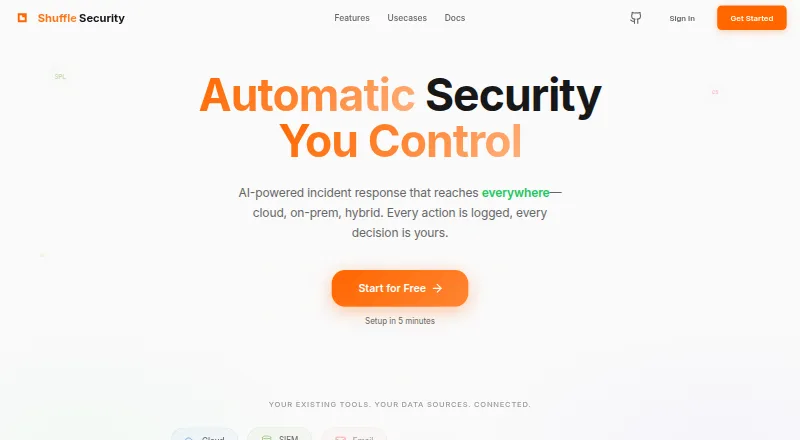
Shuffle is a security operations platform for incident response across cloud, on-premises, and hybrid infrastructure. It automates triage and threat enrichment, suggests response actions, and provides visibility into automated decisions. Shuffle can work with cloud LLM APIs or models supplied by users. Its homepage advertises 3,000+ MCP-ready integrations, including Splunk, CrowdStrike, Sentinel, and ServiceNow, and says teams can build integrations with an SDK that supports bidirectional sync. Shuffle Pipelines can ingest and parse data and match Sigma rules with Tenzir. Host monitors cover endpoint compliance and remote response, while continuous checks address encryption, screenlock, patching, and MDM posture; software inventory and vulnerability matching are also described. The service can be deployed on-premises or self-hosted on cloud platforms such as GCP, AWS, or Azure. Its Starter plan begins with 2,000 free App-Runs, a measure of workflow executions, and is listed at $29 per month for 10,000 App-Runs. Starter includes 10 workflows, five users, one tenant, one day of workflow run history, and seven days of workflow backup. Shuffle offers API, web, and self-hosted availability.
Good
- Automates triage and threat enrichment.
- Works with cloud LLM APIs or user models.
- SDK supports bidirectional integration sync.
- Self-hosting is available on premises or cloud.
- Starter begins with 2,000 free App-Runs.
Watch out
- Starter includes only 10 workflows.
- Starter includes one tenant and five users.
- Starter workflow history is limited to one day.
- Starter backup retention is seven days.
Who it suits
Shuffle suits security operations teams that need to automate incident response across cloud, on-premises, or hybrid environments. Its self-hosting and integration options may fit teams using varied infrastructure and models.
Verdict
Shuffle combines response automation, integrations, pipelines, and host monitoring for security operations. Check the Starter plan’s workflow, user, history, and backup limits against your needs.
Plans and prices
From Shuffle's own pricing page, checked 29 Sep 2026.
| Plan | Price | What it gives you |
|---|---|---|
| Starter | $29 a month | 10 workflows · 5 users · 1 tenant · 1 day workflow run history · 7 days workflow backup · $29/month for 10k App Runs; starts free with 2k App-Runs |
| Standard | $1,920 a month | 25 workflows · 15 users · 3 tenants · 90 days workflow run history · 30 days workflow backup · Starts from$1920/month |
| Enterprise | $2,920 a month | Custom App-Runs · unlimited tenants, environments, users, and workflows · 365+ day workflow run history · Starts from$2920/month |
The facts
Each one read from Shuffle's own pages, with the date it was checked.
What it does
- AI models
- The product page says Shuffle works with cloud LLM APIs or users’ own models.checked 29 Sep 2026
- Automation
- The site describes automatic triage and threat enrichment, suggested response actions, and visibility into automated decisions.checked 29 Sep 2026
- Detection
- Shuffle Pipelines can ingest data, parse it, and match Sigma rules with Tenzir, and the product offers host monitors for endpoint compliance and remote response.checked 29 Sep 2026
- Host monitoring
- The homepage describes continuous SOC2 checks for encryption, screenlock, patching, and MDM posture, along with software inventory and vulnerability matching.checked 29 Sep 2026
- Integrations
- The homepage advertises 3,000+ MCP-ready integrations and names Splunk, CrowdStrike, Sentinel, and ServiceNow as examples.checked 29 Sep 2026
- Integration tools
- The homepage says users can build integrations with its SDK and that integrations support bidirectional sync.checked 29 Sep 2026
- Purpose
- Shuffle Security is an AI-powered security operations platform for incident response across cloud, on-premises, and hybrid infrastructure.checked 29 Sep 2026
- Security features
- The pricing comparison lists two-factor authentication, SSO/SAML, and secret key/authentication encryption among its security features.checked 29 Sep 2026
- Self-hosting
- Shuffle can be deployed on-premises or self-hosted on a cloud platform such as GCP, AWS, or Azure.checked 29 Sep 2026
- Support
- The pricing page lists community support for Starter, standard support for Standard, and standard or enterprise-level support for Enterprise.checked 29 Sep 2026
- Usage limits
- The Starter plan begins with 2,000 free App-Runs, and the pricing page defines App-Runs as workflow automation executions used to measure platform usage.checked 29 Sep 2026
The company
- Company background
- Shuffle’s founder says Shuffle Security is a security-operations-focused interface built on Shuffle’s backend automation technology.checked 29 Sep 2026
- Founded
- 2019checked 23 Sep 2026
The full review of Shuffle
Overview
Shuffle is a security operations platform for coordinating incident response across cloud, on-premises and hybrid infrastructure. Founded in 2019, it brings automation, integrations, detection pipelines and host monitoring into a single platform. It is best suited to security teams that want to connect response workflows to their existing tools and choose between cloud-based and self-hosted deployment.
Its strongest case is breadth: teams can automate alert handling, enrich threats, build integrations and monitor endpoint posture. The trade-off is that the entry plan is tightly capped, while the paid tiers rise quickly in price.
Key features
Response automation and AI
Shuffle supports playbook automation, alert enrichment, threat-intelligence actions and case management. It can automatically triage threats, suggest response actions and show how automation reached its decisions. That visibility is useful when teams need oversight of automated response rather than a black box. Shuffle works with cloud LLM APIs or models supplied by users, offering flexibility in model choice.
Integrations and workflows
The homepage advertises more than 3,000 MCP-ready integrations, including Splunk, CrowdStrike, Sentinel and ServiceNow; the pricing comparison separately counts 2,500 published integrations. Teams can create integrations with the SDK, and integrations support bidirectional synchronization. This is a strong fit for operations built around several security and service tools, though the two integration counts give different ways to understand the catalog's scale.
Detection and host monitoring
Shuffle Pipelines ingest and parse data, then match Sigma rules with Tenzir. Host monitors cover endpoint compliance and remote response. They continuously check encryption, screenlock, patching and MDM posture, and add software inventory and vulnerability matching. These capabilities make Shuffle relevant beyond alert orchestration, especially for teams that want endpoint posture checks connected to their security operations.
Deployment and security
Shuffle is offered through web and API access, and can be deployed on-premises or self-hosted on cloud infrastructure such as GCP, AWS or Azure. That flexibility suits organizations with deployment constraints, although the supplied plan details do not assign particular deployment options to specific tiers. Security features listed in the pricing comparison include two-factor authentication, SSO/SAML and encryption for secret keys and authentication.
Pricing
Shuffle is freemium. Starter is $29 a month, billed at $29/month for 10k App Runs, and begins free with 2k App-Runs. App-Runs measure workflow automation executions, so the included allowance matters most to teams with frequent or high-volume workflows. Starter allows 10 workflows, 5 users and 1 tenant, with 1 day of workflow run history and 7 days of workflow backup. Those limits make it a constrained starting point for small teams, but short history and backup windows may be a poor fit when investigations need older execution records or longer recovery coverage. Starter includes community support.
Standard is $1,920 a month, billed starting at $1920/month. It expands capacity to 25 workflows, 15 users and 3 tenants, and extends run history to 90 days and backups to 30 days. That added room and retention suit larger teams or longer-running operations, but the jump from Starter is substantial; Standard includes standard support.
Enterprise is $2,920 a month, billed starting at $2920/month, with custom App-Runs, unlimited tenants, environments, users and workflows, and 365+ days of run history. It is aimed at organizations needing broad scale and long retention, with standard or enterprise-level support. The custom usage allowance means buyers should weigh execution needs alongside the starting price.
Platforms
Shuffle supports API, self-hosted and web access. Its hybrid deployment model allows on-premises or self-hosted cloud deployment, including GCP, AWS and Azure.
Who it's for
Shuffle is a good fit for security operations teams that need playbooks, enrichment, integrations and host posture monitoring in one environment, particularly those that value model choice or self-hosting. Teams with modest workflow volume can start on Starter, but should check the two-user-facing constraints that matter most in practice: its 5-user ceiling and brief history and backup windows. Organizations that need more users, tenants or retention will have to consider the much more expensive Standard or Enterprise tiers.
Pros and cons
- Pros: Combines response automation, case management, threat enrichment and detection pipelines, reducing the need to treat each capability as a separate part of the workflow.
- Pros: SDK-built, bidirectional integrations and a large advertised integration catalog support teams working across multiple security tools.
- Pros: Self-hosting and support for cloud or user-provided language models give teams flexibility over deployment and AI configuration.
- Cons: Starter limits users to 5 and offers only 1 day of run history and 7 days of backup, restricting larger teams and retrospective investigation.
- Cons: Standard starts at $1920/month and Enterprise at $2920/month, a steep step up for teams that outgrow Starter's workflow, user or tenant caps.
Alternatives
For a broader category comparison, see SOAR Software.
Choose Tracecat if you want a self-hosted, free-forever option with unlimited workflows, cases and agents, and can manage monthly executions yourself.
OpenSOAR is a free, Apache 2.0-licensed self-hosted option with no feature gates or per-action billing.
Sumo Logic offers a free web plan with 20 daily credits for logs, metrics and traces, 7-day log retention and up to 3 users.
CrowdStrike Falcon Surface is another option.
Tines has a free web edition capped at 3 live workflows, making it an alternative for teams whose initial needs fit that limit.
Palo Alto Networks Cortex Cloud API Security is another option.
Swimlane Turbine is another paid option, with plans that specify action, user, AI-credit and record capacities.
Cyware Security Orchestration and Automation is another paid option, with custom quotes based on deployment, seats, feeds, automation volume and selected capabilities.
Verdict
Choose Shuffle if your security team wants a flexible SOAR platform that links response automation to integrations, detection pipelines and host monitoring, especially when self-hosting or model choice matters. Its breadth is the main reason to choose it; its short Starter retention and sharp paid-tier price increases are the main reasons to look elsewhere.
Alternatives to Shuffle
- 1

Sumo Logic
Free planWebAPILinuxmacOS7.6Free plan - 2
OpenSOAR
Free planOpen sourceWebAPILinuxSelf-hosted7.3Free plan - 3

Tines
Free planWebAPILinuxSelf-hosted7.2Free plan - 4
Google Cloud Secret Manager
Free planWeb6.5From $0.02 a month - 5

NetWitness Platform
WebAPILinuxmacOS6.5 - 6
Tracecat
Free planWebAPISelf-hosted6.3Free plan