
Selector
Selector brings telemetry from network, cloud, infrastructure, and application systems together to help teams investigate incidents and decide how to respond.
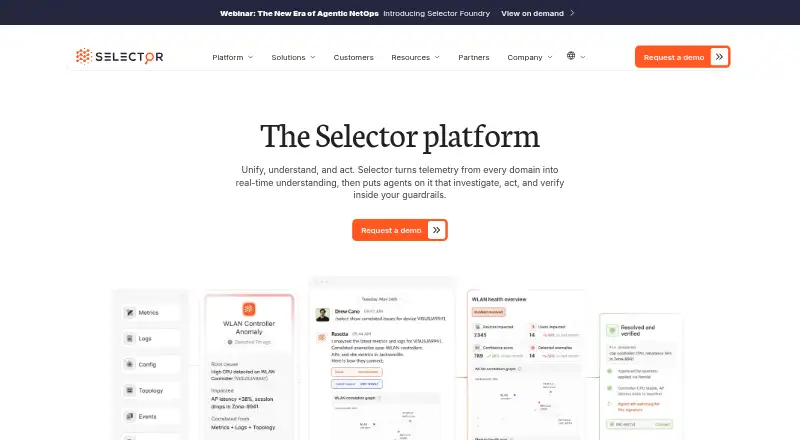
What Selector is
Selector brings telemetry from network, cloud, infrastructure, and application systems together to help teams investigate incidents and decide how to respond. It connects to 300+ telemetry sources and collects metrics, logs, configurations, and flows without agents. The platform correlates events, metrics, and logs, applies baselines, rules, and machine learning to find anomalies, and builds a live knowledge graph. It links incidents across infrastructure, applications, and services and provides explainable root-cause insights. Rosetta accepts questions in plain language and answers using operational context. Foundry coordinates specialist agents to investigate, act, and verify within defined guardrails; agents leave an auditable trail and actions require approval before execution. Teams can govern agents in a Git repository under existing role-based access controls. Selector supports MCP and A2A connections and the customer’s choice of LLM. Deployment options are on-premises, customer cloud, or SaaS. Pricing is on request; the contact page invites visitors to try it for free but does not specify duration or self-serve access.
Good
- Connects to 300+ telemetry sources without agents.
- Correlates data and builds a live knowledge graph.
- Provides explainable root-cause insights across systems.
- Agent actions wait for approval before execution.
- Offers on-premises, customer cloud, and SaaS deployment.
Watch out
- Pricing is available on request.
- Free access has no stated duration or self-serve plan.
- Agent actions require approval before execution.
Who it suits
Selector is intended for network operations teams, network architects, executives, application developers, and site reliability engineers. It may suit organizations seeking shared incident context and governed agent workflows.
Verdict
Selector combines telemetry correlation, incident investigation, and governed agent operations. Teams should clarify pricing and free-access terms with the provider.
The facts
Each one read from Selector's own pages, with the date it was checked.
What it does
- Agent governance
- Foundry supports building and governing agents in a Git repository under existing role-based access controls, and actions wait for approval before execution.checked 2 Oct 2026
- Agentic operations
- Foundry orchestrates specialist agents that investigate, act, and verify within user-defined guardrails.checked 2 Oct 2026
- Agent orchestration
- Foundry turns correlated context into agents, while Rosetta interprets intent and orchestrates specialist agents over MCP and A2A.checked 3 Oct 2026
- Correlation
- Selector correlates events, metrics, and logs, applies baselines, rules, and machine learning to detect anomalies, and builds a live knowledge graph.checked 3 Oct 2026
- Correlation and anomaly detection
- Selector correlates events, metrics, and logs, applies baselines, rules, and machine learning to detect anomalies, and builds a live knowledge graph.checked 2 Oct 2026
- Deployment
- Selector describes deployment as Kubernetes-native and available on-premises, in a customer cloud, or as SaaS.checked 3 Oct 2026
- Extensibility
- The platform supports connecting tools over MCP and A2A and running on the customer’s choice of LLM.checked 2 Oct 2026
- Governance
- Foundry agents operate within user-set guardrails, leave an auditable trail, and do not execute actions until approved.checked 3 Oct 2026
- Integrations
- Selector’s integrations page describes 500+ integrations and lists categories including alerting, APM, ITSM, logs, metrics, public cloud, and network devices.checked 3 Oct 2026
- Intended users
- Selector names network operations, network architects, executive leadership, application developers, and site reliability engineers as audiences.checked 3 Oct 2026
- Natural language
- Rosetta lets teams ask questions in plain language and get explainable answers using operational context.checked 2 Oct 2026
- Purpose
- Selector unifies telemetry across domains and uses agents to investigate, act, and verify within configured guardrails.checked 3 Oct 2026
- Root cause analysis
- Selector links incidents across infrastructure, apps, and services and delivers root cause analysis to Slack, Teams, or ITSM tools.checked 3 Oct 2026
- Support
- The company lists [email protected] and links to its support portal.checked 3 Oct 2026
- Target users
- The platform lists network operations teams, network architects, executives, application developers, and site reliability engineers among its intended users.checked 2 Oct 2026
- Telemetry ingestion
- The platform connects to 300+ telemetry sources across network, cloud, and edge, collecting metrics, logs, configs, and flows without agents.checked 3 Oct 2026
The company
- Company
- Selector Software, Inc. lists its headquarters in Santa Clara, California.checked 3 Oct 2026
- Founded
- Selector says it was founded in 2019.checked 3 Oct 2026
- Headquarters
- Selector Software, Inc. lists its headquarters in Santa Clara, California.checked 2 Oct 2026
Money
- Free access
- Selector’s contact page invites visitors to try Selector for free and directs them to contact sales; it does not state trial duration or a self-serve free plan.checked 2 Oct 2026
The full review of Selector
Overview
Selector is an operations intelligence platform for teams managing networks, infrastructure, cloud, and applications. It is best suited to organizations that need to connect incidents across those domains and govern automated response. Its breadth is compelling, but buyers should weigh it against custom pricing and an approval-led approach to action.
Selector ingests metrics, logs, configurations, and flows from more than 300 telemetry sources without agents. Its integrations span more than 500 connections across network, infrastructure, containers, and apps, including IP Fabric, LogicMonitor, Moogsoft, and SQL databases. The separate source and integration counts suggest broad coverage for mixed environments, though teams should confirm their particular systems are supported.
The platform correlates events, metrics, and logs using baselines, rules, and machine learning, then builds a live knowledge graph. It links incidents across infrastructure, services, and applications to provide explainable root-cause insights. Rosetta accepts natural-language questions and answers them using operational context; Foundry coordinates specialist agents to investigate, act, and verify. This is a coherent path from detection to response, rather than a collection of disconnected alerting features.
Key features
Context and investigation
Cross-domain correlation and the knowledge graph are Selector’s central advantage: teams can follow relationships between signals and incidents instead of investigating each layer in isolation. Explainable root-cause insights and Rosetta’s plain-language interface can make that context more accessible to operations staff and developers. The value depends on the relevance of the telemetry and operational context being connected.
Governed agent operations
Foundry turns correlated context into specialist agents that can investigate, act, and verify within user-defined guardrails. Teams can build and govern agents in a Git repository under existing role-based access controls; actions wait for approval and leave an auditable trail. That governance is a meaningful safeguard for organizations wary of letting automation make unreviewed changes, though the approval gate means it is not a hands-off remediation system.
Selector supports MCP and A2A connections and lets customers choose their LLM. That flexibility can fit existing tool and model choices. It also puts the burden on buyers to assess how their preferred stack fits the deployment and governance model.
Pricing
Selector is paid, with custom pricing. The company invites visitors to try it for free and directs them to contact sales, but does not state a trial length or describe a self-serve free plan. Buyers should clarify the scope and terms of free access, as well as the commercial offer, before comparing total costs.
There are no published plan tiers or seat and usage limits to distinguish a lower-cost entry point from a larger deployment. This makes Selector difficult to budget from the outset; it is a better fit for teams prepared to discuss requirements with sales than for buyers seeking transparent, self-serve pricing.
Platforms
Selector is available through web and API access, on Linux, and as a self-hosted offering. Its Kubernetes-native deployment can run on-premises, in a customer cloud, or as SaaS, giving organizations options for placing the platform in their environment. That flexibility is useful for hybrid operations, but teams should confirm which deployment best suits their infrastructure and operating requirements.
Who it's for
Selector names network operations teams, network architects, executives, application developers, and site reliability engineers as intended users. It is strongest for organizations whose incidents cross network, infrastructure, and application boundaries, and that want a shared operational context plus controlled agent-led response. Teams focused on a narrow monitoring scope, or those that need a clearly priced self-serve product, may find it less suitable.
Pros and cons
- Broad telemetry reach: Agentless collection across 300+ sources and 500+ integrations can help unify signals from varied technology domains.
- Connected incident analysis: Correlation, a live knowledge graph, and explainable root-cause insights support investigation across infrastructure, services, and applications.
- Governed automation: Git-based agent governance, role-based controls, audit trails, guardrails, and approval before execution give teams oversight of agent actions.
- Flexible deployment: On-premises, customer-cloud, and SaaS options can accommodate differing environment preferences.
- Commercial uncertainty: Custom pricing and unclear free-access terms make budgeting and initial evaluation harder.
- Approval remains part of response: Requiring approval before actions execute protects control, but is less suited to teams seeking fully unattended remediation.
Alternatives
AIOps Platforms is a useful category starting point for readers comparing products across the field.
Choose Digitate ignio AIOps if per-event and per-assist prices for its IT Event Management and Document Assist plans are more useful than a custom quote. BMC Helix AIOps is another paid, sales-priced option, with API, Linux, web, and Windows platform support.
ScienceLogic AI Platform may suit buyers who want a free trial and a published starting point of $5 a month for Skylar One Standard, billed from $5 USD per device/month, alongside hybrid cloud observability and 400+ integrations. OpenText AI Operations Management (formerly Operations Bridge) offers private-cloud Express and private- or public-cloud Premium plans, with event management across both.
Vitria VIA AIOps is another paid option for API, self-hosted, and web deployments. NetAI is worth considering for a freemium route: its Core Free plan covers 1–10 devices, includes the full Core platform, and can be upgraded; the supplied plan information also gives Core Enterprise a price of $5.99 a month.
IncidentFox is an open-source alternative with community support through GitHub and Slack. Keep may fit teams seeking a freemium offering with a published Growth plan at $199 a month, including 200 deduplicated alerts per month, unlimited ingested alerts, 100 workflows, 20 integrations, 10 users, and two weeks of data retention.
Verdict
Selector is a strong candidate for organizations that need full-stack telemetry correlation and want to move from incident context to governed agent operations. Its cross-domain analysis, flexible deployment, and approval controls are persuasive reasons to choose it. Look elsewhere if transparent pricing, defined free-plan limits, or autonomous action without approval is essential; Selector’s commercial terms require a sales conversation, and its agents do not execute actions until approved.
Alternatives to Selector
- 1

NetBrain
WebAPILinuxSelf-hosted6.8 - 2
ONAP
Free planWebAPILinuxSelf-hosted6.8Free plan - 3

BackBox
WebAPILinuxSelf-hosted6.4 - 4

StackStorm
Free planWebAPILinuxSelf-hosted6.4Free plan - 5

Forward Enterprise
WebAPISelf-hosted5.9 - 6

Itential Automation Platform
WebAPISelf-hosted5.7