SEC (Simple Event Correlator)
SEC (Simple Event Correlator) reads event streams and applies rules to identify and act on groups of events within defined time windows.
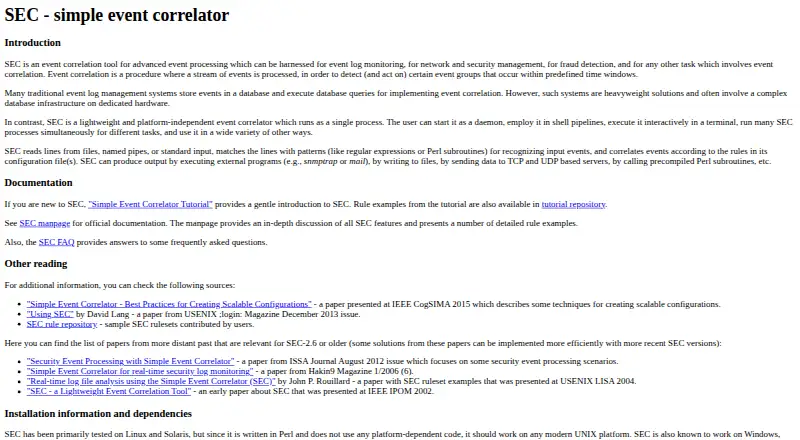
What SEC (Simple Event Correlator) is
SEC (Simple Event Correlator) reads event streams and applies rules to identify and act on groups of events within defined time windows. It can read lines from files, named pipes, or standard input, matching patterns such as regular expressions or Perl subroutines. Rule files configure correlation; documented types include threshold, event group, suppression, calendar, and pair rules. SEC can execute external programs, write files, send data to TCP or UDP servers, and call precompiled Perl subroutines. Examples in the documentation include invoking snmptrap or mail and emailing an alert for an SSH failed-login rule. The lightweight program runs as one process, either as a daemon, in a shell pipeline, or interactively in a terminal. Listed uses include event log monitoring, network and security management, and fraud detection. SEC is written in Perl and recommends Perl 5.8 or newer; it otherwise depends on standard Perl modules, with Sys::Syslog and JSON::PP optional. It is free under GPL-2.0. It has primarily been tested on Linux and Solaris, and some Unix-native functionality is disabled on Windows.
Good
- Reads event lines from files, pipes, or standard input.
- Supports several documented correlation rule types.
- Can send data to TCP or UDP servers.
- Runs as a daemon, pipeline process, or terminal process.
- Free under GPL-2.0.
Watch out
- Windows disables some Unix-native functionality.
- Recommends Perl 5.8 or newer.
- Usage questions are directed to the SEC users mailing list.
Who it suits
SEC suits users who need rule-based correlation across event streams for monitoring, security management, or fraud detection. It may fit deployments that can configure rule files and run Perl software.
Verdict
SEC provides configurable event correlation and multiple ways to act on matches. Consider its Perl requirement and Windows limitations when deciding whether it fits your environment.
Plans and prices
From SEC (Simple Event Correlator)'s own pricing page, checked 7 Oct 2026.
| Plan | Price | What it gives you |
|---|---|---|
| SEC (GNU GPL-2.0) | Free | Open-source software distributed under the GNU General Public License |
The facts
Each one read from SEC (Simple Event Correlator)'s own pages, with the date it was checked.
What it does
- Deployment limit
- On Windows, some functionality native to Unix is disabled.checked 7 Oct 2026
- How it runs
- SEC is a lightweight, platform-independent correlator that runs as a single process and can run as a daemon, in shell pipelines, or interactively in a terminal.checked 7 Oct 2026
- Inputs and matching
- SEC reads lines from files, named pipes, or standard input and matches events using patterns such as regular expressions or Perl subroutines.checked 7 Oct 2026
- Integrations
- The documentation gives examples of invoking snmptrap and mail and shows an SSH failed-login rule that emails an alert.checked 7 Oct 2026
- License
- The project repository states that SEC is distributed under the GNU General Public License and identifies the license as GPL-2.0.checked 7 Oct 2026
- Outputs
- SEC can execute external programs, write to files, send data to TCP or UDP servers, and call precompiled Perl subroutines.checked 7 Oct 2026
- Purpose
- SEC correlates event streams to detect and act on groups of events that occur within defined time windows.checked 7 Oct 2026
- Release
- The site lists SEC 2.9.4 as a download dated February 12, 2026.checked 7 Oct 2026
- Requirements
- SEC is written in Perl, recommends Perl 5.8 or newer, and otherwise depends only on modules included in standard Perl installations, with Sys::Syslog and JSON::PP optional.checked 7 Oct 2026
- Rules
- Event correlation is configured with rule files, and the man page documents rule types including threshold, event group, suppression, calendar, and pair rules.checked 7 Oct 2026
- Security capabilities
- The man page documents an option to drop root privileges by switching to a specified user and group when SEC starts with effective user ID 0.checked 7 Oct 2026
- Support
- The maker directs usage questions to the SEC users mailing list and asks users not to contact the author with usage questions.checked 7 Oct 2026
- Use cases
- The site identifies event log monitoring, network and security management, and fraud detection as use cases.checked 7 Oct 2026
The company
- Founded
- 2001checked 28 Sep 2026
Where it runs
- Platform support
- SEC has primarily been tested on Linux and Solaris, is known to work on Windows with some Unix-native functionality disabled, and is expected to work on modern Unix platforms.checked 7 Oct 2026
Alternatives to SEC (Simple Event Correlator)
- 1
Wazuh
Free planOpen sourceWebAPILinuxmacOS8.4From $571 a month - 2

PagerDuty
Free planAndroidiOSWebAPI8.3From $21 a month - 3

xMatters
Free planAndroidiOSWebAPI8.3From $15 a month - 4

AlertOps
Free planAndroidiOSWebAPI8.1From $8 a month - 5

MISP
Free planOpen sourceWebAPILinuxSelf-hosted7.9From €7.31 a year - 6

UTMStack
Open sourceWebAPILinuxmacOS7.9From $238.80 a month