
Seam
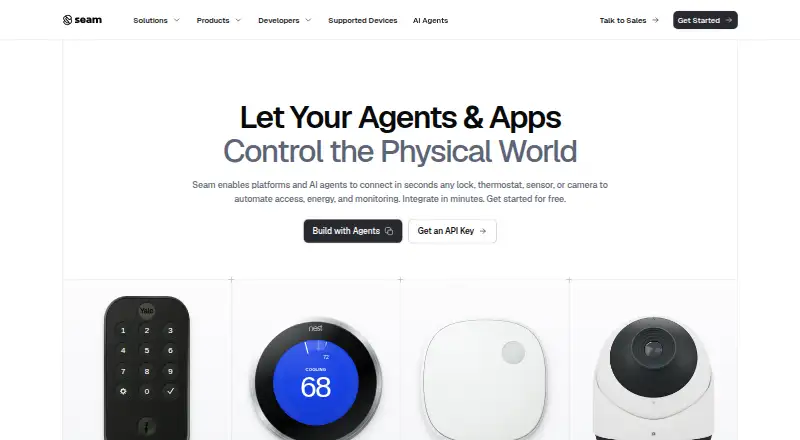
Seam provides an API for developers and businesses to connect applications to Internet of Things devices and automate access, energy and monitoring.
What Seam is
Seam provides an API for developers and businesses to connect applications to Internet of Things devices and automate access, energy and monitoring. Its stated use cases include vacation rentals, hospitality, multifamily housing, gyms, sports and coworking. The Access Grants API supports PIN codes, mobile keys, key cards, Instant Keys, schedules and device events. Webhooks provide access and device updates in a common format across connected brands. Teams can check device status, group devices by location and troubleshoot remotely. Seam Bridge connects on-premises access systems and offline devices, while its iOS and Android SDKs support app-based mobile keys for Bluetooth and NFC doors. Seam Components can be added to web projects using React or plain HTML and CSS, with interfaces adapting across desktop and mobile. Seam says it connects to thousands of devices and brands, but listing a brand in its integrations catalog does not guarantee that its integration is supported. The company does not state its headquarters or founding year.
Good
- API supports PINs, mobile keys and access schedules.
- Webhooks standardize access and device updates.
- Seam Bridge connects offline and on-premises systems.
- Mobile keys support Bluetooth and NFC doors.
- Free option includes full API access and webhooks.
Watch out
- Catalog listings do not guarantee supported integrations.
- Enterprise plan has custom pricing.
- Premium support costs $20,000/yr.
Who it suits
Seam is aimed at developers and businesses integrating device access and monitoring into their applications. Its listed use cases include hospitality, rentals, multifamily properties, gyms and coworking spaces.
Verdict
Seam offers device connectivity and access controls through APIs, webhooks and mobile SDKs. Confirm that a required device integration is supported, since catalog inclusion alone is not a guarantee.
Plans and prices
From Seam's own pricing page, checked 14 Oct 2026.
| Plan | Price | What it gives you |
|---|---|---|
| Free Trial | Free | Full API access · Webhooks · All supported brands · 14 day free trial |
| Unit Access | $5 a month | 5 actions/device/day · Priority email support · Full API access · Webhooks · All supported brands · per device/month |
| High Traffic | $50 a month | Unlimited actions · Priority email support · Full API access · Webhooks · All supported brands · per device/month |
| Enterprise | Priced on request | Dedicated Slack channel · Custom contracts · Volume pricing from 500+ devices · Dedicated support engineer · No usage limits · Custom pricing |
| Free | — | Full API access · Webhooks · All supported brands · Free trial |
The facts
Each one read from Seam's own pages, with the date it was checked.
What it does
- Access control
- The Access Grants API issues PIN codes, mobile keys and cards with people, spaces and time windows specified in one request.checked 14 Oct 2026
- Access features
- The Access Grants API supports PIN codes, mobile keys, key cards, Instant Keys, access schedules, and device events.checked 30 Sep 2026
- API documentation
- The documentation includes quickstarts, capability guides, API references, webhooks, test accounts, device integrations and production go-live guidance.checked 14 Oct 2026
- API extensibility
- Public repositories provide SDKs, generated TypeScript types, a CLI, React components and an MCP integration.checked 14 Oct 2026
- API key security
- Seam says it stores only a short token and hash after generating API keys and treats keys like passwords.checked 14 Oct 2026
- Camera monitoring
- Camera integrations can emit motion events and provide event clips, thumbnails and media URLs.checked 14 Oct 2026
- CLI
- The Seam CLI is installable through npm, Homebrew, Scoop, standalone binaries, AUR and Nix on supported systems.checked 14 Oct 2026
- Compliance
- Seam's Trust Center offers access to SOC 2 reports and other compliance documents by request.checked 30 Sep 2026
- Credential handling
- OAuth is preferred; when unavailable Seam may store refresh tokens or encrypted device credentials depending on manufacturer capabilities.checked 14 Oct 2026
- Founders
- Y Combinator lists Sy Bohy and Dawn Ho as founders.checked 14 Oct 2026
- Funding and backers
- Y Combinator says Seam is backed by Tiger Global, Root VC, Stripe, Plaid and Airbnb founders or executives, plus other angels and funds.checked 14 Oct 2026
- Independent review
- Trauth Review rated Seam 4.4 out of 5 and described it as a smart-lock developer API rather than a host-facing product.checked 14 Oct 2026
- Integration limitation
- Seam's integrations catalog states that listing a brand does not guarantee that its integration is supported.checked 30 Sep 2026
- Integrations
- The integration catalog lists brands including Yale, August, Schlage, Brivo, Salto, Dormakaba, Nest, ecobee, Ring, Verkada and many others, while warning that catalog inclusion does not guarantee support.checked 14 Oct 2026
- Limit: Trustpilot complaint
- The sole Trustpilot reviewer alleged that prepaid credit expired without clear notice and that restoring access required paying substantially more.checked 14 Oct 2026
- Mobile keys
- Seam says mobile keys unlock Bluetooth and NFC doors in an app using its iOS and Android SDKs.checked 30 Sep 2026
- Mobile SDKs
- Documentation describes iOS and Android SDKs for mobile keys using Bluetooth and NFC.checked 14 Oct 2026
- Noise monitoring
- Noise sensors support configurable decibel thresholds, quiet hours and webhook alerts without recording conversations.checked 14 Oct 2026
The company
- Company
- The about page describes Seam as building infrastructure for developers and businesses to connect applications with IoT devices; it does not state its headquarters or founding year.checked 30 Sep 2026
- Company founding
- Y Combinator lists Seam as founded in 2020, batch S20, with San Francisco as its location.checked 14 Oct 2026
- Company legal name
- The company identifies itself as Seam Labs, Inc.checked 14 Oct 2026
- Company size
- Y Combinator lists a team size of 25.checked 14 Oct 2026
Where it runs
- Device management
- The dashboard groups connected devices by location, shows status and supports remote troubleshooting.checked 14 Oct 2026
Money
- Limit: cost at scale
- Trauth Review warned that per-device pricing rising from $5 to $50 monthly could become expensive for large portfolios.checked 14 Oct 2026
The full review of Seam
Seam is an API platform for connecting applications to IoT devices and automating access, energy, and monitoring. It suits developers and operators building services for properties, hospitality, gyms, or coworking spaces. Its broad access toolkit is useful, but device compatibility needs checking before you commit.
Overview
Seam provides infrastructure for software that needs to work with connected devices, rather than a standalone access-control app. Its use cases include vacation rentals, hospitality, multifamily buildings, gyms and sports facilities, and coworking. The platform says it connects to thousands of devices and brands, but a brand appearing in its integrations catalog does not guarantee a supported integration. Confirm the specific device and integration your project requires.
Key features
Credentials and access rules
The Access Grants API supports PIN codes, mobile keys, key cards, Instant Keys, access schedules, and device events. Membership validation, scheduled access rules, mobile credentials, and multi-location access make the toolkit relevant to businesses managing permissions across sites, not just a single door. Seam’s iOS and Android SDKs let developers build mobile keys for Bluetooth and NFC doors inside an app; that approach is a fit for teams creating their own product, rather than buyers seeking a ready-made access app.
Events and device operations
Webhooks deliver access and device updates in a common format across connected brands, which can reduce the burden of handling brand-specific event formats. Teams can check device status, group devices by location, troubleshoot remotely, and scale operations. Those tools matter most to operators overseeing multiple devices and locations, but they depend on the underlying integration being supported.
Offline systems and web interfaces
Seam Bridge connects on-premises access control systems and offline devices to Seam. For web projects, Seam Components work with frontend frameworks such as React or with plain HTML and CSS, and adapt to desktop and mobile interfaces. Together, these options give development teams ways to incorporate access flows across environments, though they still require implementation work.
Security and support
Seam says it encrypts service data in transit, limits system access using least privilege, and requires personnel to use strong passwords and multi-factor authentication. Its Trust Center provides access to SOC 2 reports and other compliance documents by request. All customers receive email help and help-center access; paid support plans add faster response times and dedicated support.
Pricing
Seam uses a freemium model, with a free plan, a free trial, and paid plans from $5/mo. The Free plan includes full API access, webhooks, and all supported brands, making it a way to start without a paid subscription. Its published terms do not give a free-plan usage cap, so teams should confirm how usage is handled before relying on it at scale.
Unit Access costs $5 a month and allows 5 actions/device/day. It includes priority email support, full API access, webhooks, and all supported brands. This is the lowest-cost paid option for projects with modest device activity, but the daily action limit may not suit high-traffic sites.
High Traffic costs $50 a month and includes unlimited actions, priority email support, full API access, and all supported brands. It is the clearer fit where activity exceeds Unit Access’s daily allowance. Both paid plans list the same core access and webhook features; the main stated difference is the action allowance.
Enterprise has custom pricing and is aimed at larger deployments: volume pricing starts at 500+ devices, with no usage limits, custom contracts, a dedicated Slack channel, and a dedicated support engineer. Support can also be purchased separately: Growth is $0/yr and included, Premium is $20,000/yr, and Enterprise is $50,000/yr. The support options add cost at the upper tiers, so larger teams should weigh dedicated response against the included email and help-center access.
Platforms
Seam supports Android, iOS, web, and API. The mobile SDKs are for building Bluetooth and NFC mobile keys, while Seam Components support web interfaces across desktop and mobile layouts. The API is the central option for teams connecting their own applications and device workflows.
Who it's for
Seam is best suited to developers and businesses building connected-access services for hospitality, multifamily, vacation rentals, gyms, sports facilities, or coworking. It is especially relevant when a product needs multiple credential types, schedules, event updates, or centralized device operations. It is a weaker fit for organizations that want a finished access-control product without development work, or that cannot verify support for their chosen devices.
Pros and cons
- Pros: The API covers several credential types, scheduled access, and device events, giving developers flexibility to build access workflows.
- Pros: Common-format webhooks and device-management tools help operators handle connected equipment across locations.
- Pros: The Free plan includes full API access and webhooks, while Unit Access starts at $5 a month.
- Cons: Catalog inclusion does not guarantee a supported integration, so compatibility must be confirmed before designing around a device.
- Cons: Unit Access is capped at 5 actions/device/day, making it unsuitable for heavier activity without upgrading.
- Cons: Seam is an integration platform, not a ready-made access app, so teams need development capacity to use its APIs and SDKs.
Alternatives
For gym-focused access software, compare the Gym Access Control Software category. re:membr Access Control is a paid option for Android, iOS, and web when you want to compare another access-control product. Sentry Interactive is also paid and supports Android, API, iOS, and web, making it another option to assess for a connected-access setup.
Beckon Access has a free plan and an Android, API, iOS, and web footprint; its Club management Add-on costs €99 a month and includes memberships, contracts, user accounting, SEPA direct debit, and online payments, which may suit teams needing those club-management functions. Brivo Security Suite is a paid Android, iOS, and web option with Standard and Professional subscriptions; choose it for comparison if a reseller-priced security suite is of interest. GymAxess is a paid Android, iOS, and web alternative, with a Door License at €10 a month or a Location License at €50 a month.
KisiFit is a paid Android, API, iOS, and web alternative with a Base plan starting at $99 a month per location, for teams comparing a location-priced option. Avigilon Alta Access is a paid Android, iOS, and web option with API and webhooks among its Basic features. Echino.Access supports web and offers a Premium plan by demo request, for buyers who prefer to pursue a discussed, tailored offer.
Verdict
Choose Seam if you are building software that needs a flexible API layer for device access, credentials, events, and multi-location operations. Its breadth and low-cost entry point are compelling for development teams, but the need to verify each integration—and to build the end-user experience yourself—are good reasons to look elsewhere if you want turnkey access software.
Getting started
- Visit https://www.seam.co/.
- Choose the free plan or a paid plan starting at $5/mo.
- Use the API and webhooks to connect applications with supported devices.
- For mobile keys, use the iOS or Android SDK; for web projects, integrate Seam Components.
Limits worth knowing
The free plan has full API access, webhooks, all supported brands, and a free trial. The $5/mo Unit Access plan allows 5 actions per device per day; the $50/mo High Traffic plan offers unlimited actions. Enterprise has no usage limits, with custom pricing and a 500+ device volume-pricing threshold.
Questions
Is there a free plan?
Yes. Seam lists a free plan with full API access, webhooks, all supported brands, and a free trial.
How much do paid plans cost?
Unit Access is $5 a month and High Traffic is $50 a month. Enterprise uses custom pricing.
What platforms does Seam support?
The listed platforms are Android, iOS, web, and API.
What kinds of access credentials does it support?
The Access Grants API supports PIN codes, mobile keys, key cards, and Instant Keys, along with schedules and device events.
Does it connect to offline devices?
Yes. Seam Bridge connects on-premises access control systems and offline devices with Seam.
What support is included?
All customers receive email help and help-center access. Paid support plans offer faster response times and dedicated support; Growth support is included at $0/yr, Premium is $20,000/yr, and Enterprise is $50,000/yr.
Alternatives to Seam
- 1
FitManager Control
Free planAndroidiOSWebAPI8.0From $390 a year - 2
Swiftlane
Free planAndroidiOSWebAPI8.0From $30 a month - 3

PATO
AndroidiOSWeb7.7 - 4
Beckon Access
AndroidiOSWebAPI7.5From €0.40 a month - 5

KisiFit
AndroidiOSWebAPI6.8From $99 a month - 6
GymAxess
AndroidiOSWeb6.6From €10 a month