Sceptre
Sceptre is a free command-line tool and Python module for creating, updating, deleting, and inspecting AWS CloudFormation stacks.
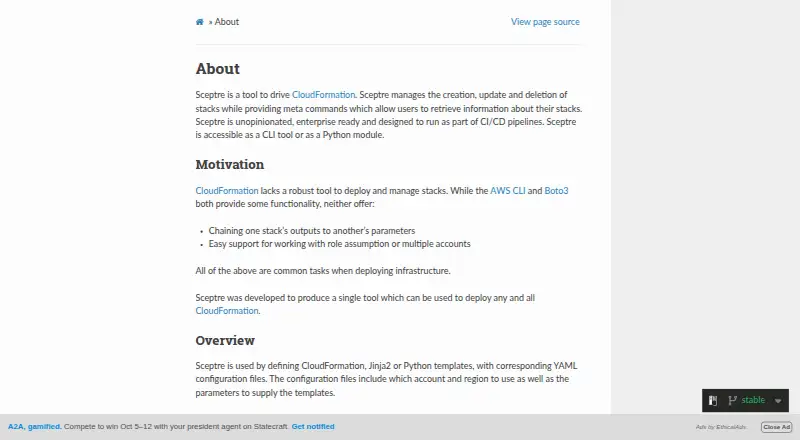
What Sceptre is
Sceptre is a free command-line tool and Python module for creating, updating, deleting, and inspecting AWS CloudFormation stacks. It is designed for CI/CD pipelines and can group related stacks into Stack Groups for multi-stack operations. Templates may use JSON, YAML, Jinja2, or Python DSLs such as Troposphere, with YAML configuration files. Sources can be local files, S3, or web URLs, and custom handlers can add other sources. Sceptre passes one stack’s outputs into another’s parameters and infers dependency order. It supports deployments across AWS accounts and regions, concurrency limits for launch, create, and update operations, and hooks before or after stack actions. Custom resolvers and hooks are Python classes. The tool uses the executing user’s AWS permissions by default and supports AWS profiles and IAM roles. Installation is available through pip or Docker. Operations require suitable AWS permissions, with extra permissions for features such as change sets or template buckets.
Good
- Free AWS CloudFormation management
- CLI and Python module
- Cross-account and region support
- Stack dependency handling
- Custom hooks and resolvers
Watch out
- AWS permissions are required
- Pip installation assumes Python
- Supports AWS only
- Extra permissions may be needed
Who it suits
It suits developers and platform teams managing AWS CloudFormation through CI/CD, command-line workflows, or Python automation.
Verdict
Sceptre adds configuration, dependency handling, grouping, and extensibility around CloudFormation operations. Its permission model and AWS-only scope are important considerations for deployment teams.
The facts
Each one read from Sceptre's own pages, with the date it was checked.
What it does
- AWS credentials
- The getting-started guide says Sceptre uses the same configuration files as the AWS CLI to access an AWS account.checked 9 Oct 2026
- CLI controls
- The CLI supports stack concurrency limits for launch, create, and update operations.checked 9 Oct 2026
- Dependencies
- Sceptre can pass one stack’s outputs to another stack’s parameters and infer the resulting dependency order.checked 9 Oct 2026
- Deployment workflow
- It is designed to run in CI/CD pipelines and is available as a CLI tool or Python module.checked 9 Oct 2026
- Extensibility
- Users can define custom resolvers and hooks as Python classes packaged for Sceptre to load.checked 9 Oct 2026
- Hooks
- Hooks can run actions before or after stack operations, and users can add custom hooks.checked 9 Oct 2026
- IAM permissions
- Sceptre uses the executing user’s permissions by default and supports configuration for AWS profiles and IAM roles.checked 9 Oct 2026
- Installation
- The maker’s installation guide supports installation with pip and use of a Docker image; pip installation assumes Python is installed.checked 9 Oct 2026
- Intended use
- The documentation describes Sceptre as designed to run as part of CI/CD pipelines.checked 9 Oct 2026
- Limit
- Sceptre requires AWS permissions for the CloudFormation operations being performed, with additional permissions needed for features such as change sets or template buckets.checked 9 Oct 2026
- Multi-account AWS
- The project README lists built-in support for managing stacks across multiple AWS accounts and regions.checked 9 Oct 2026
- Parallel builds
- The project describes its builds as fast and highly parallelized.checked 9 Oct 2026
- Purpose
- Sceptre manages the creation, update, and deletion of AWS CloudFormation stacks and provides commands to retrieve stack information.checked 9 Oct 2026
- Security configuration
- The IAM guidance describes using scoped deployment roles and permission boundaries instead of granting CI/CD systems blanket administrator permissions.checked 9 Oct 2026
- Stack dependencies
- Resolvers can pass one stack’s outputs to another stack’s inputs at runtime.checked 9 Oct 2026
- Stack groups
- Related stacks can be bundled into Stack Groups, with commands that operate on multiple stacks.checked 9 Oct 2026
- Support
- The documentation directs bugs and feature requests to the project’s GitHub Issues page and community discussion to the #sceptre channel on og-aws Slack.checked 9 Oct 2026
- Template formats
- It supports templates written in JSON, YAML, Jinja2, and Python DSLs such as Troposphere.checked 9 Oct 2026
- Templates
- It supports CloudFormation, Jinja2 and Python templates configured with YAML files.checked 9 Oct 2026
- Templates from remote sources
- Template handlers can load templates from local files, S3, or a web URL, and users can add custom handlers.checked 9 Oct 2026
- Usage
- Sceptre is available as a command-line tool or a Python module.checked 9 Oct 2026
Alternatives to Sceptre
- 1

Cloudify
Free planOpen sourceWebAPILinuxmacOS8.4From $395 a month - 2

Terraform
Free planWebAPILinuxmacOS8.0Free plan - 3

Terramate
Free planOpen sourceWebAPIExtensionLinux8.0From $449 a month - 4

AWS CloudFormation
Free planiOSWebAPILinux7.7Free plan - 5

Pulumi
Free planWebAPILinuxmacOS7.4From $40 a month - 6

Oracle Cloud Infrastructure Container Registry
Free planWebAPILinux7.0Free plan