
Rex
Rex is a free, open-source automation framework for administering local systems and remote machines through SSH.
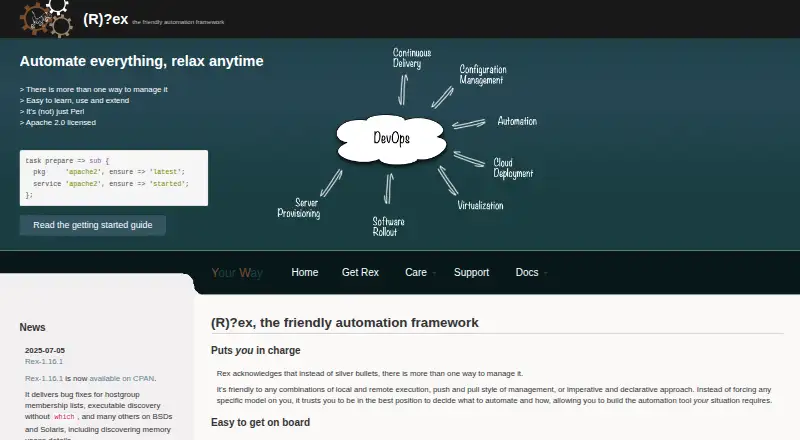
What Rex is
Rex is a free, open-source automation framework for administering local systems and remote machines through SSH. It supports combinations of local and remote execution, push and pull management, and imperative and declarative methods, making it suitable for incremental automation. A project’s Rexfile holds its inventory, environments, authentication details, and tasks. Tasks can install packages, upload configuration files, start services, or run an action when a file changes. Rex uses a DSL compatible with Perl syntax and can be extended with Perl modules or custom code. It is self-hosted and agentless, with drift detection and patch management. The control host requires Perl and its dependencies; managed hosts need a Perl 5 interpreter and valid SSH account. Supported systems include Linux, Windows, RHEL/CentOS, Fedora, OpenWRT, BSDs, and Solaris. Guides cover OpenWrt devices and Amazon EC2. Rex is released under Apache 2.0 and is available through CPAN, operating-system package managers, or source.
Good
- Combines local and remote execution methods
- Tasks manage packages, files, and services
- Agentless design with drift detection
- Apache 2.0 licensed and free
Watch out
- Managed hosts require Perl 5 and SSH accounts
- Control host requires Perl and dependencies
Who it suits
Rex suits administrators who want to automate local and SSH-managed systems with a Perl-compatible DSL. It may also fit teams seeking agentless, self-hosted management across its listed platforms.
Verdict
Rex offers flexible, file-based automation for systems managed locally or over SSH. Check the Perl and SSH requirements on both sides before choosing it.
Plans and prices
From Rex's own pricing page, checked 8 Oct 2001.
| Plan | Price | What it gives you |
|---|---|---|
| Rex | Free | Apache 2.0 licensed open-source framework |
The facts
Each one read from Rex's own pages, with the date it was checked.
What it does
- Authentication
- Rex documents password and SSH key authentication, passphrases, external credential sources, and ssh-agent.checked 8 Oct 2001
- Commercial support
- The site lists consulting, training, and custom development from a core developer, as well as professional support from inovex.checked 8 Oct 2001
- Community support
- Community support is available through GitHub Discussions, Matrix, IRC, a mailing list, and maintainer office hours.checked 8 Oct 2001
- Configuration management
- Rex tasks can install packages, upload configuration files, start services, and run an action when a file changes.checked 8 Oct 2001
- Execution choices
- Rex supports combinations of local and remote execution, push and pull management, and imperative and declarative approaches.checked 8 Oct 2001
- Installation
- The recommended installation method is CPAN, and Rex is also distributed through operating-system package managers and from source.checked 8 Oct 2001
- Integrations
- The guides include managing OpenWrt devices and Amazon EC2 instances.checked 8 Oct 2001
- Intended use
- The site describes Rex as suitable for incremental automation because it runs locally while managing remote systems over SSH.checked 8 Oct 2001
- Language
- Rex uses a simple DSL that is syntax-compatible with Perl, and users can extend it with Perl modules or their own code.checked 8 Oct 2001
- License
- Rex and all its parts are released under the Apache 2.0 license.checked 8 Oct 2001
- Purpose
- Rex is an automation framework for managing local machines and remote machines over SSH.checked 8 Oct 2001
- Requirements
- The control host requires Perl and its dependencies; managed hosts need a Perl 5 interpreter and a valid SSH account.checked 8 Oct 2001
- Task files
- Rex projects define inventory, environments, authentication information, and tasks in a Rexfile.checked 8 Oct 2001
Where it runs
- Windows support
- The project’s release notes say Rex 1.16.0 added features for running commands on Windows.checked 8 Oct 2001
Alternatives to Rex
- 1

Puppet
Free planOpen sourceWebAPILinuxmacOS8.3From $120 a month - 2

Rudder
Free planOpen sourceWebAPILinuxSelf-hosted8.2From $3.33 a month - 3

CFEngine
Free planOpen sourceWebAPILinuxmacOS7.7Free plan - 4

Uyuni
Free planOpen sourceWebAPILinuxSelf-hosted7.4Free plan - 5

Google Cloud VM Manager
Free planWebAPILinuxWindows7.1Free plan - 6

Salt
Free planAPILinuxmacOSSelf-hosted7.0Free plan