Retire.js
Retire.js is a free, open-source scanner for finding JavaScript libraries and Node.js modules with known vulnerabilities.
What Retire.js is
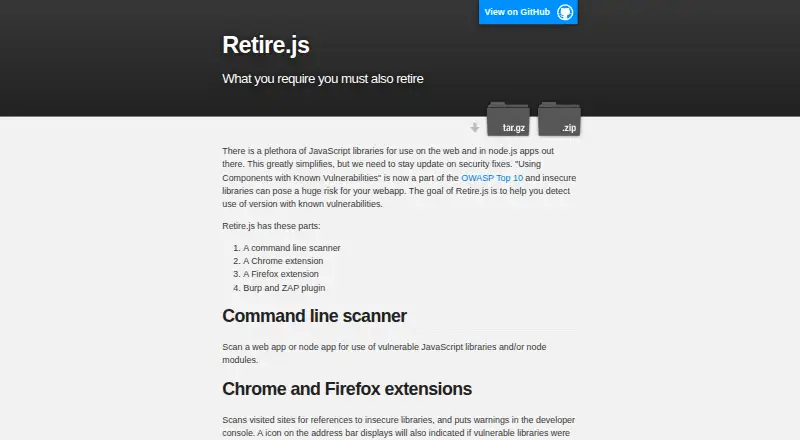
Retire.js is a free, open-source scanner for finding JavaScript libraries and Node.js modules with known vulnerabilities. Its command-line tool checks web apps and Node.js projects, including libraries kept directly in source control, and requires Node.js and npm to install and run. By default, the scanner exits with code 13 when it finds vulnerabilities; its exit behavior can be changed with `--exitwith 0`. Chrome and Firefox extensions check visited sites and report insecure libraries in the developer console and browser toolbar. The Chrome extension is not officially available in the Chrome Web Store, and the Firefox extension is deprecated. Retire.js also connects with Burp and OWASP ZAP, and the retire-site-scanner project supports headless website scans. It can produce CycloneDX SBOM output in JSON formats, including variants with a vulnerabilities section. The project is distributed under Apache License 2.0. Its Grunt plugin and Gulp task are deprecated.
Good
- Scans web apps and Node.js projects.
- Can generate CycloneDX SBOM output.
- Integrates with Burp and OWASP ZAP.
- Free and distributed under Apache License 2.0.
Watch out
- CLI requires Node.js and npm.
- Firefox extension is deprecated.
- Chrome extension is not officially in the Chrome Web Store.
- Grunt plugin and Gulp task are deprecated.
Who it suits
Retire.js suits developers and security teams checking web apps or Node.js projects for vulnerable dependencies. Its CLI, browser extensions, integrations, and SBOM output support different scanning workflows.
Verdict
Retire.js offers several ways to check JavaScript dependencies, from command-line and headless scans to integrations and SBOM generation. Check the browser extension status and CLI requirements against your workflow.
Plans and prices
From Retire.js's own pricing page, checked 12 Oct 2026.
| Plan | Price | What it gives you |
|---|---|---|
| Retire.js | Free | Open-source scanner and related tools |
The facts
Each one read from Retire.js's own pages, with the date it was checked.
Where it runs
- Browser availability
- The README says the Chrome extension is not officially available in the Chrome Web Store and the Firefox extension is deprecated.checked 11 Oct 2026
- Browser extensions
- Chrome and Firefox extensions scan visited sites and show warnings in the developer console and browser toolbar.checked 11 Oct 2026
- Browser scanning
- The browser extensions scan visited sites and report insecure libraries in the developer console and through an address-bar icon.checked 12 Oct 2026
What it does
- Chrome status
- The Chrome extension is not officially available in the Chrome Web Store.checked 12 Oct 2026
- CLI scanning
- The command-line scanner scans web apps and Node.js projects for vulnerable JavaScript libraries and Node.js modules.checked 12 Oct 2026
- Command-line scanner
- The command-line scanner checks web apps and Node.js apps for vulnerable JavaScript libraries and Node.js modules.checked 11 Oct 2026
- Deprecated integrations
- The Grunt plugin and Gulp task are marked deprecated.checked 12 Oct 2026
- Detection limit
- The README says the Firefox extension is deprecated and asks for a maintainer to resume its development.checked 11 Oct 2026
- Firefox status
- The Firefox extension is marked deprecated, and the maintainers invite someone to maintain it.checked 12 Oct 2026
- Funding
- The project says donations fund maintenance of the tool and vulnerability repository.checked 12 Oct 2026
- Headless scanning
- The retire-site-scanner project can scan websites in headless mode.checked 12 Oct 2026
- Integrations
- Retire.js has a Burp plugin and an OWASP ZAP add-on; ZAP officially supports its add-on and includes it in weekly releases.checked 12 Oct 2026
- License
- The project is published under the Apache-2.0 license.checked 12 Oct 2026
- Maintainer
- The project site identifies Erlend Oftedal as a maintainer.checked 11 Oct 2026
- Other deprecated integrations
- The README marks the Grunt plugin and Gulp task as deprecated.checked 11 Oct 2026
- Purpose
- Retire.js detects JavaScript library versions with known vulnerabilities, including libraries that are not listed in package manifests.checked 12 Oct 2026
- Runtime requirement
- The command-line scanner requires Node.js and npm to install and run.checked 12 Oct 2026
- SBOM
- Retire.js can generate CycloneDX SBOMs in XML and JSON, including newer JSON formats with vulnerability sections.checked 12 Oct 2026
- Support and contributions
- The project README invites users to contribute to the scanner and vulnerability repository and says donations fund their maintenance.checked 11 Oct 2026
- Vulnerability exit behavior
- By default, the command-line scanner exits with code 13 when it finds vulnerabilities, and its documentation says this can be overridden with --exitwith 0.checked 12 Oct 2026
The full review of Retire.js
Retire.js is a free, open-source vulnerability scanner for JavaScript libraries and Node.js modules. It is best suited to developers and security teams that want a self-hosted command-line check or an input to existing security tooling. Its CLI, headless scanner and CycloneDX export are useful strengths, but its browser and older build integrations need caution.
Overview
Retire.js identifies vulnerable versions of JavaScript libraries, including files checked directly into source control. The scope is deliberately focused: it addresses JavaScript and Node.js dependency risk rather than trying to be a complete software-composition-analysis suite. That makes it a practical addition to a JavaScript-oriented pipeline, while teams seeking broad ecosystem governance should consider a larger platform.
The project is distributed under Apache License 2.0, providing a no-charge, royalty-free license subject to its terms. It is self-hosted, and the command-line scanner requires Node.js and npm for installation and operation. The project welcomes contributions to both the scanner and vulnerability repository, while donations support maintenance.
Key features
Command-line checks
The CLI scans web applications and Node.js projects for vulnerable libraries and Node.js modules. Its default exit code is 13 when vulnerabilities are found, which is a useful failure signal for automated jobs. Documentation says --exitwith 0 can override that behavior, so teams that want reporting without stopping a script can adapt it.
Browser and headless scanning
Chrome and Firefox extensions inspect visited sites and report insecure libraries in the developer console and browser toolbar. Their current status limits how dependable this route is: the Chrome extension is not officially offered through the Chrome Web Store, and the Firefox extension is deprecated, with maintainers seeking someone to resume development. For repeatable website checks, the retire-site-scanner project provides headless scanning and is a more suitable fit for automation.
Security-tool integrations
A Burp extension and an OWASP ZAP add-on let security testing workflows incorporate Retire.js findings. The ZAP team supports its add-on and includes it in weekly releases, making ZAP the stronger integration choice. By contrast, the Grunt plugin and Gulp task are marked deprecated, so new build pipelines should not rely on them.
SBOM output
Retire.js can generate CycloneDX software bills of materials, including JSON output and variants that include a vulnerabilities section. This is valuable when a team needs a machine-readable inventory for downstream review or compliance processes, without adopting a separate inventory generator.
Pricing
Retire.js — free: The open-source scanner and related tools are free to use under Apache License 2.0. There are no paid tiers, seat charges or stated usage quotas. In exchange, users take responsibility for running the tooling themselves and may need to contribute or donate if they want to support ongoing maintenance.
Platforms
Retire.js supports API, browser extension, Linux, macOS, self-hosted, web and Windows environments. The CLI's Node.js and npm requirement makes it most natural on systems already equipped for JavaScript development. Self-hosting also suits organizations that need control over where scans and SBOM generation run.
Who it's for
Choose Retire.js if you maintain JavaScript or Node.js applications and want a free scanner that can fail scripts on findings, scan a deployed site headlessly, integrate with Burp or ZAP, or emit CycloneDX SBOMs. It is particularly appropriate for technically capable teams comfortable maintaining command-line security tooling.
Look elsewhere if you need a polished browser extension experience, dependable Grunt or Gulp support, or centralized cross-ecosystem administration. The deprecated Firefox extension and unofficial Chrome distribution make browser-led use a poor primary strategy.
Pros and cons
- Pro: Covers both web applications and Node.js projects, including libraries committed into source control.
- Pro: CycloneDX JSON and vulnerability-inclusive SBOM output supports inventory and security workflows.
- Pro: A vulnerability exit code of 13 can stop automated jobs, while --exitwith 0 allows non-blocking scans.
- Pro: Free, self-hosted operation avoids subscription and seat costs.
- Con: The CLI depends on Node.js and npm, which adds setup for teams outside that ecosystem.
- Con: Firefox support is deprecated and Chrome is not officially distributed in the Chrome Web Store.
- Con: Grunt and Gulp integrations are deprecated, reducing its value for older build-tool workflows.
Alternatives
Sonatype Nexus Repository is the better choice when you need a repository platform with full ecosystem support and CI/CD integration; its Community Edition is free, while paid editions add commercial capabilities.
DepWarden suits teams wanting report-only dependency scans without an account or API key; its free plan cannot fail a build, unlike Retire.js's configurable CLI behavior.
Docker Desktop is preferable when dependency checks belong inside a broader Docker development environment rather than a dedicated JavaScript scanner.
Endor Labs fits individual developers seeking local scans through its AURI MCP server with no account required.
ScanCode.io is a free Apache-2.0 option for teams that want containerized or Linux-server software composition analysis.
Snyk Open Source is the stronger alternative when a managed service with project-based plans is preferred.
Socket is worth choosing when extension support and a paid team service with defined scan and API quotas matter.
Accessibility Test Framework for Android is an alternative for Android accessibility testing rather than JavaScript dependency security.
For more choices, browse Software Composition Analysis Software.
Verdict
Retire.js is a strong pick for JavaScript-focused developers who want a free, self-hosted scanner with script-friendly failure behavior, headless checks and CycloneDX SBOM generation. Its main reason to look elsewhere is the aging browser and build-tool support: teams that need maintained extensions, centralized management or broader ecosystem coverage will be better served by a managed SCA platform.
Alternatives to Retire.js
- 1
DeepFilterNet
Free planOpen sourceAPILinuxmacOSSelf-hosted7.6Free plan - 2

Endor Labs
Free planWebAPIExtensionLinux7.4Free plan - 3
Grype
Free planOpen sourceLinuxmacOSSelf-hostedWindows7.4Free plan - 4

Scantist
Free planWebAPISelf-hosted7.3$200 one-time - 5

Snyk Open Source
Free planWebAPILinuxmacOS7.3From $25 a month - 6

Socket
Free planWebAPIExtensionLinux7.2From $25 a month