
DepWarden
DepWarden is a software composition analysis tool for scanning dependency manifests against vulnerability, exploitability, supply-chain, package health, and …
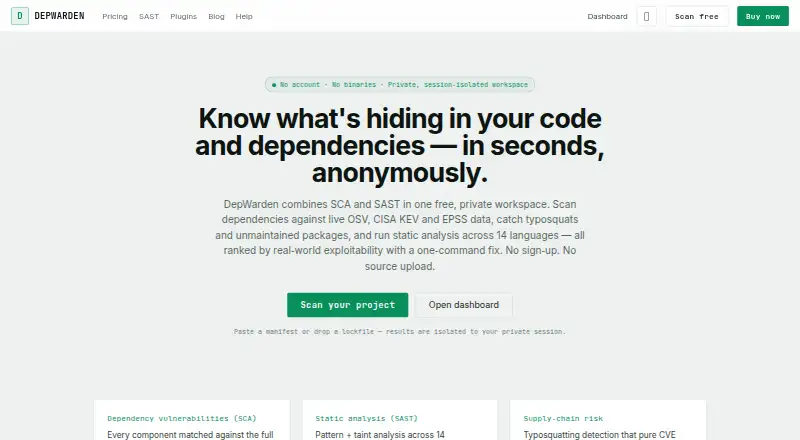
What DepWarden is
DepWarden is a software composition analysis tool for scanning dependency manifests against vulnerability, exploitability, supply-chain, package health, and license information. It ranks findings using CISA KEV, FIRST EPSS, fix availability, and dependency depth, and provides a copy-paste upgrade command. Supported ecosystems include npm, PyPI, Maven, Gradle, Go, RubyGems, Cargo, NuGet, Composer, Dart, and Swift. It accepts CycloneDX or SPDX SBOMs and can export an SBOM, an OpenVEX document, and a NOTICE license file. The About page also describes SAST across 15 languages and infrastructure-as-code formats using 300+ rules. Repository branches from GitHub, GitLab, Bitbucket, or Azure DevOps can be connected for scans and scheduled email reports. Plans range from free report-only scans that cannot fail a build to paid options with build gating, SAST, and organizational features. The hosted service runs in Mumbai, India; EU or US hosted data residency is not currently offered. DepWarden has no SOC 2, ISO 27001, or equivalent third-party attestation, and has not commissioned an independent penetration test.
Good
- Covers eleven listed package ecosystems
- Accepts CycloneDX and SPDX SBOMs
- Exports SBOM, OpenVEX, and NOTICE files
- Connects four repository providers for scans
- Free report-only plan available
Watch out
- Reachability analysis is not available
- Hosted data residency is limited to Mumbai
- No listed third-party security attestation
- No independent penetration test commissioned
Who it suits
It suits developers, open-source maintainers, security engineers, CI gate teams, and compliance teams that need dependency or source-code scanning. Its self-hosted or air-gapped Enterprise option may fit organizations with deployment requirements beyond the hosted service.
Verdict
DepWarden combines dependency checks with listed SAST, SBOM, and repository workflow capabilities. Buyers should weigh its security assurance disclosures and hosted data residency limitations against their needs.
Plans and prices
From DepWarden's own pricing page, checked 8 Oct 2026.
| Plan | Price | What it gives you |
|---|---|---|
| Free | Free | Report-only scanning · no account · no API key · HTML report · cannot fail a build |
| Developer | $19 a month | One engineer · all report formats · build gating · fix paths · $19 / month ($190 / year) |
| Team | $99 a month | A squad · SAST · scheduled delivery · VEX · IP-restricted keys · $99 / month ($990 / year) |
| Business | $399 a month | An org · high volume · report branding · long retention · $399 / month ($3,990 / year) |
| Enterprise | Priced on request | Contract terms · self-hosted or air-gapped deployment · Contract |
The facts
Each one read from DepWarden's own pages, with the date it was checked.
What it does
- Build tools
- The plugins page lists Maven, npm/yarn/pnpm, and GitHub Actions as available, with the npm CLI usable in GitLab CI, Jenkins, CircleCI, and Azure Pipelines.checked 8 Oct 2026
- Certifications
- DepWarden states it does not hold SOC 2, ISO 27001, or equivalent third-party attestation and has not commissioned an independent penetration test.checked 8 Oct 2026
- Data residency
- The hosted service runs in Oracle Cloud Infrastructure's Mumbai region, and the trust page says EU or US data residency is not currently offered for hosted service.checked 8 Oct 2026
- Ecosystems
- The site lists npm, PyPI, Maven, Gradle, Go, RubyGems, Cargo, NuGet, Composer, Dart, and Swift support for manifests, lockfiles, and SBOMs.checked 8 Oct 2026
- Intended users
- The About page identifies individual developers, open-source maintainers, security engineers, teams building CI gates, and compliance teams as intended users.checked 8 Oct 2026
- Prioritization
- It ranks findings using CISA KEV, FIRST EPSS, fix availability, and dependency depth, and provides a copy-paste upgrade command.checked 8 Oct 2026
- Privacy
- The privacy policy says anonymous scans use a session-isolated workspace and the service does not receive or store application source code or compiled binaries.checked 8 Oct 2026
- Product
- DepWarden is a software composition analysis tool that scans dependency manifests against vulnerability, exploitability, supply-chain, package health, and license data.checked 8 Oct 2026
- Repository integrations
- Users can connect GitHub, GitLab, Bitbucket, or Azure DevOps branches for scans and scheduled email reports; the page says no token is retained beyond the scan.checked 8 Oct 2026
- SAST
- The About page says DepWarden combines SCA and SAST and scans source code across 15 languages plus infrastructure-as-code formats with 300+ rules.checked 8 Oct 2026
- SBOM and compliance
- It accepts CycloneDX or SPDX SBOMs and exports an SBOM, an OpenVEX document, and a NOTICE license file.checked 8 Oct 2026
- Security controls
- The trust page lists TLS with HSTS, salted password hashing, optional TOTP, role-based access control, append-only audit logging, and SCIM 2.0 for organization deployments.checked 8 Oct 2026
- Service availability
- The trust page says the hosted service is single-region, has no published self-serve uptime SLA, and has no public status page.checked 8 Oct 2026
- Support
- The contact page lists support hours as Monday to Friday, 10:00–18:00 IST, and gives Ghatkopar, Mumbai, Maharashtra, India as the operating address.checked 8 Oct 2026
The company
- Headquarters
- Ghatkopar, Mumbai, Maharashtra 400 075, Indiachecked 28 Sep 2026
The full review of DepWarden
Overview
DepWarden is a dependency-risk scanner for developers and teams that want security checks to feed into remediation, build gates, and software-bill-of-materials work. Its combination of SCA, SAST, and compliance outputs makes it broader than a manifest-only checker, though organizations with strict assurance or regional hosting rules should look carefully at its limits.
Key features
DepWarden checks dependency manifests against vulnerability, exploitability, supply-chain, package-health, and license data. It ranks findings using CISA KEV, FIRST EPSS, fix availability, and dependency depth, then supplies copyable upgrade commands. That gives developers a clearer route from finding to fix; however, the product does not offer reachability analysis, so it cannot establish whether a vulnerable dependency is actually reachable from the code.
Beyond SCA, DepWarden scans source code in 15 languages and infrastructure-as-code formats using more than 300 rules. It accepts CycloneDX and SPDX SBOMs and can produce an SBOM, OpenVEX document, and NOTICE license file. These capabilities suit teams that want security and compliance tasks in one workflow, while the Team plan is the first listed tier that includes SAST and VEX.
Manifest, lockfile, and SBOM support spans npm, PyPI, Maven, Gradle, Go, RubyGems, Cargo, NuGet, Composer, Dart, and Swift. Pull request scans and connections to GitHub, GitLab, Bitbucket, and Azure DevOps branches bring checks closer to development work; scheduled email reports are also supported. DepWarden says it does not retain repository tokens beyond a scan. Build options include Maven, npm/yarn/pnpm, and GitHub Actions plugins, with the npm CLI also usable in GitLab CI, Jenkins, CircleCI, and Azure Pipelines.
For anonymous scans, the service uses a session-isolated workspace and says it does not receive or store source code or compiled binaries. Hosted service data stays in OCI's Mumbai region, with no EU or US residency option. The security controls include TLS with HSTS, salted password hashing, optional TOTP, role-based access control, append-only audit logs, and SCIM 2.0 for organization deployments. But DepWarden has no SOC 2, ISO 27001, or equivalent third-party attestation, and has not commissioned an independent penetration test. Its hosted service is single-region, without a published self-serve uptime SLA or public status page. Those are meaningful constraints for organizations with formal vendor assurance or availability requirements.
Pricing
The Free plan costs nothing and provides report-only scans without an account or API key, with an HTML report. It cannot fail a build, so it is suited to evaluation or visibility rather than enforcing a CI gate. A free trial is also offered.
Developer costs $19 a month, billed at $19 / month ($190 / year). It covers one engineer and adds all report formats, build gating, and fix paths. It is the practical entry point for an individual who needs CI enforcement; the free tier gives up both gating and richer report formats.
Team costs $99 a month, billed at $99 / month ($990 / year). It is aimed at a squad and adds SAST, scheduled delivery, VEX, and IP-restricted keys. Business costs $399 a month, billed at $399 / month ($3,990 / year), for an organization needing high volume, branded reports, and long retention. Enterprise has custom pricing and contract terms, with self-hosted or air-gapped deployment for organizations that need those options.
Platforms
DepWarden supports API, Linux, macOS, Windows, web, and self-hosted use, with hybrid deployment options. Its hosted service runs in Mumbai, while Enterprise offers self-hosted or air-gapped deployment. Support hours are Monday to Friday, 10:00–18:00 IST; the operating address is in Ghatkopar, Mumbai, India.
Who it's for
Individual developers, open-source maintainers, security engineers, CI gate owners, and compliance teams are the clearest fit. Developer works for a single engineer seeking actionable findings and build gating; teams that need SAST, VEX, or scheduled delivery have a stronger case for Team. Organizations requiring EU or US hosted residency, independent security attestation, or a published uptime commitment should consider another approach or evaluate Enterprise deployment terms carefully.
Pros and cons
- Pros: Risk ranking combines exploitability signals, fix availability, and dependency depth, with upgrade commands that help turn results into remediation.
- Pros: Broad ecosystem coverage, repository integrations, and multiple CI options make it adaptable to varied development workflows.
- Pros: SBOM, OpenVEX, and NOTICE outputs support compliance work alongside SCA and SAST.
- Cons: No reachability analysis means findings cannot be narrowed by whether a vulnerable dependency is used in reachable code.
- Cons: Hosted data is restricted to Mumbai, and the service lacks third-party attestation and an independent penetration test.
- Cons: Single-region hosting, no self-serve uptime SLA, and no public status page may be unsuitable for availability-sensitive teams.
Alternatives
For a broader category comparison, browse Software Composition Analysis Software. Choose Sonatype Nexus Repository if repository management and CI/CD integration are the priority; its free Community Edition includes full ecosystem support and an option for an external PostgreSQL database. Docker Desktop is a different fit for users seeking a container-development environment and Docker tooling, with a free Personal plan.
Endor Labs offers a free, account-free developer tier for local scans through its AURI MCP server, but that tier has no UI, policies, or scan history. For a free open-source scanner, consider Retire.js; for a Docker-container or Linux-server option without stated usage limits, consider ScanCode.io.
Snyk Open Source may suit teams comparing a free SCA tier capped at five projects with a paid Team plan. Socket is worth considering for teams whose needs align with its Team plan's per-developer pricing, five-developer minimum, and monthly scan and API quotas. Accessibility Test Framework for Android is a free Android accessibility-testing tool rather than a dependency-security product.
Verdict
DepWarden is a strong fit for developers and security teams that want dependency triage, build gating, SAST, and SBOM-related outputs across common ecosystems. Its actionable prioritization and workflow coverage are compelling reasons to choose it; the lack of reachability analysis and the hosted service's residency, assurance, and availability limitations are the reasons to look elsewhere. For organizations that can accept those trade-offs—or use self-hosted deployment where appropriate—it offers a practical route to connect dependency checks with remediation and compliance work.
Getting started
- Visit the DepWarden website.
- Use the free plan for report-only scanning without an account or API key, or choose a paid plan.
- Connect a GitHub, GitLab, Bitbucket, or Azure DevOps branch for scans and scheduled email reports.
- Use a listed build tool such as Maven, npm/yarn/pnpm, or GitHub Actions.
- For organization deployments, consider the listed self-hosted or air-gapped Enterprise option.
Limits worth knowing
The Free plan is report-only and cannot fail a build. Developer is for one engineer; Team is for a squad, while Business is for an organization with high volume. Enterprise terms are by contract.
Questions
What does DepWarden cost?
Free is free. Developer is $19 a month, Team is $99 a month, and Business is $399 a month. Enterprise is billed by contract.
What is included in the free plan?
Free provides report-only scanning with no account or API key and an HTML report. It cannot fail a build.
Which ecosystems does DepWarden support?
It lists npm, PyPI, Maven, Gradle, Go, RubyGems, Cargo, NuGet, Composer, Dart (Pub), and Swift.
Can it scan source code as well as dependencies?
Yes. DepWarden's About page describes SAST across 15 languages and infrastructure-as-code formats, with 300+ rules.
Which deployment options and platforms are available?
Platforms listed are API, Linux, macOS, web, and Windows, along with self-hosted availability. Enterprise includes self-hosted or air-gapped deployment.
Does DepWarden have security certifications?
DepWarden states it does not hold SOC 2, ISO 27001, or equivalent third-party attestation and has not commissioned an independent penetration test.
Alternatives to DepWarden
- 1
DeepFilterNet
Free planOpen sourceAPILinuxmacOSSelf-hosted7.6Free plan - 2

Endor Labs
Free planWebAPIExtensionLinux7.4Free plan - 3
Grype
Free planOpen sourceLinuxmacOSSelf-hostedWindows7.4Free plan - 4

Scantist
Free planWebAPISelf-hosted7.3$200 one-time - 5

Snyk Open Source
Free planWebAPILinuxmacOS7.3From $25 a month - 6

Socket
Free planWebAPIExtensionLinux7.2From $25 a month