
Railway
Railway is a deployment platform for provisioning infrastructure, developing locally with that infrastructure, and deploying services to the cloud.
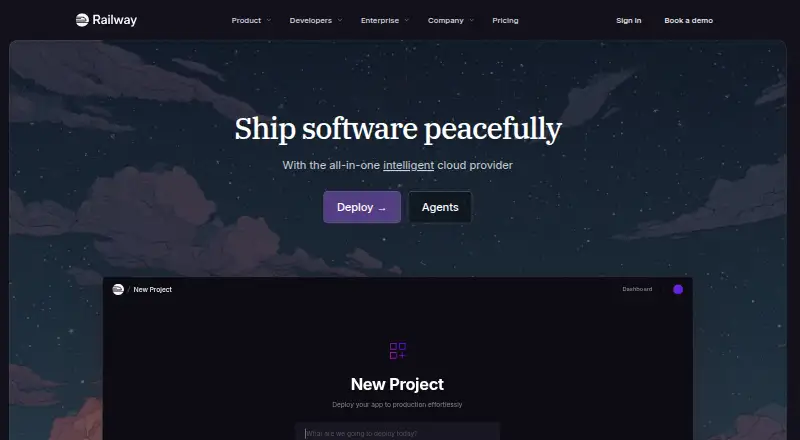
What Railway is
Railway is a deployment platform for provisioning infrastructure, developing locally with that infrastructure, and deploying services to the cloud. Projects can be deployed from Docker images, GitHub repositories or local repositories. Railway provides PostgreSQL, MySQL, MongoDB and Redis templates with built-in backups, alongside persistent volumes with usage metrics. Networking includes public and private options, TCP proxying, custom domains and managed TLS certificates. Services can scale vertically, horizontally and across four regions. For operations, Railway includes build and deployment logs retained for up to 90 days, dashboards, distributed tracing, health checks, usage limits and alerts. Teams can use unlimited environments, pull-request and preview deployments, GitHub branch deploys and one-click rollbacks. A GraphQL API and CLI are also available, and mobile apps for iOS and Android support deploying, monitoring and managing services. The Trial plan includes a one-time $5 free credit. Hobby costs $5 per month, and Pro costs $20 per month; Enterprise pricing is custom. Railway lists a Free plan with $1 monthly credit, but its pricing summary says there is no free plan.
Good
- Deploy from Docker images, GitHub or local repositories.
- Includes four database templates with built-in backups.
- Supports preview deployments and one-click rollbacks.
- Offers public and private networking options.
- iOS and Android apps manage services.
Watch out
- Hobby costs $5 per month.
- Pro costs $20 per month.
- Enterprise pricing is custom.
- The listing says no free plan despite a Free plan entry.
Who it suits
Railway suits developers and teams deploying services from repositories or Docker images who want infrastructure, databases, deployment environments and operational tools in one platform. Mobile apps may also suit users who want to manage services from iOS or Android.
Verdict
Railway combines deployment, infrastructure provisioning, databases, networking and service operations features. Its listed Trial includes a one-time $5 credit, while Hobby starts at $5 per month; note the conflicting free-plan details in the listing.
Plans and prices
From Railway's own pricing page, checked 15 Oct 2026.
| Plan | Price | What it gives you |
|---|---|---|
| Free | Free | 1 project after trial · 3 services/project · 1 vCPU · 0.5 GB RAM · 0.5 GB volume · community support · per month |
| Trial | Free | 2 replicas · 1 GB RAM · 2 vCPU · 1 GB ephemeral storage · 0.5 GB volume storage · 4 GB image size · one-time $5 free credit |
| Hobby | $5 a month | $5 monthly usage credit · up to 48 vCPU/48 GB RAM per service · 5 replicas · 5 GB storage · single-developer workspace · 99.9% availability target · minimum monthly usage |
| Pro | $20 a month | $20 monthly usage credit · up to 1,000 vCPU/1 TB RAM per service · 42 replicas · 1 TB storage · unlimited workspace seats · minimum monthly usage |
| Enterprise | Priced on request | 90-day log history · SSO · 18-month audit retention · RBAC · HIPAA BAAs · support SLOs · dedicated VMs · bring your own cloud · custom |
The facts
Each one read from Railway's own pages, with the date it was checked.
What it does
- API and CLI
- Railway provides a GraphQL API with more than 100 methods and a Rust-powered CLI with more than 25 commands.checked 30 Sep 2026
- API limits
- API quotas are 100 requests/hour for Free, 1,000 for Hobby and 10,000 for Pro, with higher per-second limits on paid plans.checked 15 Oct 2026
- Build system
- Railway builds applications with Railpack or a user-supplied Dockerfile.checked 15 Oct 2026
- CLI installation
- The CLI installer supports macOS, Linux and Windows through WSL, and other installation methods include Homebrew, npm, Scoop, binaries and source builds.checked 15 Oct 2026
- Compliance
- Railway's Trust Center lists SOC 2 Type 2, SOC 3, HIPAA, GDPR EU-US Data Privacy Framework, and Swiss-US Data Privacy Framework compliance information.checked 30 Sep 2026
- Container deployment
- Services can be deployed from Docker images, GitHub repositories or local repositories.checked 15 Oct 2026
- Databases
- Built-in database options include PostgreSQL, MySQL, MongoDB and Redis, with backups available.checked 15 Oct 2026
- Deployment sources
- Services can be deployed from Docker images, GitHub repositories, or local repositories.checked 30 Sep 2026
- Documentation depth
- Documentation covers deployment, databases, networking, observability, CLI commands, API operations, infrastructure as code and troubleshooting.checked 15 Oct 2026
- Environments
- Railway supports unlimited environments, pull-request environments, GitHub branch deploys, preview deploys, and one-click rollbacks.checked 30 Sep 2026
- Environment workflow
- Environments, pull-request previews, staged changes and one-click rollbacks support collaborative release workflows.checked 15 Oct 2026
- Funding
- Crunchbase lists Railway as a private Series B company with three funding rounds and nine investors, including Unusual Ventures and TQ Ventures.checked 15 Oct 2026
- Independent outage report
- TechRadar reported that the May 19, 2026 incident lasted roughly eight hours and affected dashboard access, deployments and workloads.checked 15 Oct 2026
- Integrations
- Official Railway integrations include ChatGPT, Codex, Claude, Claude Code, Grok, Cursor, and other AI assistant connectors.checked 30 Sep 2026
- Limit: account restrictions
- Multiple Trustpilot reviewers say workspaces were disabled with limited explanations or inadequate data-export paths.checked 15 Oct 2026
- Limit: outages and reliability
- Trustpilot reviewers report recurring outages, degraded service and deployment interruptions.checked 15 Oct 2026
- Limit: support responsiveness
- Trustpilot complaints frequently mention difficult support access, automated replies and unresolved cases.checked 15 Oct 2026
- Mobile availability
- Railway's iOS app provides deployment notifications, logs, metrics, service management and the Railway Agent; the changelog said Android beta was coming soon.checked 15 Oct 2026
- Networking
- The platform provides public domains, private service networking, TCP proxying, custom domains, managed TLS and DDoS protections.checked 15 Oct 2026
- Notable outage
- Railway's status history records a May 19, 2026 service disruption linked to a Google Cloud account outage, alongside 99.26% uptime for May.checked 15 Oct 2026
Where it runs
- App requirement
- The iPhone app requires iOS 16.4 or later and is also compatible with Apple-silicon Macs running macOS 12 or later.checked 15 Oct 2026
- Mobile apps
- Railway provides mobile apps for iOS and Android for deploying, monitoring, and managing services.checked 30 Sep 2026
The company
- Company profile
- LinkedIn lists Railway as a privately held software-development company founded in 2020, headquartered in San Francisco, with 11–50 employees.checked 15 Oct 2026
Money
- Limit: billing complexity
- Trustpilot reviewers complain about unexpected charges, cancellation problems and bills exceeding expectations.checked 15 Oct 2026
The full review of Railway
Railway is a cloud platform for provisioning infrastructure, developing against it locally and deploying services. It is best suited to developers who want deployment, databases and operational controls together; the $5 Hobby entry point is approachable, but the Trial has tight resource limits and the free-plan terms are inconsistent.
Overview
Railway brings infrastructure and application deployment into one platform. Services can come from GitHub or local repositories, Docker images, container registries, regional cloud services or templates, giving teams several ways to move from development to deployment. That breadth is useful for varied workflows, but readers should weigh it against their need for a particular cloud or self-hosted setup.
Key features
Built-in PostgreSQL, MySQL, MongoDB and Redis templates include backups, while persistent volumes can reach 5 TB and expose disk usage metrics. This makes Railway a credible option for applications that need storage and common databases alongside compute; the volume and per-plan limits still shape how much can run on each tier.
Networking includes public connections up to 10 Gbps, private networking up to 100 Gbps, TCP proxying, custom domains and managed TLS certificates. Services can scale vertically to 48 vCPU and 48 GB of memory per replica, horizontally to 50 replicas and across four regions. Those ceilings provide room for growth, though the plan-specific replica and resource allowances are more relevant when sizing a deployment.
Build and deployment logs are retained for up to 90 days. Configurable dashboards, distributed tracing, health checks, usage limits and alerts give teams tools to monitor services and respond to operational issues. Unlimited environments, pull-request environments, GitHub branch deploys, previews and one-click rollbacks support parallel development and recovery. Approval gates and deployment audit logs add control to release workflows.
A GraphQL API with more than 100 methods and a Rust-powered CLI with more than 25 commands offer programmatic control. The CLI supports macOS, Linux and Windows via WSL, with installation through Homebrew, npm, Scoop or pre-built binaries. iOS and Android apps can deploy, monitor and manage services, extending service operations to mobile devices.
Official integrations include ChatGPT, Codex, Claude, Claude Code, Grok, Cursor and other AI assistant connectors. Enterprise features include SAML single sign-on, audit logs, bring-your-own-cloud deployment, zero-trust networking, support SLOs and dedicated VMs. Railway's Trust Center lists SOC 2 Type 2, SOC 3, HIPAA, GDPR EU-US Data Privacy Framework and Swiss-US Data Privacy Framework compliance information.
Pricing
The Trial costs nothing and includes a one-time $5 free credit, two replicas, 1 GB RAM, 2 vCPU, 1 GB ephemeral storage, 0.5 GB volume storage and a 4 GB image-size limit. It is a small starting allocation, not a recurring free tier. The entry-level Hobby plan is $5 a month, billed monthly, and includes six replicas, 48 GB RAM, 48 vCPU, 100 GB ephemeral storage, 5 GB volume storage, a 100 GB image-size limit and $5 monthly resource usage included. It suits smaller recurring deployments, but the included usage allowance and storage caps matter as services grow.
Pro costs $20 a month, billed monthly, and raises the allowance to 42 replicas, 1 TB RAM, 1,000 vCPU, 100 GB ephemeral storage, 1 TB volume storage, unlimited image size and $20 monthly resource usage included. It is the more capable option for larger workloads, with substantially higher resource ceilings than Hobby. Enterprise has custom pricing, 50 replicas, 2.4 TB RAM, 2,400 vCPU, 100 GB ephemeral storage, 5 TB volume storage and unlimited image size; its security and support features make it the tier to consider when those controls are required.
A separate Free plan is described as billed monthly, with $1 free credit per month, one replica, 0.5 GB RAM, 1 vCPU, 1 GB ephemeral storage, 0.5 GB volume storage and a 4 GB image-size limit. That conflicts with the stated absence of a free plan and the separate one-time-credit Trial. Confirm which arrangement applies before relying on a recurring free allowance. A 30-day trial is also advertised, but its relationship to the one-time Trial credit is unclear.
Platforms
Railway lists Android, iOS, Linux, macOS, web and Windows support. Its CLI runs on macOS and Linux and on Windows via WSL; the mobile apps handle deploying, monitoring and service management.
Who it's for
Railway fits developers and teams who want cloud deployment, managed database templates, persistent storage, preview environments and operational monitoring under one roof. Its API, CLI and deployment controls also suit teams automating releases. It is less compelling for readers who need a dependable no-cost tier: the Trial is limited, and the separate Free plan terms conflict.
Pros and cons
- Pros: Multiple deployment sources and database templates let teams combine application delivery with common infrastructure in one platform.
- Pros: Previews, branch deployments, rollbacks, approval gates and audit logs support controlled release workflows.
- Pros: Scaling, observability and networking features cover a broad range of service operations needs.
- Cons: The Trial's one-time $5 credit and small resource allocation make it a limited basis for ongoing use.
- Cons: The conflicting Free and Trial terms make it difficult to plan around a recurring free allowance.
- Cons: Hobby's included usage and storage limits may constrain growing workloads before its headline compute ceilings do.
Alternatives
Choose sh0 if a free tier with unlimited apps and deployments, 170+ templates, local backups and community support is a better fit. Temps offers a self-hosted plan billed $0 forever, with storage and query compute on your hardware. Encore may suit teams prioritizing free development environments and a monthly trace-event allowance, with 7-day log and trace retention. Northflank offers a free Sandbox with services, a database, cron jobs and always-on compute.
Nullstone has a free Individual plan for one user, one environment and 10 deploys per week on AWS or GCP. Okteto offers a free Starter plan with five seats. Signadot is an alternative with a free Starter plan that includes monthly sandbox and test-invocation allowances. Upsun (formerly Platform.sh) offers a 15-day trial with a monthly credit covering one project fee and one user license. Compare Preview Environment Software and Deployment Automation Software for broader category options.
Verdict
Railway is a strong choice for developers who want deployment, infrastructure, databases and service operations in one platform, with room to scale and practical release controls. Its principal drawback is the unclear free-plan story, so readers who need predictable no-cost use should consider an alternative; teams comfortable starting with a paid plan get a more complete proposition at Hobby and above.
Getting started
- Visit https://railway.com/.
- Choose a plan: Trial includes a one-time $5 credit, while Hobby is $5 per month and Pro is $20 per month.
- Start a deployment from a Docker image, GitHub repository, or local repository.
- For local CLI use, install on macOS, Linux, or Windows via WSL using Homebrew, npm, Scoop, or a pre-built binary.
- Use the iOS or Android app to deploy, monitor, and manage services.
Limits worth knowing
The Trial plan includes 2 replicas, 1 GB RAM, 2 vCPU, 1 GB ephemeral storage, 0.5 GB volume storage, and a 4 GB image-size limit, with a one-time $5 credit. Hobby, the listed paid plan at $5 per month, allows 6 replicas, 48 GB RAM, 48 vCPU, 100 GB ephemeral storage, 5 GB volume storage, and 100 GB image size; it includes $5 monthly resource usage.
Questions
What does Railway cost?
The Trial plan is listed with a one-time $5 free credit. Hobby costs $5 per month and Pro costs $20 per month; Enterprise pricing is custom.
What can I deploy with Railway?
Services can be deployed from Docker images, GitHub repositories, or local repositories. Deployment targets also include container registries, regional cloud services, and templates.
Which databases does Railway provide?
Railway offers PostgreSQL, MySQL, MongoDB, and Redis database templates with built-in backups.
Which platforms does Railway support?
Railway lists Android, iOS, Linux, macOS, web, and Windows platforms. Its CLI supports macOS, Linux, and Windows via WSL.
Can I roll back a deployment?
Yes. Railway supports one-click rollbacks.
What security and compliance information does Railway provide?
Enterprise features include SAML single sign-on, audit logs, bring-your-own-cloud deployment, zero-trust networking, support SLOs, and dedicated VMs. Its Trust Center lists SOC 2 Type 2, SOC 3, HIPAA, GDPR EU-US Data Privacy Framework, and Swiss-US Data Privacy Framework compliance information.
Alternatives to Railway
- 1

Firestore
Free planAndroidiOSWebAPI8.1$0.03 usage-based - 2

TiDB Cloud
Free planOpen sourceWebAPILinuxSelf-hosted8.1Free plan - 3

Aiven for PostgreSQL
Free planOpen sourceWebAPISelf-hosted7.8From $5 a month - 4

Amazon DynamoDB
Free planAndroidiOSWebAPI7.8Free plan - 5

Azure SQL Database
Free planAndroidiOSWebAPI7.7Free plan - 6
Turso
Free planAndroidiOSWebAPI7.7$4.99 usage-based