
Temps
Temps is a self-hosted deployment platform that brings deployment and developer tools together in one Rust binary.
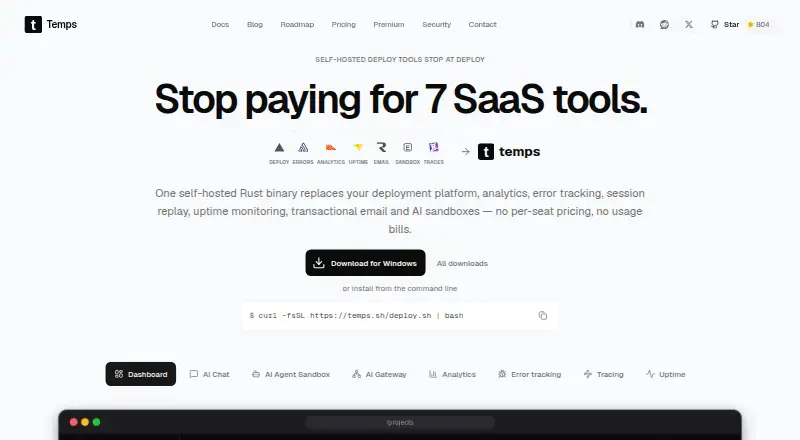
What Temps is
Temps is a self-hosted deployment platform that brings deployment and developer tools together in one Rust binary. It supports git-push deployments, pull request preview URLs, and zero-downtime rollouts. Built-in analytics cover visitors, custom events, session replays, and funnels, with data stored on the operator's infrastructure. Temps also ingests OpenTelemetry traces, logs, and metrics, provides log history, monitors uptime, and tracks real-user Web Vitals by page. Its dashboard provisions PostgreSQL, MariaDB, MongoDB, Redis, and RustFS services. The platform says application secrets and credentials are encrypted before they reach the database, using a key generated at installation and held by the operator. Telemetry is off by default; analytics, replays, error reports, logs, and metrics remain in the operator's PostgreSQL database. Self-hosting is available now, while Temps Cloud plans are marked coming soon. The self-hosted plan is free. Temps Fleet desktop installers are available for macOS, Windows 10 or later, and 64-bit Linux.
Good
- Self-hosted plan is free.
- Supports pull request previews and zero-downtime rollouts.
- Analytics and operational data stay on the operator's infrastructure.
- Provisions several database services through its dashboard.
- Telemetry is off by default.
Watch out
- Temps Cloud plans are marked coming soon.
- Temps says it is not SOC 2 certified.
- Listed cloud plans are not currently available.
Who it suits
Temps suits teams seeking to bring deployment and developer services together while keeping data on infrastructure they own. It is intended for self-hosting now; its cloud plans are marked as coming soon.
Verdict
Temps combines deployment, analytics, observability, and managed services for teams willing to self-host. Its cloud pricing is only indicative of plans marked coming soon, and the platform states that it is not SOC 2 certified.
Plans and prices
From Temps's own pricing page, checked 3 Oct 2026.
| Plan | Price | What it gives you |
|---|---|---|
| Self-hosted | Free | Local unmetered telemetry · storage and query compute on your hardware · unlimited projects, deployments and users · $0 forever |
| Temps Cloud trial | Free | Starter access for every new managed account · Cloud coming soon · 14 days free · no card required |
| Starter | $29 a month | 10 GB telemetry/month · 30 days retention · 50 GB backup storage · 7-day PITR · 10 GB monthly restore verification · 10 compute hours/month · coming soon · $29/ month |
| Team | $99 a month | 100 GB telemetry/month · 90 days retention · 250 GB backup storage · 30-day PITR · 20 GB monthly restore verification · 50 compute hours/month · coming soon · $99/ month |
| Business | $299 a month | 250 GB telemetry/month · 13 months retention · 1 TB backup storage · 90-day PITR · 20 GB monthly restore verification · 200 compute hours/month · coming soon · $299/ month |
| Enterprise | Priced on request | Negotiated telemetry and query compute · custom retention, backup storage, recovery policy and region · Custom |
The facts
Each one read from Temps's own pages, with the date it was checked.
What it does
- Analytics
- Built-in analytics include visitor analytics, custom events, session replay and funnel analysis, with data stored on the user's infrastructure.checked 3 Oct 2026
- Audience
- Temps presents itself as a self-hosted option for teams seeking to consolidate deployment and developer SaaS tools while keeping data on infrastructure they own.checked 3 Oct 2026
- Compliance
- Temps states that it is not SOC 2 certified and offers source code, a pre-filled security questionnaire and GDPR and data-ownership documentation for due diligence.checked 3 Oct 2026
- Deployment
- Temps supports git-push deployments, pull request preview URLs and zero-downtime rollouts.checked 3 Oct 2026
- Integrations
- The platform lists AWS S3, Scaleway, SMTP and Sentry-compatible error ingestion as integrations.checked 3 Oct 2026
- Managed services
- Temps provisions PostgreSQL, MariaDB, MongoDB, Redis and RustFS services through its dashboard.checked 3 Oct 2026
- Monitoring
- Temps provides continuous uptime monitoring and tracks real-user Web Vitals per page.checked 3 Oct 2026
- Notable limit
- The Temps Cloud plans are marked coming soon; self-hosting is available now.checked 3 Oct 2026
- Observability
- Temps ingests OpenTelemetry traces, logs and metrics, and provides log history.checked 3 Oct 2026
- Privacy
- Telemetry is off by default, and Temps says analytics, session replays, error reports, logs and metrics remain in the operator's own PostgreSQL database.checked 3 Oct 2026
- Product
- Temps is a self-hosted deployment platform that combines git-push deployments with analytics, error tracking, session replay, uptime monitoring, OpenTelemetry tracing, managed databases, transactional email and AI agent sandboxes in one Rust binary.checked 3 Oct 2026
- Security
- Temps says application secrets and credentials are encrypted before they reach the database, using a key generated at installation that only the operator holds.checked 3 Oct 2026
- Support
- Temps says security review inquiries sent to [email protected] receive a response within 2 business days.checked 3 Oct 2026
Where it runs
- Desktop app
- Temps Fleet is a desktop client for installing and managing Temps, with installers for macOS, Windows 10 or later, and 64-bit Linux.checked 3 Oct 2026
The full review of Temps
Temps is a self-hosted deployment platform that brings releases, product analytics, observability and managed services together. It is best suited to teams that want to consolidate developer tools while keeping data on infrastructure they control. Its breadth is compelling, but teams seeking a ready-to-use hosted service should wait: Temps Cloud plans are coming soon.
Overview
Temps combines git-push deployment with analytics, error tracking, session replay, uptime monitoring, OpenTelemetry observability, managed databases, transactional email and AI agent sandboxes in one Rust binary. The appeal is consolidation: teams can bring several development and operational workflows under one self-hosted platform rather than scatter data across separate services. The trade-off is that storage and query compute for the free self-hosted plan run on the operator’s own hardware, so the team takes on infrastructure responsibility.
Key features
- Deployment: Git-push releases, pull request preview URLs and zero-downtime rollouts cover both routine deployments and review environments. Previews work with GitHub, GitLab, Bitbucket, Gitea/Forgejo and other git servers; database previews and custom domains add useful flexibility. There are no preview expiry controls, which may leave teams to manage preview cleanup themselves.
- Analytics and privacy: Visitor analytics, custom events, session replay and funnel analysis are built in, with data stored on the operator’s infrastructure. Telemetry is off by default; analytics, replays, error reports, logs and metrics remain in the operator’s PostgreSQL database.
- Observability and monitoring: Temps ingests OpenTelemetry traces, logs and metrics and provides log history, continuous uptime monitoring and per-page real-user Web Vitals. This gives teams several operational signals in one place, alongside Sentry-compatible error ingestion.
- Managed services: The dashboard can provision PostgreSQL, MariaDB, MongoDB, Redis and RustFS. Listed integrations also include AWS S3, Scaleway and SMTP.
- Security and compliance: Temps says secrets and credentials are encrypted before reaching the database, using an installation-generated key held only by the operator. It is not SOC 2 certified; it offers source code, a pre-filled security questionnaire and GDPR and data-ownership documentation for due diligence. Security review inquiries sent to [email protected] receive a response within 2 business days.
Pricing
Self-hosting is available now; every Temps Cloud plan is marked coming soon, so the cloud prices and allowances are not a current hosted-service option.
- Self-hosted — free: Billed $0 forever, with local unmetered telemetry and unlimited projects, deployments and users. Storage and query compute use the operator’s hardware, making this the clearest fit for teams prepared to run their own infrastructure.
- Temps Cloud trial — free: Billed 14 days free, no card required, with Starter access for every new managed account. The trial is time-limited, and the cloud is coming soon.
- Starter — $29 a month: Billed $29/ month, with 10 GB telemetry/month, 30 days retention, 50 GB backup storage, 7-day PITR, 10 GB monthly restore verification and 10 compute hours/month. It is the smallest proposed paid tier, but is not yet available.
- Team — $99 a month: Billed $99/ month, with 100 GB telemetry/month, 90 days retention, 250 GB backup storage, 30-day PITR, 20 GB monthly restore verification and 50 compute hours/month. The larger quotas and longer retention are aimed at teams with heavier usage, once the cloud launches.
- Business — $299 a month: Billed $299/ month, with 250 GB telemetry/month, 13 months retention, 1 TB backup storage, 90-day PITR, 20 GB monthly restore verification and 200 compute hours/month. The extended retention and recovery allowances suit teams with greater continuity needs, but remain future cloud offerings.
- Enterprise — custom pricing: Negotiated telemetry and query compute, custom retention, backup storage, recovery policy and region. This is the flexible option for bespoke requirements, also marked coming soon.
The cloud tiers distinguish themselves by telemetry, retention, backup, recovery and compute allowances; only the free self-hosted plan is usable now. No seat cap is stated for the cloud tiers.
Platforms
Temps supports API, Linux, macOS, self-hosted, web and Windows. Temps Fleet, its desktop client for installing and managing Temps, has installers for macOS, Windows 10 or later, and 64-bit Linux.
Who it's for
Temps fits teams that want deployment, analytics and operational tooling in one place without handing their data to a hosted platform. Its strongest case is for operators comfortable providing their own hardware and keeping telemetry in their own PostgreSQL database. It is a weaker fit for teams that need a managed cloud service today, or whose procurement requires SOC 2 certification.
Pros and cons
- Pro: Deployment, previews, analytics, observability and several managed databases are brought together, reducing the need to assemble those capabilities across separate products.
- Pro: Telemetry defaults to off and operational data stays on the operator’s infrastructure, giving data-conscious teams control over storage location.
- Pro: Unlimited projects, deployments and users on the free self-hosted plan avoid per-seat restrictions, while relying on the operator’s own compute and storage.
- Con: Cloud plans are coming soon, so teams cannot currently choose the advertised managed tiers.
- Con: Self-hosting puts storage and query compute on the operator’s hardware, adding infrastructure responsibility.
- Con: Temps is not SOC 2 certified, which may rule it out for teams with that requirement.
- Con: Preview expiry controls are absent, leaving teams without a built-in expiry setting for review environments.
Alternatives
For a broader comparison of tools focused on review deployments, see Preview Environment Software.
- sh0 is worth considering for a free self-hosted option organized around stacks, with unlimited apps and deployments and 170+ templates; its free plan is limited to 1 stack.
- Slipway offers a free plan billed forever with a $5 one-time usage grant, for readers who want to compare a different free deployment option.
- Signadot has a free Starter tier with monthly sandbox and test-invocation quotas, 10 concurrent devboxes and 1 Kubernetes cluster, making it relevant when sandbox capacity is the priority.
- Miren may suit teams prioritizing an open-source runtime: its deployment runtime is Apache 2.0 licensed and its Always free plan is billed forever.
- Spunto offers a free BYOC beta plan with unlimited workers on the user’s own nodes, for readers focused on that model.
- Okteto has a free Starter plan capped at 5 seats, which may fit a small team comparing another self-hosted option.
- Northflank offers a free Sandbox with 2 free services, 1 free database, 2 free cron jobs and always-on compute, making it a useful comparison for teams wanting those free resource allowances.
- PullPreview has a Commercial license at €300 a year per organization, an alternative to compare for readers considering a paid preview-focused tool.
Verdict
Choose Temps if your team wants one self-hosted platform for deployment, analytics and observability, and values keeping operational data on infrastructure it controls. The breadth of its tools and the unlimited free self-hosted plan are strong reasons to consider it. Look elsewhere if you need managed cloud service now, require SOC 2 certification, or cannot take on the hardware and operations that self-hosting entails.
Getting started
- Open the Temps website
- Choose self-hosted use or the 14-day cloud trial
- Install Temps Fleet on macOS, Windows 10 or later, or 64-bit Linux
- Connect a supported Git provider or other Git server
- Deploy through Git pushes and configure preview URLs or custom domains
Limits worth knowing
Self-hosted use is unmetered for local telemetry, storage and query compute, with unlimited projects, deployments and users. The Starter cloud listing allows 10 GB telemetry monthly, 30-day retention, 50 GB backup storage, 7-day PITR, 10 GB monthly restore verification and 10 compute hours, and is marked coming soon.
Questions
Is Temps free?
The Self-hosted plan is free and billed at $0 forever. It includes local unmetered telemetry, storage and query compute on your hardware, plus unlimited projects, deployments and users.
Is there a trial?
A Temps Cloud trial is free for 14 days, requires no card and provides Starter access for each new managed account.
Which platforms does Temps support?
Temps lists API, Linux, macOS, self-hosted, web and Windows. Temps Fleet installers are available for macOS, Windows 10 or later, and 64-bit Linux.
What databases can it provision?
Its dashboard can provision PostgreSQL, MariaDB, MongoDB, Redis and RustFS services.
Does Temps keep telemetry on its own infrastructure?
Telemetry is off by default, and analytics, session replays, error reports, logs and metrics remain in the operator’s PostgreSQL database.
What integrations are listed?
Temps lists AWS S3, Scaleway, SMTP and Sentry-compatible error ingestion.
Alternatives to Temps
- 1

Coolify
Free planOpen sourceAndroidiOSWebAPI8.6From $5 a month - 2

Railway
Free planAndroidiOSWebAPI8.3From $5 a month - 3

Northflank
Free planWebAPILinuxmacOS8.0From $2.70 a month - 4

sh0
Free planAndroidiOSWebAPI8.0From $19 a month - 5
Nullstone
Free planWebAPILinuxmacOS7.9From $50 a month - 6

Okteto
Free planOpen sourceWebAPILinuxmacOS7.7Free plan