
sh0
sh0 is a self-hosted deployment platform that combines deployment, reverse proxy, SSL, monitoring and backups in one Rust-built binary.
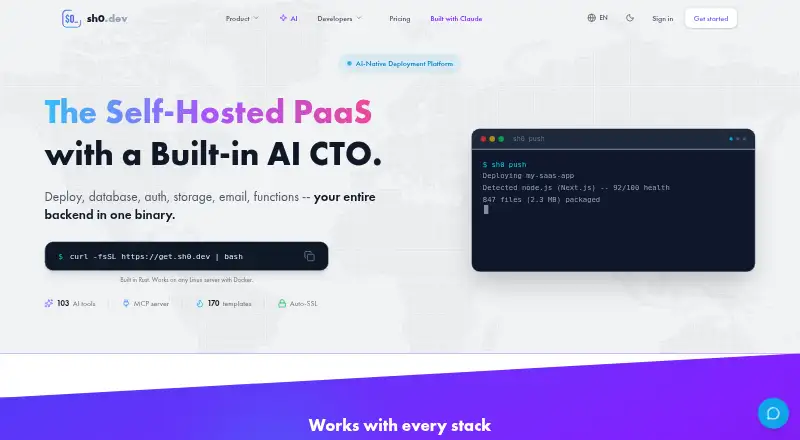
What sh0 is
sh0 is a self-hosted deployment platform that combines deployment, reverse proxy, SSL, monitoring and backups in one Rust-built binary. It connects to GitHub, GitLab and Bitbucket for push-triggered deployments, and supports pull-request preview environments. Users can choose from 170 one-click templates, including WordPress, PostgreSQL, Redis, Grafana and Ollama; the platform also detects 19 software stacks.
The REST API has more than 180 endpoints and supports bearer-token and API-key authentication. Listed features include custom domains, database previews, configurable preview expiry, and notifications to Slack, Discord, Telegram, email or webhooks. Its security features include secret encryption, two-factor authentication, role-based access controls and audit logging. The Free plan allows one stack, while all listed plans include unlimited apps and deployments. sh0 lists Android, iOS, Linux, macOS and web, along with API and self-hosted options.
Good
- 170 one-click templates are listed.
- Pull-request preview environments are supported.
- Custom domains and database previews are available.
- All plans list unlimited apps and deployments.
- Notifications can go to chat, email or webhooks.
Watch out
- The Free plan is limited to one stack.
- The listed minimum includes 1 vCPU and 1 GB RAM.
Who it suits
sh0 suits developers seeking a self-hosted deployment platform with Git-based previews and templates. Its paid plans also target growing projects, agencies and teams, with plan features varying by tier.
Verdict
sh0 combines deployment and operations features, with a free tier and paid plans that expand stack limits and support. The one-stack Free limit and listed system requirements are worth checking before choosing it.
Plans and prices
From sh0's own pricing page, checked 15 Oct 2026.
| Plan | Price | What it gives you |
|---|---|---|
| Free | Free | 1 stack · unlimited apps · unlimited deployments · 170+ templates · community support · local backups · 103 AI tools · forever |
| Pro | $19 a month | unlimited stacks · database servers · S3-compatible storage · managed email · PostgREST · Logto auth · Centrifugo realtime · Deno functions · 90-day audit log · monthly |
| Scale | $49 a month | unlimited stacks · managed services · cloud backups · full monitoring and alerts · uptime monitoring |
| Business | $99 a month | multi-server BYOS · unlimited team members · RBAC · auto-scaling · cloud backups · 1-year audit log · priority support · BYOK · monthly |
The facts
Each one read from sh0's own pages, with the date it was checked.
What it does
- AI and MCP
- The pricing page includes an AI assistant, 103 AI tools and an MCP server for Claude Desktop and Cursor on every listed plan.checked 2 Oct 2026
- AI limitation
- The terms say AI suggestions may be outdated or inaccurate and that complex deployments can require manual configuration.checked 15 Oct 2026
- AI safety
- AI operations use scoped API keys, risk classification, confirmation tokens and audit logging for destructive actions.checked 15 Oct 2026
- API
- The REST API exposes more than 180 endpoints with bearer-token and API-key authentication, and an OpenAPI specification is available.checked 15 Oct 2026
- Automatic SSL
- Caddy provisions and renews Let's Encrypt certificates automatically for domains and preview URLs.checked 15 Oct 2026
- Backend services
- Paid plans add S3-compatible storage, Stalwart email hosting, PostgREST, Logto authentication, Centrifugo realtime messaging and Deno serverless functions.checked 15 Oct 2026
- Backups
- Scheduled backups support 13 storage providers, including S3, Cloudflare R2, SFTP, Dropbox and Google Drive.checked 15 Oct 2026
- CLI
- The sh0 CLI provides more than 30 commands, including push, watch, deploy, logs, SSH, scaling, previews, cron and export.checked 15 Oct 2026
- Database engines
- Managed database servers support PostgreSQL, MySQL, MariaDB, MongoDB and Redis.checked 15 Oct 2026
- Deployment methods
- Deployments can come from Git repositories, Docker images, Dockerfiles, ZIP uploads, templates or sh0.yaml configuration.checked 15 Oct 2026
- Docker Hub availability
- Docker Hub lists a zerosuiteinc/sh0 image with more than 10K pulls and a quick-start container command exposing ports 9000, 80 and 443.checked 15 Oct 2026
- Docker Hub feature inventory
- The Docker Hub listing documents six deployment methods, 20 auto-detected stacks, 170-plus templates and seven export formats.checked 15 Oct 2026
- Docker Hub setup limitation
- The Docker Hub quick start displays default administrator credentials, so operators must change them during initial setup.checked 15 Oct 2026
- Founder
- Juste A. Gnimavo is identified as founder and CEO of ZeroSuite, Inc.checked 15 Oct 2026
- Git deployment
- It connects GitHub, GitLab and Bitbucket for push-triggered deployments and pull-request preview environments.checked 2 Oct 2026
- GitHub activity
- The public zerosuite-inc/sh0 repository is shown as public with zero stars, zero forks, zero issues and one commit.checked 15 Oct 2026
- GitHub distribution
- The repository README describes sh0 as a self-hosted Rust PaaS and directs users to download binaries from GitHub Releases.checked 15 Oct 2026
- Git integrations
- The platform connects to GitHub, GitLab and Bitbucket and supports push-triggered deployments.checked 15 Oct 2026
- Install method
- Installation uses a curl script that downloads and checksum-verifies a single binary.checked 15 Oct 2026
- Integrations
- Git provider integrations include GitHub, GitLab and Bitbucket; deploy notifications can go to Slack, Discord, Telegram, email or a webhook endpoint.checked 2 Oct 2026
Where it runs
- CLI platforms
- CLI binaries are documented for Linux x86_64, Linux ARM64, macOS Intel and macOS Apple Silicon.checked 15 Oct 2026
The company
- Company jurisdiction
- ZeroSuite, Inc. is described as a Delaware C-Corporation with operations across West Africa.checked 15 Oct 2026
- Company legal name
- The website identifies ZeroSuite, Inc. as the operator and product owner of sh0.checked 15 Oct 2026
- Headquarters
- Newark, Delaware, USAchecked 28 Sep 2026
The full review of sh0
Overview
sh0 is a self-hosted platform for deploying and operating applications on your own infrastructure. It suits developers and teams who want deployment, security and backup tools in one place, especially when pull-request previews or infrastructure control matter. Its strongest appeal is breadth; the one-stack Free and Pro limits make the higher tiers important for anyone managing several projects.
Key features
Deployments and previews
GitHub, GitLab and Bitbucket connections support push-triggered deployments, while the broader provider list also includes Gitea and Forgejo. Pull-request preview environments can include database previews, and expiry controls are configurable. That combination is useful for teams reviewing changes against temporary environments, though sh0 still requires a host that meets its system requirements.
Templates and stack detection
There are 170 one-click templates, including WordPress, PostgreSQL, Redis, Grafana and Ollama, plus automatic detection for 19 stacks such as Node.js, Python, Go, Rust, PHP, Java, .NET and static HTML. Templates and detection can shorten setup for familiar workloads; they do not remove the need to run and maintain the underlying infrastructure.
Operations, API and security
sh0 combines reverse proxy, SSL, monitoring and backups with deployments in one Rust binary. Scheduled backups can use 13 storage providers, including S3, R2, SFTP, Dropbox and Google Drive. Its REST API has over 180 endpoints and supports bearer-token and API-key authentication. Deploy notifications can go to Slack, Discord, Telegram, email or a webhook endpoint.
Security controls include AES-256-GCM encryption for secrets, Argon2id password hashing, TOTP two-factor authentication, RBAC and audit logging. The maker reports that three parallel audits found 34 issues, including six critical and ten high-severity findings, and that all were resolved. AI tools are also included on every plan: an assistant, 103 AI tools and an MCP server for Claude Desktop and Cursor.
Pricing
sh0 has a free tier and three paid monthly plans. All plans list unlimited apps and deployments, but Free and Pro cap users at one stack; Scale and Business remove that cap.
| Plan | Price | What it includes |
|---|---|---|
| Free | free | One stack, unlimited apps and deployments, 170+ templates, local backups and community support. |
| Pro | $19 a month | One stack, managed databases, storage, email, auth, realtime and functions, a 90-day audit log and email support. |
| Scale | $49 a month | Unlimited stacks, managed services, cloud backups, full monitoring and alerts, uptime monitoring and email support. |
| Business | $99 a month | Unlimited stacks, multi-server BYOS, unlimited team members, RBAC, auto-scaling, a one-year audit log and priority support. |
Free is a sensible starting point for an individual with one stack, but local backups and community support are meaningful trade-offs. Pro adds managed services and a longer audit trail, yet remains a one-stack plan. Scale is the step up for projects or agencies that need multiple stacks, cloud backups and stronger monitoring. Business is aimed at teams and larger deployments that need unlimited members, role controls and auto-scaling. No paid plan is described as annual, so the listed prices are monthly.
Platforms
sh0 is listed for Android, iOS, Linux, macOS, web, API and self-hosted use. The download requirements call for at least 1 vCPU, 1 GB RAM, 10 GB of disk and Docker Engine 20+, with Linux x64 or macOS ARM64 named as minimum operating-system options. Check those requirements against the machine you intend to use before choosing a self-hosted setup.
Who it's for
sh0 is best for developers who want to deploy and operate applications on infrastructure they control, and for agencies or teams that need previews, backups and operational controls across multiple stacks. It is less compelling for someone seeking a hosted deployment service without server requirements, or for a multi-stack project that plans to stay on Free or Pro.
Pros and cons
- Pros: Deployment, reverse proxy, SSL, monitoring and backups are brought together in a single binary, reducing the number of separate tools to assemble.
- Pros: Pull-request previews support database previews and configurable expiry, useful for review workflows.
- Pros: Scale and Business offer unlimited stacks, while Business also includes unlimited team members and RBAC.
- Cons: Free and Pro are both limited to one stack, which can force a growing project onto a higher-priced tier.
- Cons: Self-hosting requires a qualifying machine and Docker Engine, adding infrastructure responsibility that hosted alternatives avoid.
- Cons: Free relies on local backups and community support rather than cloud backups or paid-plan support.
Alternatives
Preview Environment Software is a category option for comparing tools focused on preview environments.
Choose Temps instead if its self-hosted plan's local unmetered telemetry and on-hardware storage and query compute better fit your needs. Encore may suit a developer prioritizing its two free dev environments and monthly trace-event allowance. Northflank is worth considering for its free sandbox allocation of services, database and cron jobs with always-on compute.
Nullstone offers a free individual plan capped at one user, one environment and 10 deploys a week on AWS or GCP, so it may fit a smaller, bounded deployment workload. Okteto is another option if its five-seat free Starter plan suits the team. Signadot is aimed at sandbox-oriented work, with its Starter plan offering monthly sandboxes, test invocations and concurrent devboxes.
Firebase Cloud Messaging is a free messaging option for Android, iOS and web rather than a broad deployment platform. Miren may appeal if an open-source runtime under the Apache 2.0 license is a priority.
Verdict
Choose sh0 if you want a self-hosted deployment and operations platform that pairs Git workflows and previews with backups, monitoring and security controls. Its range is unusually broad for a single tool, but the one-stack Free and Pro plans and the hardware requirements are real constraints. Look elsewhere if you want hosted infrastructure, or need several stacks without moving to Scale.
Getting started
- Open the sh0 website
- Choose the Free, Pro, Scale, or Business plan
- Use a system with at least 1 vCPU, 1 GB RAM, 10 GB disk, and Docker Engine 20+
- Run it on Linux x64 or macOS ARM64
- Connect GitHub, GitLab, or Bitbucket
- Use a listed deployment template or connect a repository
Limits worth knowing
The Free plan permits one stack, although it includes unlimited apps and deployments. Pro costs $19 a month, Scale costs $49 a month, and Business costs $99 a month.
Questions
Is sh0 free?
Yes. The Free plan costs nothing and allows one stack with unlimited apps and deployments.
What platforms does sh0 support?
It is listed for Android, API, iOS, Linux, macOS, self-hosted use, and web.
Which Git providers connect to sh0?
GitHub, GitLab, and Bitbucket are listed as Git-provider integrations.
What does Pro cost?
The Pro plan costs $19 a month.
Does sh0 provide backups?
Yes. The product page lists scheduled backups and 13 storage providers, including S3, R2, SFTP, Dropbox, and Google Drive.
Alternatives to sh0
- 1

Coolify
Free planOpen sourceAndroidiOSWebAPI8.6From $5 a month - 2

Railway
Free planAndroidiOSWebAPI8.3From $5 a month - 3

Northflank
Free planWebAPILinuxmacOS8.0From $2.70 a month - 4
Nullstone
Free planWebAPILinuxmacOS7.9From $50 a month - 5

Okteto
Free planOpen sourceWebAPILinuxmacOS7.7Free plan - 6

Zeabur
Free planWebAPIExtensionLinux7.3From $5 a month