RAGFlow
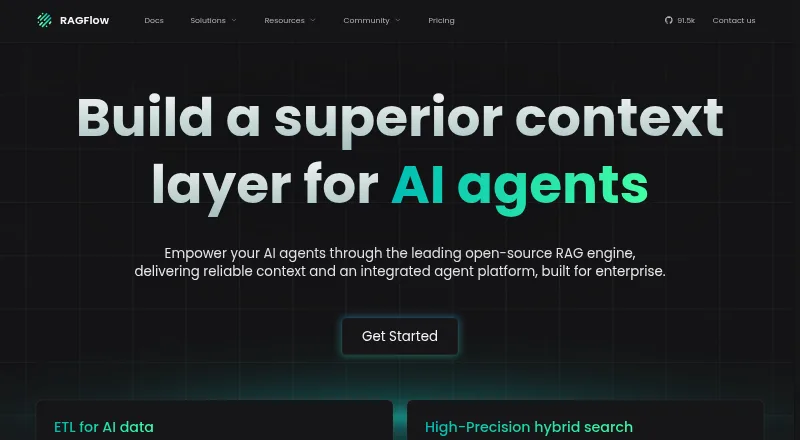
RAGFlow is an open-source retrieval-augmented generation engine and agent platform for building a context layer for AI agents.
What RAGFlow is
RAGFlow is an open-source retrieval-augmented generation engine and agent platform for building a context layer for AI agents. Its ingestion pipeline processes multiple data formats into semantic representations for retrieval. Search combines vector search and BM25 with custom scoring and result re-ranking. Visual workflows connect retrieval, tools, and MCP servers for agent orchestration, while model connections support online, local, and OpenAI-compatible providers across knowledge bases, chat, search, and agents. Documented sources include Notion, Google Drive, S3, Microsoft Teams, REST API, and Sitemap. HTTP and Python APIs are available, and a chat assistant can be embedded in another webpage with an iframe. RAGFlow offers cloud and self-hosted deployment; Docker deployment has a stated minimum of 4 CPU cores, 16 GB RAM, and 50 GB disk. The free plan includes five apps and 500 monthly credits but no API key.
Good
- Combines vector search, BM25, scoring, and re-ranking.
- Visual workflows connect RAG, tools, and MCPs.
- Supports online, local, and OpenAI-compatible models.
- Offers HTTP and Python APIs.
- Self-hosting is available.
Watch out
- Free plan has no API key.
- Free plan includes only 0.1 GB dataset storage.
- Minimum Docker build requires 4 CPU cores and 16 GB RAM.
- ARM Docker images are not maintained by RAGFlow.
Who it suits
RAGFlow suits organizations building knowledge-backed AI agents, especially those needing configurable retrieval and agent workflows. It is positioned for enterprise use, including financial services, legal and compliance, manufacturing, and education.
Verdict
RAGFlow brings ingestion, search, model connections, and agent orchestration into one platform. Check the free plan’s storage and API limits, and the stated deployment requirements, against your needs.
Plans and prices
From RAGFlow's own pricing page, checked 15 Oct 2026.
| Plan | Price | What it gives you |
|---|---|---|
| Free | Free | 5 apps · 1 team member · 0.1 GB dataset storage · 500 credits/month · API key unavailable · $0 month |
| Starter | $29 a month | 50 apps · 5 team members · 5 GB dataset storage · 5,000 credits/month · API key available · $29 month; page also shows $59 month |
| Pro | $129 a month | Unlimited apps · 20 team members · 50 GB dataset storage · 20,000 credits/month · API key available · $129 month; page also shows $259 month |
| Enterprise | Priced on request | BYOC deployment · on-premises deployment · dedicated support · custom SLA · Contact us |
The facts
Each one read from RAGFlow's own pages, with the date it was checked.
What it does
- Agent orchestration
- Visual workflows combine retrieval, tools and MCP services for agent construction.checked 15 Oct 2026
- Agent workflows
- Its visual workflows integrate RAG, tools, and MCPs for agent orchestration.checked 29 Sep 2026
- API and embedding
- RAGFlow provides HTTP and Python APIs and supports embedding a Chat assistant in a third-party webpage with an iframe.checked 29 Sep 2026
- API migration
- RAGFlow 1.0 moves its public REST backend from Python to Go and documents endpoint and parameter changes.checked 15 Oct 2026
- Architecture limitation
- The official Go image targets Linux AMD64; ARM64 requires a matching dependency image and native libraries.checked 15 Oct 2026
- Chat channels
- Supported chat-channel integrations include Discord, DingTalk, Telegram, WeCom and Feishu/Lark.checked 15 Oct 2026
- Chunking control
- Users can inspect chunking results and intervene in parsing through configurable chunk templates.checked 15 Oct 2026
- Data connectors
- Documented data sources include Notion, Google Drive, S3, Microsoft Teams, REST API, and Sitemap.checked 29 Sep 2026
- Data processing
- Its built-in ingestion pipeline cleanses and processes multi-format data into semantic representations for retrieval.checked 29 Sep 2026
- Deep document understanding
- RAGFlow supports parsing complex documents such as scanned PDFs, tables, images and slide decks.checked 15 Oct 2026
- Deployment complexity
- Independent analysis says Docker deployment also runs Elasticsearch or Infinity, MinIO, MySQL and Redis, increasing operational complexity.checked 15 Oct 2026
- Developer interfaces
- Independent documentation describes web UI, REST, Python and JavaScript APIs, MCP and agent workflows.checked 15 Oct 2026
- Document ingestion
- Its built-in ingestion pipeline cleans and processes multi-format data into semantic representations for retrieval.checked 15 Oct 2026
- Enterprise support
- The Enterprise plan lists dedicated support and a custom SLA.checked 29 Sep 2026
- External tools
- Agents can connect to external MCP servers over Streamable HTTP or SSE; stdio servers require a gateway or another service exposing a supported endpoint.checked 29 Sep 2026
- Hardware limitation
- An independent review warns that deployments with less than 16 GB RAM can suffer Elasticsearch out-of-memory kills and silent ingestion failures.checked 15 Oct 2026
- Hybrid search
- The product combines vector search, BM25, custom scoring and reranking for retrieval.checked 15 Oct 2026
- Intended users
- The site describes the platform as built for enterprise and lists solutions for financial services, legal and compliance, manufacturing, and education.checked 29 Sep 2026
- Knowledge compilation
- The platform organizes documents into structured knowledge artifacts through knowledge compilation.checked 15 Oct 2026
- License
- The public repository is labeled Apache-2.0 licensed.checked 15 Oct 2026
The company
- Company founded
- LinkedIn lists InfiniFlow as founded in 2023.checked 15 Oct 2026
- Company headquarters
- LinkedIn lists InfiniFlow headquarters in Shanghai, China.checked 15 Oct 2026
- Company legal name
- Crunchbase lists the legal name as InfiniFlow Inc.checked 15 Oct 2026
- Company size
- LinkedIn lists InfiniFlow as having 11–50 employees.checked 15 Oct 2026
The full review of RAGFlow
RAGFlow is a platform for building knowledge-backed AI apps and agent workflows. It is best suited to teams that need control over document retrieval and model connections; its self-hosting requirements make it a poor fit for resource-constrained setups.
Overview
RAGFlow brings document ingestion, search, model connections and agent orchestration together for teams building AI applications around their own information. Its appeal is breadth: the same platform can process varied sources, retrieve relevant material and connect that context to chats or agents. That scope also means teams should weigh operating requirements and plan limits before committing.
Key features
Ingestion and retrieval
The ingestion pipeline cleans and processes multiple data formats into semantic representations. Document sources include Notion, Google Drive, S3, Microsoft Teams, REST API and Sitemap. Search combines vector retrieval with BM25, custom scoring and re-ranking, giving teams several ways to shape retrieval rather than relying on vector search alone. Source citations are supported, a useful fit for knowledge applications where users need to see supporting material.
Agents and models
Visual workflows combine retrieval, tools and MCP servers for agent orchestration. RAGFlow connects online, local and OpenAI-compatible model providers for knowledge bases, chats, search and agents. External MCP servers can connect over Streamable HTTP or SSE; stdio servers need a gateway or another service that exposes a supported endpoint, so not every tool setup connects directly.
By default, RAGFlow validates MCP server URLs and rejects hosts resolving to loopback, private, link-local, reserved or other non-public addresses. That is a sensible safeguard for tool connections, though it may require adjustment to workflows built around internal hosts.
Integration and deployment
HTTP and Python APIs support integration, and an assistant can be embedded in a third-party webpage with an iframe. Docker deployment provides a browser-accessible service. The documented minimum build requirement—4 CPU cores, 16 GB RAM and 50 GB disk—puts self-hosting beyond lightweight hardware. RAGFlow tests ARM64 platforms but does not maintain ARM Docker images; users on Linux or macOS ARM must build an image themselves.
Pricing
The Free plan costs nothing and allows 5 Apps, 1 team member, 0.1 GB dataset storage and 500 credits per month, but has no API key. It is useful for a small initial evaluation, not for API-led integration or substantial datasets.
Starter costs $29 a month and raises the allowance to 50 Apps, 5 team members, 5 GB storage and 5,000 credits per month; an API key is available. It suits small teams moving beyond a trial, though storage and monthly credits remain finite. Pro costs $129 a month and includes unlimited Apps, 20 team members, 50 GB storage, 20,000 credits per month and an API key. That is the stronger fit for larger teams and heavier use, at a higher monthly cost.
Enterprise has custom pricing and lists BYOC and on-premises deployment, dedicated support and a custom SLA. It is aimed at organizations that need deployment options and defined support arrangements. The listed plans make monthly prices and allowances clear, but do not provide a basis for comparing renewal terms.
Platforms
RAGFlow supports API, Linux, macOS, self-hosted and web use. The ARM image caveat matters for teams seeking a ready-made Docker deployment on ARM systems.
Who it's for
The platform is positioned for enterprise use, with solutions for financial services, legal and compliance, manufacturing and education. It fits teams that want one environment for data ingestion, retrieval and agent workflows, and can work within the chosen deployment's resource demands and plan limits. Those looking for a small, API-enabled free tier should look elsewhere: RAGFlow's free plan has no API key.
Pros and cons
- Pros: Combines multi-format ingestion, hybrid search, scoring and re-ranking, which gives teams more retrieval controls in one platform.
- Pros: Connects online, local and OpenAI-compatible models and supports visual agent workflows with external MCP servers.
- Pros: Offers HTTP and Python APIs, iframe embedding, and both cloud-style and self-hosted deployment options.
- Cons: The Free plan has just 0.1 GB storage and 500 monthly credits, with no API key, limiting its usefulness for integrated projects.
- Cons: Self-hosting requires at least 4 CPU cores, 16 GB RAM and 50 GB disk, while ARM Docker images must be built by the user.
- Cons: MCP stdio servers need an intermediary gateway or supported endpoint, which adds setup for those integrations.
Alternatives
Retrieval-Augmented Generation Tools is a useful starting point for comparing the category. Choose AnythingLLM instead if Android or Windows support matters, or if its self-hosted Docker deployment better matches your preferred setup. Flowise is worth considering for a free trial and a free plan that includes 2 flows and assistants, 100 predictions per month and 5 MB storage. I3K RAG Enterprise offers a free, self-hosted Community plan for Linux x86_64, ARM64 or Windows users.
OpenRAG is a free, self-hosted option with no features held back. Dify offers a free Sandbox plan with 200 message credits, one workspace and one member, making it an alternative for a tightly bounded start. Haystack Enterprise Platform has a free Studio plan with one workspace, one user and 100 pipeline hours, plus a free trial. Ragen is a free self-hosted choice with no licence fees, though users pay for their own infrastructure and models. Google Cloud Agent Evaluation is a paid, usage-priced option for teams seeking agent evaluation rather than an integrated RAG and agent platform.
Verdict
Choose RAGFlow if your team needs a configurable path from document ingestion through retrieval to model-powered agent workflows, and can meet the deployment and plan requirements. Its strongest reason to choose is that this toolchain lives in one platform; its clearest reasons to look elsewhere are the free tier's lack of API access and the hardware burden of self-hosting.
Alternatives to RAGFlow
- 1
Dify
Free planOpen sourceWebAPIExtensionLinux8.4From $590 a year - 2

AnythingLLM
Free planAndroidWebAPILinux7.9From $50 a month - 3
Flowise
Free planWebAPILinuxmacOS7.2From $35 a month - 4
LlamaIndex
Free planWebAPILinuxSelf-hosted7.1From $50 a month - 5
PrivateGPT
Free planWebAPILinuxmacOS6.9Free plan - 6
LangChain
Free planAPISelf-hosted6.8$39 usage-based