
Dify
Dify is an open-source platform for building AI applications with workflows, knowledge retrieval, model management, observability, and tools.
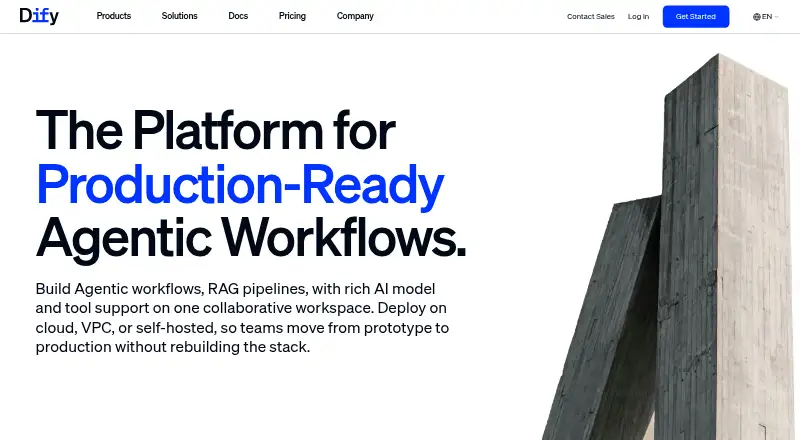
What Dify is
Dify is an open-source platform for building AI applications with workflows, knowledge retrieval, model management, observability, and tools. Its visual Workflow Studio lets teams arrange model calls, retrieval, code, branching, triggers, tools, and human review on a shared canvas. Workflows can start from user input, API calls, schedules, webhooks, plugin events, or uploaded payloads. Knowledge Pipeline turns files, online documents, drives, crawlers, and web content into searchable knowledge bases with metadata and citations. Retrieval can be semantic, keyword-based, hybrid, or reranked, with metadata filters. Applications can be published as hosted web apps, website embeds, API endpoints, or MCP servers. Dify connects with model providers including OpenAI, Anthropic, Google Gemini, and xAI, and its Marketplace lists more than 200 tools. The Community Edition is self-deployable with Docker; Enterprise deployment options include customer VPCs, on-premises environments, and air-gapped networks. The Sandbox and Community plans are free. Professional is listed at $590 per workspace per year, while Team is $1590 per workspace per year; Enterprise pricing is custom.
Good
- Visual canvas includes branching and human review.
- Knowledge bases support citations and metadata filters.
- Publish as web apps, embeds, APIs, or MCP servers.
- Community Edition can be self-hosted with Docker.
- Enterprise supports air-gapped deployment.
Watch out
- Sandbox limits usage to 200 message credits.
- Professional costs $590 per workspace per year.
- Enterprise pricing is custom.
Who it suits
Dify is suited to teams building AI applications that need visual workflow design, knowledge grounding, and multiple publishing options. Its Community Edition may suit users who want to self-host with Docker.
Verdict
Dify combines workflow building, retrieval, model connections, and several deployment paths. The free plans have stated workspace and usage limits, while paid and enterprise options expand capacity and controls.
Plans and prices
From Dify's own pricing page, checked 15 Oct 2026.
| Plan | Price | What it gives you |
|---|---|---|
| Sandbox | Free | 200 message credits · 1 workspace · 1 member · 5 apps · 50 knowledge documents · 50MB storage · 3,000 trigger events · 30-day logs · 5,000 API calls/month |
| Community | Free | core public-repository features · single workspace · subject to Dify Open Source License |
| Professional | $59 a month | 5,000 message credits/month · 3 members · 50 apps · 500 documents · 5GB storage · unlimited logs · no Dify API rate limit · monthly |
| Team | $159 a month | 10,000 message credits/month · 50 members · 200 apps · 1,000 documents · 20GB storage · unlimited triggers · unlimited logs · no Dify API rate limit · monthly |
| Professional | $590 a year | 5,000 message credits/month · 3 members · 50 apps · 500 documents · 5GB storage · unlimited logs · no Dify API rate limit · annually |
| Team | $1,590 a year | 10,000 message credits/month · 50 members · 200 apps · 1,000 documents · 20GB storage · unlimited triggers · unlimited logs · no Dify API rate limit · annually |
| Enterprise | Priced on request | commercial license authorization · multiple workspaces · SSO · advanced security controls · negotiated SLAs · official updates and maintenance · professional support |
The facts
Each one read from Dify's own pages, with the date it was checked.
What it does
- Adoption claim
- The March 2026 funding announcement said Dify ran on more than 1.4 million machines and had more than 280 enterprise customers.checked 15 Oct 2026
- Agents
- Agents can be configured conversationally or manually, published as apps, embedded in websites, or reused as workflow nodes.checked 15 Oct 2026
- API authentication
- API calls use Bearer keys, with app keys scoped to one app and knowledge keys optionally scoped to selected knowledge bases.checked 15 Oct 2026
- API hosting
- Dify Cloud uses https://api.dify.ai/v1 while self-hosted deployments use the instance’s own API base URL.checked 15 Oct 2026
- API surface
- Every published app and knowledge base has a REST API; the documentation covers chat, completion, workflow, conversation, file, audio, feedback, annotation, end-user, and knowledge endpoints.checked 15 Oct 2026
- Chrome extension rating
- The Chrome Web Store listing for Dify Chatbot shows 3.6 out of 5 from 13 ratings and about 8,000 users.checked 15 Oct 2026
- Compliance
- Dify reports completing SOC 2 Type II and ISO 27001:2022 audits and maintaining GDPR compliance for the second consecutive year.checked 1 Oct 2026
- Docker architecture
- The quick start launches seven core services, eight dependent components, and a one-time permissions task.checked 15 Oct 2026
- Enterprise controls
- Enterprise includes SAML/OIDC SSO, workflow-level RBAC, SCIM provisioning, tamper-evident audit logs, per-call traces, and PII-redacted prompt history.checked 1 Oct 2026
- Enterprise deployment
- Dify Enterprise can run inside a customer VPC, on-premises, or in an air-gapped network, with Helm deployment for Kubernetes.checked 1 Oct 2026
- Enterprise security
- The official product page lists SSO/SAML, RBAC, audit logs, SOC 2 Type II, ISO 27001, and dedicated support for Enterprise.checked 15 Oct 2026
- Funding news
- On March 9, 2026, Dify announced a $30 million Series Pre-A round led by HSG at a $180 million valuation.checked 15 Oct 2026
- Independent limitation: operational burden
- ToolVerse says self-hosting shifts responsibility for databases, vector stores, secrets, backups, upgrades, capacity, and incident response to the customer.checked 15 Oct 2026
- Independent limitation: retrieval assurance
- ToolVerse says Dify’s visual RAG workflow does not itself prove answer correctness, permission safety, freshness, or recoverability, so buyers need representative evaluations.checked 15 Oct 2026
- Integrations
- The Marketplace provides model providers, tools, data sources, MCP integrations, and reusable plugins, with support for custom definitions.checked 15 Oct 2026
- Knowledge Pipeline
- Knowledge Pipeline ingests files, websites, online documents, and drives, then extracts, chunks, indexes, and tests retrieval.checked 15 Oct 2026
- Knowledge pipelines
- Knowledge Pipeline turns files, online documents, drives, crawlers, and web content into searchable knowledge bases with metadata and citations.checked 1 Oct 2026
- License
- Dify uses a modified Apache 2.0 license with restrictions on unauthorized multi-tenant operation and removing frontend branding or copyright notices.checked 15 Oct 2026
- Limit: support responsiveness
- The same G2 review said paid-plan support sometimes returned generic documentation referrals instead of implementation help.checked 15 Oct 2026
- Limit: workflow variables
- A G2 reviewer reported that hidden startup variables, low cloud variable-size limits, and missing list-membership operations blocked some personalization and routing workflows.checked 15 Oct 2026
The company
- Company headquarters and size
- LinkedIn lists Dify headquarters in Menlo Park, California, with a company size of 51–200 employees.checked 15 Oct 2026
- Company legal name
- Dify’s terms identify the provider as LangGenius, Inc., a Delaware corporation.checked 15 Oct 2026
- Founded
- G2 lists Dify as serving customers since 2023 and gives a 2023 founding year.checked 15 Oct 2026
- Headquarters
- California, United Stateschecked 28 Sep 2026
Alternatives to Dify
- 1

RAGFlow
Free planOpen sourceWebAPILinuxmacOS8.0From $29 a month - 2

AnythingLLM
Free planAndroidWebAPILinux7.9From $50 a month - 3
Flowise
Free planWebAPILinuxmacOS7.2From $35 a month - 4

LlamaIndex
Free planWebAPILinuxSelf-hosted7.1From $50 a month - 5
PrivateGPT
Free planWebAPILinuxmacOS6.9Free plan - 6

LangChain
Free planAPISelf-hosted6.8$39 usage-based