PrivateGPT
PrivateGPT is a free, open-source API layer for building private AI applications on your own infrastructure.
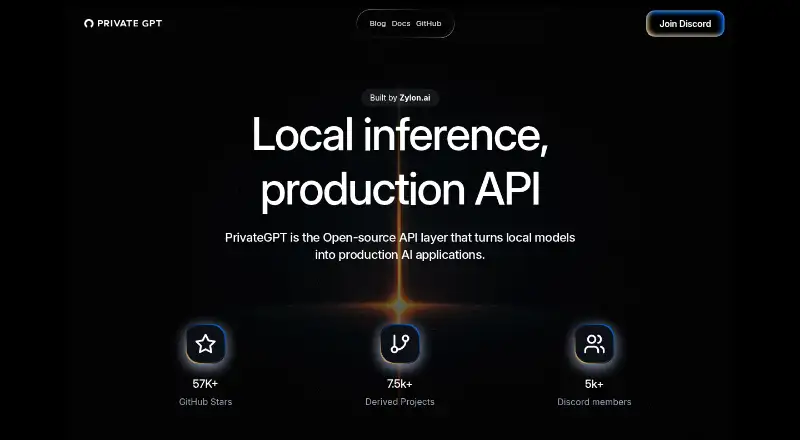
What PrivateGPT is
PrivateGPT is a free, open-source API layer for building private AI applications on your own infrastructure. It connects to an OpenAI-compatible inference server rather than running models itself; that server can be local or remote. The Messages API supports streaming, asynchronous processing, and token counting. Developers can ingest files and other artifacts, retrieve relevant material with citations, and access databases and tabular data such as CSVs. Documented tools include web search and extraction, code execution, custom tools, and MCP connectors. A browser-based workbench at `/ui` supports testing, demos, and API-request inspection, but it is described as a local demonstrator: chats and settings stay in browser localStorage, and it has no access control. Deployment options include a Python package, source installation, or Docker. Package installation requires Python 3.11; Python 3.10 and Python 3.12 or later are unsupported. The project documents connections to Ollama, LM Studio, llama.cpp, and vLLM, and lists tools such as VS Code, Cline, and n8n as compatible integrations.
Good
- Free and open source
- Supports document retrieval with citations
- Offers Python, source, and Docker installation
- Connects to local or remote inference servers
Watch out
- Does not run models itself
- Package installation requires Python 3.11
- Workbench has no access control
Who it suits
PrivateGPT is aimed at developers who want an open-source application layer and API for private AI products. It suits users prepared to configure a separate OpenAI-compatible inference server.
Verdict
PrivateGPT provides a flexible API and document workflow layer, but requires a separate inference server. Its workbench is a demonstrator rather than an access-controlled interface.
Plans and prices
From PrivateGPT's own pricing page, checked 9 Oct 2026.
| Plan | Price | What it gives you |
|---|---|---|
| PrivateGPT | Free | Open-source API layer; self-hosted; connects to a separate OpenAI-compatible inference server |
The facts
Each one read from PrivateGPT's own pages, with the date it was checked.
What it does
- API
- Its Messages API supports streaming, asynchronous processing, and token counting.checked 4 Oct 2026
- Data tools
- It provides structured access to databases and tabular data such as CSVs.checked 4 Oct 2026
- Deployment
- PrivateGPT can be installed as a Python package, from source, or with Docker, and runs as a local server.checked 4 Oct 2026
- Developer integrations
- The maker lists Claude Code, OpenCode, VS Code, Cline, and n8n as compatible tools or workflow integrations.checked 4 Oct 2026
- Document workflows
- It supports file and artifact ingestion, retrieval-augmented generation, and citation support.checked 4 Oct 2026
- Inference
- PrivateGPT does not run models itself and connects to an external OpenAI-compatible inference server.checked 9 Oct 2026
- Inference providers
- The documentation lists Ollama, LM Studio, LlamaCPP, and vLLM as inference provider options.checked 9 Oct 2026
- Installation requirement
- The package installation guide requires Python 3.11 and says Python 3.10 and 3.12 or later are unsupported.checked 4 Oct 2026
- Integrations
- Documented integration guides cover Claude Code, Claude Desktop, Claude for Microsoft 365, and OpenCode.checked 9 Oct 2026
- Intended user
- The maker recommends PrivateGPT for users who want an open-source local AI application layer and developer API.checked 4 Oct 2026
- Limitations
- The compatibility table marks skills as basic or in progress and prompt caching and OAuth or organizations as unsupported.checked 9 Oct 2026
- MCP and tools
- It supports custom tools and MCP connectors, with MCP usage documented through the Messages API.checked 4 Oct 2026
- Messages API
- Its messages API supports streaming, asynchronous processing, and token counting.checked 9 Oct 2026
- Observability
- Optional observability can emit traces for LLM calls, embedding requests, and retrieval steps, with console, Arize Phoenix, and Opik backends documented.checked 9 Oct 2026
- Privacy
- The maker says PrivateGPT lets developers build private AI products without depending on cloud AI APIs; it can connect to local or remote OpenAI-compatible servers.checked 4 Oct 2026
- Product
- PrivateGPT is an open-source API layer for building private AI applications on local models.checked 4 Oct 2026
- Purpose
- PrivateGPT provides an open-source API layer for building private AI applications on your own infrastructure.checked 9 Oct 2026
- Python requirement
- The package guide requires Python 3.11 and says Python 3.10 and Python 3.12 or later are unsupported.checked 9 Oct 2026
- Retrieval
- The API supports file and artifact ingestion and retrieval with citations.checked 9 Oct 2026
- Storage
- The package guide says application data, including the vector store, ingested documents, models, and caches, is stored under a local home directory by default.checked 9 Oct 2026
- Support
- The maker links to a community Discord for users.checked 4 Oct 2026
- Tools
- Documented capabilities include database querying, CSV and tabular analysis, web search and extraction, MCP, code execution, and custom tools.checked 9 Oct 2026
Where it runs
- Install platforms
- The package installation guide provides instructions for macOS, Linux, and Windows, and the project also documents Docker installation.checked 9 Oct 2026
The company
- Maker
- The PrivateGPT site identifies Zylon as its maker and lists PriBAI Technology Corp in its copyright notice.checked 9 Oct 2026
The full review of PrivateGPT
PrivateGPT suits developers building private AI applications around models they operate or select. Its strength is a flexible API for documents, data, and tools; its trade-off is that you must supply and maintain the inference server.
Overview
PrivateGPT is a free, open-source API layer that runs as a local server. It connects to OpenAI-compatible inference servers such as Ollama, LM Studio, llama.cpp, and vLLM rather than running models itself. That separation gives developers room to choose their model setup, but means PrivateGPT is not a complete, ready-to-use AI service.
By default, application data—including ingested documents, vector-store data, models, and caches—is stored under a local home directory. Developers can also connect to remote compatible servers, so local storage does not by itself ensure that inference stays on the same machine. Optional observability can emit traces for LLM calls, embedding requests, and retrieval steps, with console, Arize Phoenix, and Opik backends.
Key features
The Messages API supports streaming, asynchronous processing, and token counting, giving application developers controls for building beyond a basic prompt-and-response flow. File and artifact ingestion feed retrieval-augmented generation, and citations let users trace answers to source material.
PrivateGPT extends beyond document retrieval with structured access to databases and tabular data such as CSVs. Its documented capabilities also include web search and extraction, code execution, custom tools, and MCP connectors; MCP usage is documented through the Messages API. This breadth makes it a useful application layer for varied workflows, though the compatibility table marks skills as basic or in progress and prompt caching and OAuth or organizations as unsupported.
A browser workbench at /ui can help developers test, demonstrate, and inspect API requests. It is explicitly a local demonstrator, not a secure shared interface: chats and settings are stored in browser localStorage, and the workbench has no access control.
Pricing
The PrivateGPT plan costs nothing. It provides the open-source API layer for self-hosting and connects to a separate OpenAI-compatible inference server. That makes it a straightforward fit for developers who can manage their own deployment and model infrastructure; it is not a bundled model-hosting plan.
Platforms
PrivateGPT supports API use and self-hosted deployment, with package installation instructions for macOS, Linux, and Windows, plus Docker installation. The package route requires Python 3.11; Python 3.10 and Python 3.12 or later are unsupported. That narrow version requirement is a practical constraint when fitting it into an existing development environment.
Who it's for
PrivateGPT is best suited to developers who want an open-source layer for private AI products, need document retrieval with citations, or want to combine document workflows with structured data and tools. Its API and deployment choices are more compelling for teams building an application than for people looking for a finished chat product. The maker links to a community Discord for users.
Pros and cons
- Open-source and free: self-hosting avoids a PrivateGPT plan charge and gives developers control over deployment.
- Broad developer workflow support: the API combines document ingestion, retrieval with citations, tabular data access, and tool integrations.
- Inference is a separate dependency: users must provide an OpenAI-compatible model server, adding setup and operational responsibility.
- Workbench is not access-controlled: localStorage-based chats and settings make it a poor choice as a shared production interface.
- Python version constraint: package installation requires Python 3.11 and excludes both Python 3.10 and 3.12 or later.
Alternatives
For a broader comparison, see Retrieval-Augmented Generation Tools.
- AnythingLLM is worth considering if you want an alternative with Android support and a self-hosted Docker option, or prefer its freemium plans.
- Flowise may suit readers seeking a free tier with stated flow, prediction, and storage limits, plus a free trial.
- I3K RAG Enterprise offers a free AGPL-3.0 self-hosted Community plan with Linux, ARM64, or Windows support.
- RAGFlow is an option for readers who want a free plan with stated app, team, dataset-storage, and monthly-credit limits.
- txtai is another free, open-source API and self-hosted option, installable with pip or Docker.
- RAGStack may fit developers looking for a free open-source RAG package using Astra DB Serverless or Apache Cassandra as a vector store.
- LlamaIndex is an alternative if you want its open-source LlamaIndex and Workflows projects, with LlamaParse offered as a commercial platform.
- OpenRAG provides an AGPL-3.0 self-hosted option deployed on your own infrastructure.
Verdict
Choose PrivateGPT if you are building an application and want a free, open-source API layer for document, data, and tool workflows around an inference server you control. Look elsewhere if you need models included or a secure, access-controlled workbench rather than a local demonstrator.
Getting started
- Choose an OpenAI-compatible inference server such as Ollama, LM Studio, llama.cpp, or vLLM.
- Install PrivateGPT as a Python package, from source, or with Docker.
- Use Python 3.11 for package installation.
- Run PrivateGPT as a local server.
- Open `/ui` in a browser to test requests and demos.
- Connect files, databases, tabular data, tools, or MCP connectors through the API.
Limits worth knowing
PrivateGPT is free and requires a separate OpenAI-compatible inference server for model inference. The browser workbench stores chats and settings in localStorage and has no access control; package installation supports Python 3.11 only.
Questions
Is PrivateGPT free?
Yes. The listed plan is free, and the project is open source.
Does PrivateGPT run AI models itself?
No. It connects to a separate local or remote OpenAI-compatible inference server.
Which platforms can run it?
Documentation covers macOS, Linux, and Windows package installation, plus Docker, self-hosting, web, and API use.
What does the Messages API provide?
It supports streaming, asynchronous processing, token counting, retrieval with citations, and MCP usage.
Who makes PrivateGPT?
The PrivateGPT site identifies Zylon as its maker and links to a community Discord.
Does it support citations for documents?
Yes. File and artifact ingestion and retrieval workflows can provide source citations.
Alternatives to PrivateGPT
- 1

Dify
Free planOpen sourceWebAPIExtensionLinux8.4From $590 a year - 2

RAGFlow
Free planOpen sourceWebAPILinuxmacOS8.0From $29 a month - 3

AnythingLLM
Free planAndroidWebAPILinux7.9From $50 a month - 4
Flowise
Free planWebAPILinuxmacOS7.2From $35 a month - 5

LlamaIndex
Free planWebAPILinuxSelf-hosted7.1From $50 a month - 6

LangChain
Free planAPISelf-hosted6.8$39 usage-based