
Quemsi
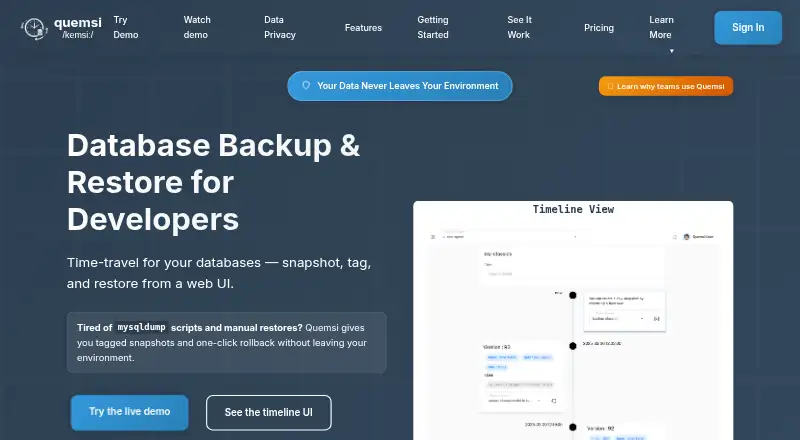
Quemsi is a hybrid tool for managing database backups and restores through a web interface.
What Quemsi is
Quemsi is a hybrid tool for managing database backups and restores through a web interface. It provides tagged database snapshots, a timeline view, and one-click restore, and supports MySQL, PostgreSQL, SQL Server, and MongoDB. Backup and restore flows can include custom steps such as stopping services or running scripts. Backups can be kept in AWS S3, Azure Blob, or local drives under the user's control. Quemsi's agent performs backup and restore operations within the user's infrastructure; the cloud service handles metadata rather than database content. The agent is available for Windows, Linux, and macOS, and can also run as a Java JAR or Docker container. Quemsi describes the agent as open source and says users can audit, modify, or build it from source. Its stated security measures include TLS 1.3 for agent-to-cloud communication, certificate-based mutual TLS for agents, and SHA-256 checksums for backup integrity. Example REST endpoints cover flow execution and queries for agents and executions, while full API documentation is described as forthcoming. The free Solo plan has no time limit and includes unlimited databases, environments, and flows for one user, with community support.
Good
- Supports MySQL, PostgreSQL, SQL Server, and MongoDB.
- Free Solo includes unlimited databases, environments, and flows.
- Custom flows can stop services or run scripts.
- Backups can use AWS S3, Azure Blob, or controlled local drives.
- Agent is described as open source.
- Agent operates within the user's infrastructure.
Watch out
- Solo is limited to a single user.
- Solo includes community support; priority support is an Enterprise feature.
- Full API documentation is described as forthcoming.
Who it suits
Quemsi suits individual developers who want to manage database snapshots and restore flows without a time-limited Solo plan. Companies may consider Enterprise for its listed authorization, CI/CD, priority support, and organizational additions.
Verdict
Pick Quemsi if you want a free, single-user way to organize snapshots and database restore flows across its four supported database systems.
Plans and prices
From Quemsi's own pricing page, checked 21 Oct 2026.
| Plan | Price | What it gives you |
|---|---|---|
| Solo | Free | Unlimited databases · Unlimited environments · Unlimited flows · Core functionality · Single user · Community support |
| Enterprise | Priced on request | Everything in Solo · Detailed authorization · CI/CD integration · Extra functionality · Priority support · Organizational features |
The facts
Each one read from Quemsi's own pages, with the date it was checked.
What it does
- Agent architecture
- A locally deployed agent performs database operations while the cloud handles metadata, authentication and coordination.checked 21 Oct 2026
- API
- The architecture page lists example REST endpoints for executing flows and querying agents and flow executions, and says full API documentation will be provided in the future.checked 9 Oct 2026
- API authentication
- Company API tokens use qsk-prefixed secrets with selectable scopes and optional agent binding.checked 21 Oct 2026
- API limitation
- The architecture page says complete API documentation is planned for a future release.checked 21 Oct 2026
- Audience
- The Solo plan is described as being for individual developers, while Enterprise is described as being for companies.checked 9 Oct 2026
- Automation
- Recurring flows can be scheduled with timers and triggered through the UI, CLI or API.checked 21 Oct 2026
- Backup flow model
- Backup flows require a source and destination, with optional processing steps such as Zip.checked 21 Oct 2026
- CI integration
- The documented API and CLI support snapshot-before-deploy and restore-before-tests workflows.checked 21 Oct 2026
- CLI
- Quemsi publishes a CLI for Linux, Windows and Java 21 JAR execution, with --wait enabled by default.checked 21 Oct 2026
- Cross-environment sharing
- Snapshots can be shared between development, testing and production environments while remaining in customer-controlled infrastructure.checked 21 Oct 2026
- Databases
- The product supports MySQL, PostgreSQL, SQL Server, and MongoDB.checked 9 Oct 2026
- Data residency
- Quemsi states that database contents and backups remain in the customer's environment and only metadata is sent to the cloud.checked 21 Oct 2026
- Demo
- The demo supplies preconfigured databases and flows, requires no installation or credit card, and resets every day at midnight.checked 21 Oct 2026
- Deployment options
- Agents can run as Windows, Linux or macOS services, standalone processes, Docker containers or Java JARs.checked 21 Oct 2026
- Developer stack
- The repository describes the agent as a Spring Boot and GraalVM project that can be built by users.checked 21 Oct 2026
- Flow customization
- Backup and restore flows can include custom workflows such as stopping services and running scripts.checked 9 Oct 2026
- Independent listing
- UMA Technology lists Quemsi at 7.4 out of 10 from 26 directory entries.checked 21 Oct 2026
- Licence
- The public quemsi-agent repository identifies its licence as LGPL-2.1.checked 21 Oct 2026
- Limit: customer responsibility
- The terms require customers to deploy, patch and secure agents, credentials, retention rules and database contents themselves.checked 21 Oct 2026
- Limit: future processing
- The architecture page says additional processing options will be added in future releases.checked 21 Oct 2026
Where it runs
- Agent platforms
- The agent is available for Windows, Linux, and macOS, and can also run as a Java JAR or Docker container.checked 9 Oct 2026
Money
- Free usage
- The site says the Solo plan has no time limit and includes core features without restriction.checked 9 Oct 2026
The company
- Headquarters
- The privacy policy gives Quemsi GmbH's postal address as Leopoldstraße 24, 12305 Berlin, Germany.checked 21 Oct 2026
- Legal maker
- The terms identify the provider as Quemsi GmbH.checked 21 Oct 2026
The full review of Quemsi
Quemsi is a hybrid database backup and restore service built around tagged snapshots and configurable flows. It is best suited to developers and organizations managing MySQL, PostgreSQL, SQL Server, or MongoDB who want backups to run within their own infrastructure.
Its strongest case is the combination of user-controlled storage and a web interface for tracking and restoring snapshots; the free Solo plan’s single-user limit makes it less suitable for teams collaborating in the product.
Overview
Quemsi pairs a cloud service for metadata with an agent that performs backup and restore operations inside the user's infrastructure. That separation lets users coordinate work through a web UI without sending database content to the cloud service. It is a practical fit when infrastructure control matters as much as a central view of recovery points.
Key features
Snapshots can be tagged and viewed on a timeline, with one-click restore through the web UI. Tags and chronology help distinguish recovery points, while the direct restore action keeps recovery accessible without leaving the interface.
Backup and restore flows can include steps such as stopping services or running scripts. This flexibility suits environments where database operations need to fit a broader sequence, though users must configure those steps for their own workflows.
Storage options include AWS S3, Azure Blob, and local drives under the user's control. Quemsi's architecture uses TLS 1.3 for agent-to-cloud communication, certificate-based mutual TLS for agents, and SHA-256 checksums to verify backup integrity. Its agent is open source, so users can audit or modify it, or build it from source.
The agent runs on Windows, Linux, and macOS, and can also run as a Java JAR or Docker container. The architecture page gives example REST endpoints for executing flows and querying agents and flow executions; full API documentation is planned for the future, so API-focused users should account for that limitation.
Pricing
Quemsi uses a freemium model. Solo costs nothing and includes unlimited databases, environments, and flows, with a single user and community support. The site says the plan has no time limit and includes core features without restriction. It is a substantial allowance for an individual developer, but the one-seat cap rules it out as a shared team workspace.
Enterprise has custom pricing and includes everything in Solo, plus detailed authorization, CI/CD integration, extra functionality, priority support, and more organizational features. It is aimed at companies that need those controls and integrations; organizations should weigh the custom-price model against their requirements.
Platforms
Quemsi supports API, Linux, macOS, web, and Windows. Its agent options cover Windows, Linux, and macOS, with Java JAR and Docker deployment also available. This mix supports varied deployment environments, while the web UI provides the central way to view snapshots and manage restores.
Who it's for
Solo developers can use the free plan to manage multiple databases, environments, and flows without a time limit, provided one user is enough. Companies may find Enterprise a better fit when detailed authorization, CI/CD integration, or priority support is needed. Quemsi is less appropriate for teams that need several users on the free plan or for buyers who require full API documentation before adopting an API-driven workflow.
Pros and cons
- Pros: Unlimited databases, environments, and flows on the free Solo plan give an individual room to manage multiple backup workflows.
- Pros: User-controlled storage and in-infrastructure backup operations keep database content separate from the cloud metadata service.
- Pros: Custom flow steps, open-source agent code, and integrity checks support operational flexibility and inspection.
- Cons: Solo is limited to one user, which makes it a poor fit for shared use without moving to Enterprise.
- Cons: Full API documentation is still planned, limiting the appeal for teams that need documented endpoints before integrating.
- Cons: Enterprise pricing is custom, so companies cannot assess its cost from a fixed published price.
Alternatives
For a wider category comparison, browse Database Backup Software.
- MySQL is worth considering for its GPL-licensed Community Edition, which includes SQL and NoSQL applications plus replication and high-availability components.
- DBDock is a free, MIT-licensed, self-hosted CLI option for readers who prefer that deployment model.
- Percona Backup for MongoDB is another free option for readers focused on MongoDB backup.
- SqlBak may suit users who want a defined free allowance of one server, two databases, and one-month backup history, with a Standard plan at $6 a month.
- WAL-G is a free, Apache License 2.0 database archiving and restoration tool for readers who prefer that approach; LZO support uses GPL 3.0+.
- DBAegis offers a free Community plan with one admin, three connections, and three schedules for users whose needs fit those caps.
- mariadb-backup is a free option for physical MariaDB backups on Linux and Windows.
- Barman is a free open-source PostgreSQL disaster recovery tool for Linux and self-hosted environments.
Verdict
Choose Quemsi if you are an individual developer who wants a free, single-user way to organize snapshots and database restore flows across its four supported database systems. Its combination of customizable operations, user-controlled storage, and an agent that works inside your infrastructure is the main reason to pick it. Look elsewhere if several users need access on the free tier or if your team depends on full API documentation before integrating.
Getting started
- Visit the Quemsi website.
- Choose the free Solo plan for individual use, or consider Enterprise for company-oriented features.
- Install or run an agent for Windows, Linux, or macOS; agents can also run as a Java JAR or Docker container.
- Choose AWS S3, Azure Blob, or a local drive under your control for backups.
- Configure backup or restore flows, including custom steps if needed.
Limits worth knowing
The Solo plan is for one user and includes community support. Detailed Authorization, CI/CD integration, extra functionality, priority support, and more organizational features are listed for Enterprise instead.
Questions
Is Quemsi free?
The Solo plan is free at no cost, with no time limit and core features without restriction.
Which databases does it support?
Quemsi supports MySQL, PostgreSQL, SQL Server, and MongoDB.
Where can backups be stored?
Backups can be stored in AWS S3, Azure Blob, or local drives under the user's control.
Is the agent open source?
Yes. Quemsi describes its agent as open source and says users can audit, modify, or build it from source.
Which platforms can run the agent?
The agent is available for Windows, Linux, and macOS, and can also run as a Java JAR or Docker container.
Alternatives to Quemsi
- 1

MySQL
Free planAPILinuxmacOSSelf-hosted7.9Free plan - 2

SqlBak
Free planWebAPILinuxSelf-hosted7.6From $6 a month - 3

DBDock
Free planOpen sourceWebAPILinuxmacOS7.5Free plan - 4

IBM Db2
Free planWebAPILinuxSelf-hosted7.4From $630 a month - 5
DBAegis
Free planOpen sourceWebAPILinuxSelf-hosted7.2Free plan - 6

DT Database Backup Wizard
Free planWindows7.2Free plan