
Qualflare
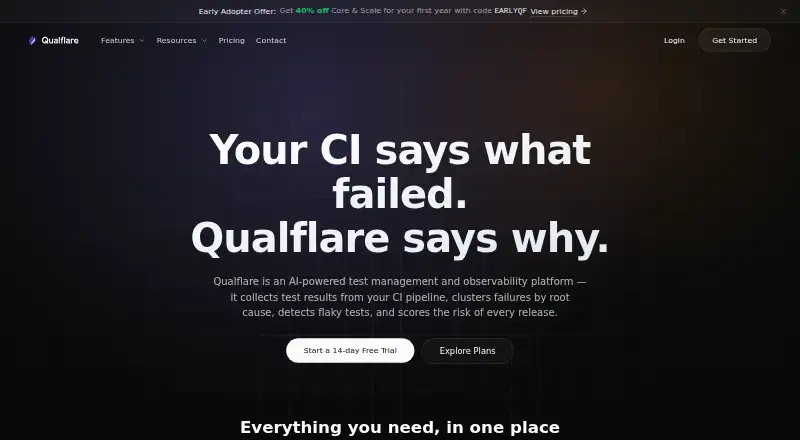
Qualflare is an AI-powered test management and observability platform for teams that want to collect CI results, organize failures, detect flaky tests, and a…
What Qualflare is
Qualflare is an AI-powered test management and observability platform for teams that want to collect CI results, organize failures, detect flaky tests, and assess release risk. Teams can manage manual tests in its web app or use the CLI to upload automated results. The CLI supports 23 testing frameworks, including JUnit, pytest, Jest, Playwright, Cypress, Newman, k6, and security tools. Its AI assistant, Quo, can identify coverage gaps, suggest test cases, draft test steps, and answer questions about test data. AI Failure Clusters group similar issues and provide root-cause summaries, fix suggestions, and severity information. Integrations include GitHub, GitLab, Jira, Slack, Discord, Jenkins, and custom webhooks. Qualflare also provides a REST API with project-scoped access tokens. Mobile test results can be ingested, but the platform does not provision devices or run mobile tests.
Good
- Supports 23 testing frameworks through its CLI.
- AI assistant analyzes coverage gaps and suggests test cases.
- Failure clusters include root-cause summaries and severity information.
- Integrates with GitHub, GitLab, Jira, Slack, and others.
Watch out
- Does not provision devices or run mobile tests.
- No self-hosted deployment option.
- SOC 2 Type II and ISO 27001 certifications are not held.
Who it suits
Qualflare suits software teams coordinating manual and automated test management across supported frameworks and CI/CD workflows. It can also fit teams that need failure analysis or mobile test-result ingestion without running mobile tests through the platform.
Verdict
Qualflare combines test management, CI result collection, and AI-assisted failure analysis, with a free plan and paid plans from $16/user/mo (annual). Teams should note its lack of self-hosting and that it ingests, rather than runs, mobile tests.
Plans and prices
From Qualflare's own pricing page, checked 15 Oct 2026.
| Plan | Price | What it gives you |
|---|---|---|
| Open source plan | Free | Public OSI-licensed repository · public report page · README badge/banner · higher usage limits than Starter · Free for eligible public GitHub projects |
| Starter | Free | 1 project · 1 active user · 200 test cases · 100 test reports · API access · basic analytics · CI/CD integrations · community support · $0 / user / mo |
| Core | $16 a month | 3 projects · 10 active users · 1,000 test cases · 2,000 test reports · shared steps and plans · unlimited AI analysis and RCA · priority email support · $9.60 / user / mo for first 12 months with 40% early-adopter discount, then $16 |
| Scale | $48 a month | 10 projects · 30 active users · 5,000 test cases · 10,000 test reports · advanced analytics · AI suite optimization · priority email support · $28.80 / user / mo for first 12 months with 40% early-adopter discount, then $48 |
| Enterprise | Priced on request | Unlimited projects and users · unlimited test cases and reports · SSO · custom branding · 99.9% SLA · 24/7 support · Custom |
The facts
Each one read from Qualflare's own pages, with the date it was checked.
What it does
- AI analysis
- Its Quo Agent can identify coverage gaps, suggest test cases, and help investigate flaky suites.checked 15 Oct 2026
- AI assistant
- Quo analyzes coverage gaps, suggests test cases, generates test steps, and answers questions about test-management data.checked 1 Oct 2026
- API
- Qualflare provides a REST API for managing test cases, uploading results, querying launches, and accessing other test data with project-scoped access tokens.checked 1 Oct 2026
- Certification limitation
- The GDPR page says Qualflare itself does not hold SOC 2 Type II, ISO 27001, or GDPR certification.checked 15 Oct 2026
- CLI installation
- The qf CLI is distributed through Homebrew, a curl installer, Chocolatey, Docker, and downloadable binaries.checked 15 Oct 2026
- CLI licence
- The published @qualflare/cli package is Apache-2.0 licensed, has no runtime dependencies, and provides macOS, Linux, and Windows binaries.checked 15 Oct 2026
- CLI query features
- CLI commands can validate files, upload collections, and query suites, cases, plans, launches, defects, clusters, and milestones with JSON output.checked 15 Oct 2026
- Compliance
- Qualflare stores customer data in the European Union and states that it does not currently hold SOC 2 Type II or ISO 27001 certification.checked 1 Oct 2026
- Data retention
- Project retention defaults are 30 days for Starter, 90 days for Core, one year for Scale, and custom retention for Enterprise.checked 1 Oct 2026
- Defect automation
- Core and higher plans can automatically create defects from failed test results.checked 15 Oct 2026
- Documentation and support
- Qualflare provides a searchable documentation site, FAQ, troubleshooting guides, GitHub discussions/issues, status page, and direct support channels.checked 15 Oct 2026
- Failure analysis
- AI Failure Clusters group similar failures and provide root-cause summaries, fix suggestions, and severity information.checked 1 Oct 2026
- Failure clustering
- Qualflare groups related failures and provides root-cause analysis for paid Core features and above.checked 15 Oct 2026
- Flaky detection
- All listed plans include flaky-test detection for identifying unstable tests.checked 15 Oct 2026
- Framework coverage
- The CLI accepts results from frameworks and tools including JUnit, pytest, Jest, Playwright, Cypress, Selenium, Appium, Newman, k6, OWASP ZAP, Trivy, Snyk, and SonarQube.checked 15 Oct 2026
- Framework support
- The Qualflare CLI parses and uploads results from 23 testing frameworks, including JUnit, pytest, Jest, Playwright, Cypress, Newman, k6, and security tools.checked 1 Oct 2026
- GDPR posture
- Qualflare says EU customer data is stored in Google Cloud Warsaw with EU routing, uses TLS 1.2+, AES-256 at rest, staff MFA, access auditing, and SCC-based contractual protections.checked 15 Oct 2026
- Go SDK limitation
- The qualflare-go reporter is Apache-2.0 and has documented limitations involving pre-1.24 Go builds, goroutine metadata, and retry handling.checked 15 Oct 2026
Where it runs
- Browser support
- The service supports current Chrome, Firefox, Safari, and Edge browsers.checked 15 Oct 2026
The company
- Company founding
- G2 lists Qualflare as serving customers since 2026.checked 15 Oct 2026
- Company legal identity
- Crunchbase lists the active private company as Qualflare OÜ and names İbrahim Süren as founder.checked 15 Oct 2026
- Company location
- Company listings place Qualflare in Tallinn, Harjumaa, Estonia.checked 15 Oct 2026
- Company size
- Crunchbase places Qualflare in the 1–10 employee range.checked 15 Oct 2026
- Headquarters
- Tallinn, Estoniachecked 28 Sep 2026
The full review of Qualflare
Qualflare is a test-management and observability platform for teams that want to bring manual cases and automated CI results together. It is strongest for software teams working across multiple test frameworks and looking for AI-assisted triage. Its tiered quotas and result-focused mobile support make the plan choice important.
Overview
Qualflare pairs manual test management in a web application with automated result uploads through a CLI. The CLI supports 23 frameworks, from JUnit, pytest and Jest to Playwright, Cypress, k6 and security tools. That breadth is useful for teams with mixed test stacks: they can collect results across those frameworks without consolidating on one runner.
The platform also reports execution trends, detects flaky tests and scores release risk. These signals add context to test results, but they do not replace a team's own release judgment. Qualflare collects results; it does not run mobile tests or provision Android and iOS devices.
Key features
- AI-assisted test planning: Quo identifies coverage gaps, suggests test cases, generates test steps and answers questions about test-management data. This can help teams turn existing test information into follow-up work.
- Failure triage: AI Failure Clusters group similar failures and provide root-cause summaries, fix suggestions and severity information. That is most useful when teams need to sort recurring failures; the suggestions still require engineering review.
- Integrations and API: GitHub, GitLab, Jira, Slack, Discord, Jenkins and custom webhooks support defect synchronization, notifications and CI/CD workflows. The REST API supports test-case management, result uploads and launch queries, using project-scoped access tokens.
- Security and data location: Qualflare states that it uses TLS 1.2+ in transit, AES-256 at rest, role-based access control, mandatory SSO and MFA for staff, and immutable employee-access audit logs. Customer data is stored in the European Union. Teams that require SOC 2 Type II or ISO 27001 certification should look elsewhere; Qualflare does not currently hold either.
Pricing
Qualflare has a free plan, a 14-day trial and paid plans priced per user. Core and Scale show 40% early-adopter discounts for the first 12 months; the quoted discounted rates are $9.60/user/mo and $28.80/user/mo, respectively. The plans are billed annually, while the standard paid prices are $16.00 and $48.00 per month. Compare the post-discount rate and the quotas against your expected usage before committing.
| Plan | Price | Limits and support |
|---|---|---|
| Starter | free | 1 project, 1 active user, 200 test cases and 100 test reports; community support; 30-day retention. |
| Core | $16 a month; 40% early-adopter discount: $9.60/user/mo for first 12 months | 3 projects, 10 active users, 1,000 test cases and 2,000 test reports; priority email support; 90-day retention. |
| Scale | $48 a month; 40% early-adopter discount: $28.80/user/mo for first 12 months | 10 projects, 30 active users, 5,000 test cases and 10,000 test reports; priority email support; one-year retention. |
| Enterprise | Custom pricing | Unlimited projects, users, test cases and reports; 24/7 customer support, a 99.9% SLA and custom retention. |
Starter is a practical fit for a single user evaluating a small project, but its 100-report cap and 30-day retention constrain ongoing history. Core raises the limits for a small team; Scale is better suited to broader use and longer retention. Enterprise is the option for organizations needing unlimited quotas, custom retention or the stated SLA. Public, OSI-licensed GitHub projects can use a separate free Open Source plan, with higher limits, public reports and README badges or banners.
Platforms
Qualflare supports API, Linux, macOS, web and Windows. Its mobile scope is result ingestion for Android, iOS and cross-platform tests, not device provisioning or test execution. Teams seeking an all-in-one mobile test-running service will need another tool for that work.
Who it's for
Qualflare suits QA and development teams that want manual case management, CI result collection and failure analysis in one workflow, particularly when they use several supported frameworks. It is less suitable for teams that require self-hosting, certified SOC 2 Type II or ISO 27001 controls, or mobile test execution from the platform itself.
Pros and cons
Pros
- Support for 23 testing frameworks gives teams a broad route for collecting results across different test stacks.
- Failure clustering, flaky-test detection and release-risk scoring put several triage signals alongside test management.
- Core and Scale offer larger quotas and longer retention than Starter, while Enterprise includes a 99.9% SLA and 24/7 support.
Cons
- Starter is capped at one active user, one project and 100 test reports, limiting its usefulness as a shared team system.
- Self-hosted deployment is not supported, and neither SOC 2 Type II nor ISO 27001 certification is held.
- Mobile tests can be ingested, but Qualflare does not run them or provision devices.
Alternatives
- ReportPortal is worth considering when self-hosting matters: its free community edition is open-source, self-hosted and supports Docker, Kubernetes or Google Cloud Marketplace deployment.
- TestBeats is another freemium option, with Pro 200 at $18 a month for 200 credits, up to 400 test runs and up to 4,000 test cases.
- Testspace offers a freemium alternative with Basic at $32 a month for 4 users, 2 private projects, unlimited public projects and 200 sessions.
- Allure Report is a free, open-source test reporting tool under the Apache License 2.0.
- Buildkite is a freemium option with a free plan for up to 5 users and 10 concurrent jobs, plus up to 2,000 Linux vCPU minutes per month.
- Tesults has a free plan with lifetime billing and limits including 100 test cases per run, 5 targets, and 10 lists and runs.
- BuildPulse is a paid alternative with a free trial and 3,000 free runner minutes every month before per-minute pricing.
- BrowserStack Test Reporting & Analytics offers a free plan with up to 60 days of test-run history and assertion-failure logs.
Browse Test Analytics Software or Test Flakiness Management Software for more options.
Verdict
Choose Qualflare if your team wants one place for manual test cases, CI results and AI-assisted failure triage across multiple frameworks. Its broad result collection and tiered retention are the main reasons to consider it; the lack of self-hosting and mobile test execution are the clearest reasons to look elsewhere.
Getting started
- Open the Qualflare website
- Choose the Starter, Core, Scale or Enterprise plan
- Use the web application for manual test management
- Install or run the Qualflare CLI to upload automated results
- Connect your CI/CD, issue-tracking, chat or webhook integrations
- Use project-scoped access tokens for REST API operations
Limits worth knowing
Starter includes one project, one active user, 200 test cases and 100 test reports. Data retention is 30 days on Starter, 90 days on Core and one year on Scale; Enterprise offers custom retention.
Questions
Is there a free plan?
Yes. Starter is listed as free and includes one project, one active user, 200 test cases and 100 test reports.
What does paid access cost?
Core is listed at $16 a month, with a 40% early-adopter rate of $9.60/user/mo for the first 12 months.
Which platforms are supported?
Qualflare is listed for API, Linux, macOS, web and Windows.
Does it run mobile tests?
It ingests Android, iOS and cross-platform mobile test results, but does not provision devices or run mobile tests itself.
Is there an open-source plan?
Public, OSI-licensed GitHub projects can use a free Open Source plan with higher limits, public reports and README badges or banners.
Is Qualflare self-hosted?
No. Self-hosted deployment is listed as unavailable.
Alternatives to Qualflare
- 1

Cypress
Free planOpen sourceWebAPILinuxmacOS8.4From $67 a month - 2

TeamCity
Free planAndroidWebAPILinux8.2From $15 a month - 3

Captain
Free planOpen sourceWebAPILinuxmacOS8.1$10 one-time - 4
Bitbucket Pipelines
Free planWebAPILinuxmacOS8.0From $3.65 a month - 5

BuildPulse
Free planWebAPILinuxmacOS7.9Free plan - 6

HyperExecute
Free planWebAPIExtensionLinux7.9From $103 a month