
Qoder
Qoder is an agentic software development platform with an IDE and a command-line tool for terminal workflows.
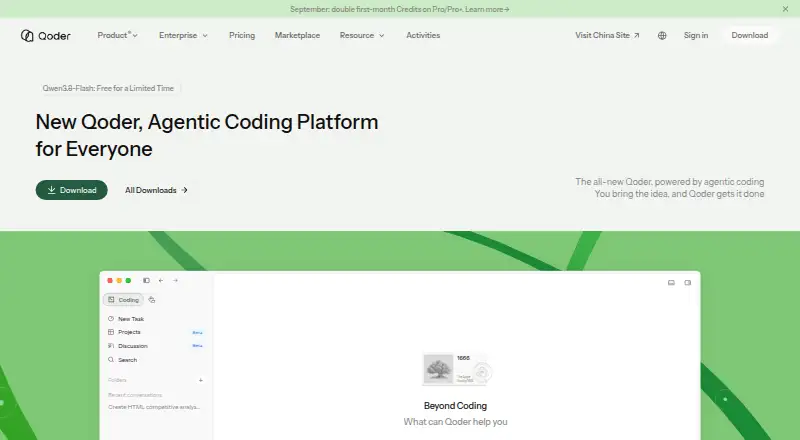
What Qoder is
Qoder is an agentic software development platform with an IDE and a command-line tool for terminal workflows. Its agent workflow is designed to understand task context, plan work, use tools, check results, and iterate toward a deliverable. Qoder CLI supports building and debugging, code review, test generation, issue fixing, and CI/CD workflows. Paid plans include Quest for delegated long-running development tasks, Repo Wiki for project documentation, and Knowledge Card. The Agent SDK provides task planning, tool invocation, context management, access control, and session memory, with tool-call logs and approval controls described on its page. Qoder lists multiple models, codebase indexing, a built-in terminal, and extension support. The Free plan provides basic models with limited user messages and completions, plus BYOK. Pro costs $20/mo and includes 2,000 credits per month for premium models, alongside the paid development features. If premium credits run out, the platform switches to basic models with limited messages and daily limits; plan credits reset at the subscription period's end. Enterprise controls include identity integration, role and access controls, billing and budget controls, and audit logs.
Good
- Includes IDE and command-line workflows.
- Supports code review, test generation, and issue fixing.
- Pro includes 2,000 monthly premium-model credits.
- Enterprise features include audit logs and access controls.
Watch out
- Free plan limits messages and completions.
- Premium credits run out, usage switches to limited basic models.
- Credit packs expire one month after purchase and are nonrefundable.
Who it suits
Qoder suits developers who want an IDE or CLI workflow with agent assistance for coding and project tasks. Teams may also consider its Enterprise identity, access, budget, and audit controls.
Verdict
Qoder combines agent-based development workflows with IDE, CLI, and SDK options. Compare plan limits and credit terms with the intended workload before choosing a paid tier.
Plans and prices
From Qoder's own pricing page, checked 15 Oct 2026.
| Plan | Price | What it gives you |
|---|---|---|
| Free | Free | Basic models with limited user messages · limited completions and next edits · BYOK · 2-week Pro trial |
| Pro | $20 a month | 2,000 premium-model credits/month · more completions and next edits · chat and agent requests · Quest · Repo Wiki · Knowledge Card · 20 USD/mo |
| Credit Pack | $20, paid once | Prepaid and stackable · credits expire one month after purchase · non-refundable · 20 USD / 1,500 Credits |
| Pro+ | $60 a month | 6,000 premium-model credits/month · more completions and next edits · chat and agent requests · Quest · Repo Wiki · Knowledge Card · 60 USD/mo |
| Ultra | $200 a month | 20,000 premium-model credits/month · more completions and next edits · chat and agent requests · Quest · Repo Wiki · Knowledge Card · 200 USD/mo |
| Teams | Priced on request | Centralized billing and management · SAML/OIDC SSO · team knowledge engine · privacy controls · development metrics |
| Enterprise | Priced on request | All Teams features · group permissions and billing · model policy controls · plugin distribution controls · private marketplace · audit log · priority support |
The facts
Each one read from Qoder's own pages, with the date it was checked.
What it does
- Agent SDK
- The Qoder Agent SDK provides TypeScript package @qoder-ai/qoder-agent-sdk and Python package qoder-agent-sdk with APIs for agents, tools, sessions, permissions, hooks, MCP, skills and plugins.checked 15 Oct 2026
- Agent workflow
- Its agent workflow is designed to understand task context, plan work, use tools, verify results, and iterate toward a deliverable.checked 30 Sep 2026
- CLI
- Qoder CLI supports interactive and non-interactive prompts, JSON output, worktrees, permission modes, remote sessions, plugins, skills, hooks, agents, Sites and Wiki generation.checked 15 Oct 2026
- CLI operating systems
- Qoder CLI supports macOS, Linux and Windows on arm64 or amd64, but Windows arm64 is unsupported.checked 15 Oct 2026
- Cloud API
- Cloud Agents expose API-managed Environments, Agents and Sessions with streamed results.checked 15 Oct 2026
- Connectors
- Connectors link Qoder to external services through a marketplace or custom MCP servers, with publisher, capability and access review before installation.checked 15 Oct 2026
- Data security
- The privacy policy says personal data is encrypted in transit and at rest and that information is stored on servers in the United States, Singapore, and Japan.checked 30 Sep 2026
- Development features
- Paid plans include Quest for delegated long-running development tasks, Repo Wiki for project documentation, and Knowledge Card.checked 30 Sep 2026
- Editor workflow
- Qoder IDE combines context-aware completion, inline chat, Q&A, multi-file editing and agent automation in one desktop editor.checked 15 Oct 2026
- Enterprise controls
- Enterprise features listed include SAML/OIDC identity integration, granular role and access control, centralized billing and budget controls, and audit logs.checked 30 Sep 2026
- IDE
- Qoder IDE is described as an agentic development workspace for real software development.checked 30 Sep 2026
- Integrations
- Cloud Agents lists DingTalk, Feishu, WeChat, and Slack as messaging integrations, and API, SDK, Plugin, MCP, and Skills as code integration methods.checked 30 Sep 2026
- JetBrains integration
- The JetBrains plugin supports macOS, Windows and Linux, JetBrains IDEs 2020.3 or later, and products including IntelliJ IDEA, Android Studio, PyCharm, GoLand and CLion.checked 15 Oct 2026
- Knowledge Card
- Knowledge Cards extract architecture, specifications and technology details into .qoder/repowiki and can be synchronized through Teams or Git.checked 15 Oct 2026
- Limit: reliability
- A Qoder forum bug report described Quest hangs, repeated context rebuilding, IDE crashes during document edits and rapid credit consumption.checked 15 Oct 2026
- Limit: subscription dispute
- A Trustpilot reviewer alleged a post-cancellation charge and an unsuccessful refund request, while also criticizing performance and transparency.checked 15 Oct 2026
- Limit: usage caps
- Reddit users reported unexpectedly reaching daily Chat or request quotas despite having unused credits or a paid Pro subscription.checked 15 Oct 2026
- Limit: workflow polish
- ToolCenter's hands-on review rated Qoder strongest for multi-file autonomous work but weakest for tab completion, IDE polish and predictable cost.checked 15 Oct 2026
The company
- Company profile
- LinkedIn lists Qoder as a Singapore software-development company founded in 2025 with 51–200 employees.checked 15 Oct 2026
- Headquarters
- Singaporechecked 28 Sep 2026
- Maker address
- Qoder lists 51 Bras Basah Road, #03-01 Lazada One, Singapore 189554.checked 15 Oct 2026
- Maker legal name
- The service footer and privacy policy identify the provider as BRIGHT ZENITH PRIVATE LIMITED.checked 15 Oct 2026
Money
- Free trial
- New users can receive a free 14-day Pro trial with 300 credits; the offer is limited to one account per user and is unavailable on virtual machines.checked 30 Sep 2026
Where it runs
- macOS requirements
- The macOS client requires macOS 14 or later, Apple silicon or Intel, at least 500 MB application storage and stable internet access.checked 15 Oct 2026
The full review of Qoder
Qoder is an agentic software-development platform with an IDE, CLI, cloud execution and an Agent SDK. It is best suited to developers who want agents involved in both day-to-day coding and delegated work, and who can work within monthly credit limits.
Its range of development tools is a strength; premium model usage is metered, so the right tier depends on how much agent and chat work you expect to do.
Overview
Qoder’s workflow has agents interpret tasks, plan steps, use tools, check results and iterate toward a deliverable. Its IDE supports software development, while its CLI brings agent workflows to terminal tasks such as debugging and test generation. Cloud execution and the Agent SDK extend that approach to delegated tasks and integrations. This breadth can suit developers who want several ways to work with agents, but it does not remove the need to manage usage credits.
Key features
IDE and CLI
Qoder IDE combines agent mode, multiple model choices, codebase indexing, a built-in terminal and extension support. That makes it relevant to developers who want agent assistance within a development workspace, rather than a tool limited to generating code from prompts. Qoder CLI supports building and debugging, code review, test generation and issue fixing, including CI/CD workflows; it is the more pertinent route for terminal- and pipeline-oriented work.
Delegated development and project context
Paid plans include Quest for long-running development tasks, Repo Wiki for project documentation and Knowledge Card. These additions make the paid tiers more compelling when work can be delegated or project context needs organizing. They offer less reason to upgrade for someone who only needs occasional basic-model assistance.
Integrations and SDK
Cloud Agents lists DingTalk, Feishu, WeChat and Slack as messaging integrations, alongside API, SDK, Plugin, MCP and Skills code integration methods. The Agent SDK provides task planning, tool invocation, context management, access control and session memory, with tool-call logs and approval controls. Those capabilities make the platform relevant to teams connecting agent work to existing processes; the enterprise controls also include SAML/OIDC identity integration, role and access control, centralized billing and budget controls, and audit logs.
Usage and data security
When premium credits run out, Qoder switches to basic models with limited user messages and daily limits. Credits reset at the end of the subscription period, so a high-usage month cannot be covered by carrying unused subscription credits forward. Qoder says it is certified to ISO/IEC 27001 and has completed a SOC 2 Type II audit. Its privacy policy says personal data is encrypted in transit and at rest, with information stored on servers in the United States, Singapore and Japan.
Pricing
Qoder has a free plan and a 14-day trial. The Free plan costs nothing and uses basic models, with limited user messages, completions and next edits; it also supports BYOK. It is a sensible starting point for light use, but those caps make it a poor substitute for sustained premium-model work.
Pro costs $20 a month, billed 20 USD/mo, and includes 2,000 Credits/month for premium models, limited credits for chat and agent requests, Quest, Repo Wiki and Knowledge Card. It is the entry paid tier for individual developers who want the paid development features and a defined premium allocation. Pro+ costs $60 a month, billed 60 USD/mo, with 6,000 Credits/month for premium models and the same listed development features and limited chat and agent credits. It suits heavier use, though the larger allocation still does not mean unlimited premium access. Ultra costs $200 a month, billed 200 USD/mo, and raises the premium allocation to 20,000 Credits/month, with the same feature set; it is the tier for workloads that need a substantially larger monthly allowance.
The Credit Pack costs $20, paid once, billed $20 USD / 1,500 Credits. It is prepaid and stackable, expires 1 month from purchase, is nonrefundable, and is available to Pro, Pro+ and Ultra subscribers. That short expiry and nonrefundable term make it best reserved for subscribers with a near-term need for extra credits, not as a way to stockpile usage.
Platforms
Qoder supports Android, iOS, Linux, macOS and Windows, as well as API and extension access. Its CLI and SDK options add terminal and integration routes alongside the IDE.
Who it's for
Qoder is a strong candidate for developers who want agent workflows across IDE and CLI work, or teams that need delegated tasks, project documentation and integration controls. It is less suitable for users who require unlimited premium-model use, or whose needs are limited to occasional coding assistance and do not justify a paid tier.
Pros and cons
- Pros: IDE and CLI cover both interactive development and terminal-based tasks, including CI/CD workflows.
- Pros: Paid plans combine delegated Quest tasks with Repo Wiki and Knowledge Card.
- Pros: SDK controls and enterprise access, budget and audit features support more structured team workflows.
- Cons: Premium-model credits are capped, and exhaustion means a switch to basic models with limited messages and daily usage.
- Cons: The Credit Pack expires after one month and is nonrefundable.
Alternatives
AI Code Editors and AI Code Generators are useful category roundups for comparing other options.
Choose Replit instead if its free Starter allowance of one live project and one background task at a time fits your needs. Choose Kiro instead if you want its free plan with 50 credits per month. Tesseract is another freemium alternative. Zubvo offers a free Hobby plan with 100 credits per month and up to 2,000 tab completions. ACLIDE is another freemium option. Creor offers a free plan with 200 gateway requests and five cloud-agent runs per month. Devgrex offers local completions, agent chat and offline mode on its free plan. Devin Desktop offers a free plan with a light agent quota and unlimited inline edits and Tab completions.
Verdict
Choose Qoder if you want a single agentic development platform spanning IDE, CLI and delegated workflows, with paid tiers that add project-context features and larger monthly premium-credit allowances. Look elsewhere if uncapped premium usage is essential or you cannot make use of its paid features enough to justify a recurring subscription.
Getting started
- Visit https://qoder.com/
- Choose a supported platform such as Android, iOS, Linux, macOS, or Windows
- Start with the Free plan or use the 14-day trial
- Use Qoder IDE or Qoder CLI for development work
- Upgrade to Pro, Pro+, or Ultra for paid features and premium-model credits
Limits worth knowing
The Free plan provides basic models with limited user messages, completions, and next edits, with BYOK. When premium credits run out, Qoder switches to basic models with limited messages and daily limits; subscription credits reset at the period’s end. Credit Packs contain 1,500 credits, expire one month after purchase, and cannot be refunded.
Questions
Is Qoder free?
Yes. The Free plan costs nothing and includes basic models with limited user messages and completions, plus BYOK.
What does Pro cost?
Pro costs $20 a month and includes 2,000 credits per month for premium models, limited credits for chat and agent requests, Quest, Repo Wiki, and Knowledge Card.
Which platforms does Qoder support?
Qoder lists Android, API, extension, iOS, Linux, macOS, and Windows.
Is there a trial?
Yes. Qoder offers a 14-day trial.
What is the Credit Pack?
It costs $20, paid once for 1,500 credits, is prepaid and stackable, expires one month after purchase, and is nonrefundable. It is available to Pro, Pro+, and Ultra subscribers.
Does Qoder offer enterprise controls?
Yes. Listed controls include SAML/OIDC identity integration, granular role and access control, centralized billing and budget controls, and audit logs.
Alternatives to Qoder
- 1

Replit
Free planAndroidiOSWebLinux8.4From $18 a month - 2

Google Antigravity IDE
Free planAndroidAPIExtensionLinux8.0From $30 a month - 3

Cortex AI IDE
Free planOpen sourceLinuxmacOSWindows7.9From $40 a year - 4
Tesseract
Free planAndroidiOSWebExtension7.9Free plan - 5

Creor
Free planWebAPILinuxmacOS7.7From $20 a month - 6

Tidet
Free planWebAPIExtensionLinux7.7From $15 a month