
PyOD
PyOD is a free Python library for anomaly detection, with documented detectors for tabular, time-series, graph, text, image and audio data.
What PyOD is
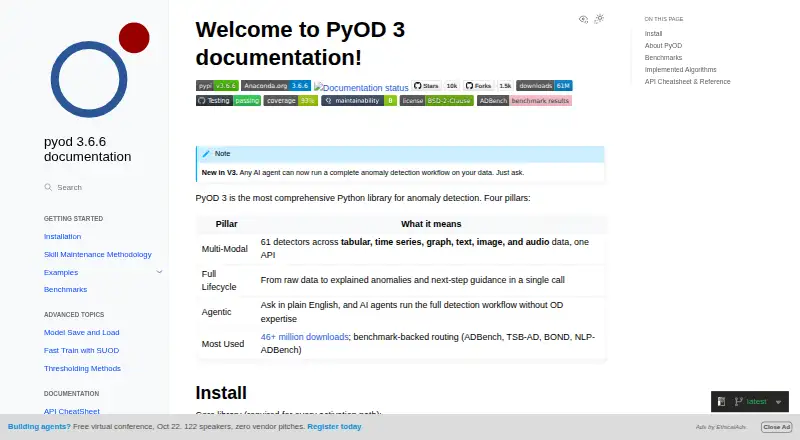
PyOD is a free Python library for anomaly detection, with documented detectors for tabular, time-series, graph, text, image and audio data. Its documentation lists 61 detectors exposed through one API. Users can choose the classic detector API or ADEngine, which profiles data, selects benchmark-backed detectors, runs multiple detectors in parallel, computes consensus scores and reports diagnostics. ADEngine also works as a standalone Python API without an LLM. PyOD offers an agentic investigation workflow and activation paths for Claude Code, Codex and MCP-compatible agents, including an od-expert skill and optional MCP server. Installation is available through pip, conda-forge or source, and requires Python 3.9 or higher. Optional pip extras enable capabilities including PyTorch detectors, graph detectors, embeddings, audio and MCP support. The project serves academic research and commercial products. ADEngine describes its quality verdict as a heuristic rather than a guarantee, and recommends validation against held-out labels or domain review.
Good
- Documents 61 detectors across six data types.
- ADEngine runs detectors in parallel and reports diagnostics.
- Available through pip, conda-forge or source.
- Free open-source library.
Watch out
- Requires Python 3.9 or higher.
- Optional capabilities require pip extras.
- Quality verdicts are heuristic, not guarantees.
Who it suits
PyOD suits Python users working on anomaly detection across varied data types, including researchers and commercial product teams. Agent and LLM integrations are available, but ADEngine can also run without an LLM.
Verdict
PyOD combines a broad detector catalog with orchestration and agent-oriented workflows. Treat ADEngine’s quality assessment as a starting point and validate results with labels or domain review.
Plans and prices
From PyOD's own pricing page, checked 30 Sep 2026.
| Plan | Price | What it gives you |
|---|---|---|
| PyOD | Free | Open-source Python library · optional capabilities require pip extras |
The facts
Each one read from PyOD's own pages, with the date it was checked.
What it does
- Agent integrations
- The installation guide describes activation paths for Claude Code, Codex, and MCP-compatible agents.checked 30 Sep 2026
- Agent support
- PyOD provides an od-expert skill for Claude Code and Codex, plus an optional MCP server for MCP-compatible agents.checked 30 Sep 2026
- Contribution criterion
- PyOD says contributors to newly proposed detectors should commit to at least two years of maintenance.checked 30 Sep 2026
- Data types
- PyOD 3 documents detectors for tabular, time-series, graph, text, image, and audio data.checked 30 Sep 2026
- Detector catalog
- The documentation describes 61 detectors across multiple data types, exposed through one API.checked 30 Sep 2026
- Detector count
- The documentation lists 61 detectors across its supported data types.checked 30 Sep 2026
- Distribution
- The guide documents installation through pip, conda-forge, or from source.checked 30 Sep 2026
- Install options
- The package is distributed through pip and conda-forge and can also be installed from source.checked 30 Sep 2026
- Integrations
- Optional pip extras enable PyTorch, SUOD, XGBoost, model combination, thresholding, embeddings, OpenAI embeddings, Hugging Face encoders, graph models, MCP, and audio features.checked 30 Sep 2026
- Intended users
- The project says PyOD serves academic research and commercial products worldwide.checked 30 Sep 2026
- Lifecycle orchestration
- ADEngine profiles data, selects benchmark-backed detectors, runs multiple detectors in parallel, computes consensus scores, and reports diagnostics.checked 30 Sep 2026
- Optional components
- Optional pip extras include support for PyTorch detectors, graph detectors, embeddings, audio, and an MCP server.checked 30 Sep 2026
- Project history
- The About page says Dr. Yue Zhao initialized the project in 2017.checked 30 Sep 2026
- Purpose
- PyOD is a Python library for anomaly detection.checked 30 Sep 2026
- Python integration
- ADEngine can be used as a standalone Python API without an LLM.checked 30 Sep 2026
- Requirements
- The installation guide lists Python 3.9 or higher as a requirement.checked 30 Sep 2026
- Result quality limits
- ADEngine describes its quality verdict as a heuristic, not a guarantee that results are correct, and recommends validation against held-out labels or domain review.checked 30 Sep 2026
- Runtime requirement
- The installation guide requires Python 3.9 or higher.checked 30 Sep 2026
- Security guidance
- The model persistence guide warns that pickle and joblib can deserialize arbitrary Python code and requires callers to pass trusted=True before loading artifacts.checked 30 Sep 2026
- Support
- The FAQ invites users to open an issue or contact the maintainer at [email protected].checked 30 Sep 2026
- Support and community
- The documentation links to a GitHub repository for source installation and examples; it does not state a paid support plan on the pages reviewed.checked 30 Sep 2026
- Usage
- PyOD offers a classic detector API, ADEngine lifecycle orchestration, and an agentic investigation workflow.checked 30 Sep 2026
The company
- Founded
- 2017checked 28 Sep 2026
The full review of PyOD
PyOD is a free, open-source Python library for detecting anomalies across several kinds of data. It is best suited to developers and researchers who want a broad detector toolkit they can run in their own Python workflows. Its breadth and orchestration are compelling, but anomaly scores still need validation against labels or domain expertise.
Overview
Initialized in 2017, PyOD brings 61 detectors for tabular, time-series, graph, text, image, and audio data behind one API. It supports hybrid detection, real-time detection, self-hosted deployment, and anomaly explanations. That makes it a flexible foundation for building anomaly detection into a product or analysis pipeline, rather than a turnkey monitoring service.
Users can work with the classic detector API, use ADEngine to coordinate detector selection and execution, or draw on an agent-oriented investigation workflow. The range is useful when a project may span different data types or methods, though some capabilities depend on optional packages and the project requires Python 3.9 or higher.
Key features
Detector catalog and orchestration
The catalog spans six data types, and its detectors share a common API. ADEngine adds profiling, benchmark-backed detector selection, parallel runs, consensus scores, and diagnostic reporting. This can reduce the work of coordinating multiple detectors, especially when an analyst wants a comparative view; its quality verdict is a heuristic, not a guarantee, so it should not replace checks against held-out labels or domain review.
Python and agent workflows
ADEngine works as a standalone Python API without an LLM. For agent workflows, PyOD provides an od-expert skill for Claude Code and Codex, along with an optional MCP server for compatible agents. The installation guide also describes activation paths for Claude Code, Codex, and MCP-compatible agents. These options suit teams already building with those tools, while the conventional API keeps PyOD usable without them.
Extensions and safe model loading
Optional pip extras cover PyTorch and graph detectors, embeddings, audio, MCP, and integrations including SUOD, XGBoost, model combination, and thresholding. The breadth is valuable, but users need to choose and install extras for optional capabilities. PyOD warns that pickle and joblib can deserialize arbitrary Python code; loading saved artifacts requires callers to pass trusted=True, so those files should only be trusted when their origin is trusted.
Pricing
PyOD — free. The plan is an open-source Python library, with optional capabilities requiring pip extras. There is no free-trial period because the library itself is free. The practical cost is assembling and maintaining the Python environment and any optional dependencies; the project does not state a paid support plan. Installation is available through pip, conda-forge, or from source.
Platforms
PyOD supports Linux, macOS, and Windows, as well as API and self-hosted use. It is a Python library rather than a hosted end-user application, so it fits teams prepared to integrate and operate software in their own environment.
Who it's for
PyOD is a strong fit for data scientists, researchers, and product teams that need anomaly detection inside Python applications or analysis pipelines, particularly when they work across more than one data type. It is less suitable for buyers seeking a managed interface, a paid support commitment, or a result-quality guarantee. The project says it serves academic research and commercial products; contributors proposing new detectors are expected to commit to at least two years of maintenance.
Pros and cons
- Pro: Broad detector coverage. Sixty-one detectors share one API across tabular, time-series, graph, text, image, and audio data.
- Pro: Multiple ways to work. The classic API, ADEngine orchestration, and agent-oriented workflows support different development styles, and ADEngine does not require an LLM.
- Pro: Free and self-hosted. The library can be installed from common Python package channels or source and run on Linux, macOS, or Windows.
- Con: Optional features add setup work. Extra capabilities require additional pip extras, so the full catalog is not a single minimal installation.
- Con: Quality still needs human or labeled-data checks. ADEngine calls its verdict heuristic and recommends validation with held-out labels or domain review.
- Con: Saved models carry a security risk. Pickle and joblib artifacts can execute arbitrary Python code when loaded, requiring care with trusted inputs.
Alternatives
For a different focus, consider PySAD, also a free open-source Python framework, or ManageEngine NetFlow Analyzer, which offers a free edition limited to two interfaces and paid editions starting at $172 a month for 10 interfaces. For pipeline testing and data observability, Soda has a free plan with pipeline testing, metrics observability, and alerting and ticketing integrations. Metaplane may suit teams wanting hosted data monitoring: its free plan covers 10 monitored tables, four users, and three custom SQL monitors.
ObservabilityOS offers a source-available, self-hosted option with a free developer plan capped at one service, 500MB of logs per month, and seven-day retention. For security-focused detection, Corelight Open NDR, Securonix UEBA, and Vectra AI Identity Threat Detection and Response are paid alternatives.
Browse more options in Anomaly Detection Software.
Verdict
Choose PyOD if you want a free, self-hosted Python toolkit with a wide detector catalog and orchestration that can help compare methods across varied data. Its strongest advantage is flexibility within a Python workflow; its main limitation is that neither detector consensus nor ADEngine’s heuristic removes the need to validate results. Look elsewhere if you need managed monitoring, committed paid support, or a guarantee of detection quality.
Getting started
- Confirm that your environment uses Python 3.9 or higher.
- Install PyOD through pip, conda-forge, or from source.
- Choose the classic detector API or ADEngine for your workflow.
- Install optional pip extras for capabilities your project needs, such as graph detectors, embeddings, audio, or MCP.
- For agent workflows, use the documented activation path for Claude Code, Codex, or an MCP-compatible agent.
Questions
How much does PyOD cost?
The listed plan is free at no cost. PyOD is a free Python library.
Which kinds of data does it support?
Its documented detectors cover tabular, time-series, graph, text, image, and audio data.
What is required to install PyOD?
The installation guide requires Python 3.9 or higher. It documents installation through pip, conda-forge, or source.
Can I use PyOD without an LLM?
Yes. ADEngine can be used as a standalone Python API without an LLM.
Which agent integrations does PyOD document?
The installation guide describes activation paths for Claude Code, Codex, and MCP-compatible agents. An od-expert skill and an optional MCP server are also available.
Can ADEngine guarantee that its results are correct?
No. Its quality verdict is a heuristic; the project recommends validation against held-out labels or domain review.
Alternatives to PyOD
- 1

Soda
Free planWebAPILinuxSelf-hosted7.5From $750 a month - 2
Anomalib
Free planOpen sourceWebAPILinuxSelf-hosted7.4Free plan - 3

ManageEngine NetFlow Analyzer
Free planAndroidiOSWebLinux7.1From $172 a month - 4

OpenSearch
Free planWebAPILinuxmacOS6.7Free plan - 5

ObservabilityOS
Free planWebAPISelf-hosted6.5From $29 a month - 6
Cisco Catalyst Center
WebAPILinuxmacOS6.2