PySAD
PySAD is a free, open-source Python framework for detecting anomalies in streaming data.
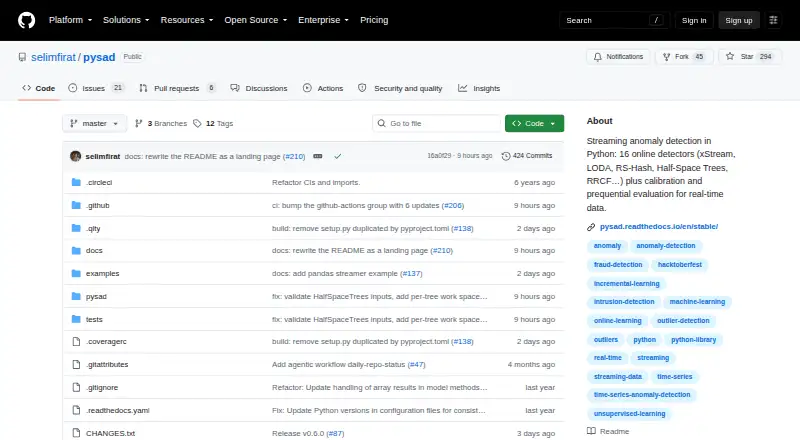
What PySAD is
PySAD is a free, open-source Python framework for detecting anomalies in streaming data. Its online models update as each new instance arrives, supporting sequential detection on both univariate and multivariate data. The project describes 16 online detectors, including xStream, LODA, RS-Hash, Half-Space Trees, and Robust Random Cut Forest. PySAD includes stream simulators, evaluators, preprocessors, statistic trackers, postprocessors, and probability calibrators for building and assessing detection workflows. It also connects batch anomaly detectors from PyOD to streaming use. Experiments can use supervised, semi-supervised, or unsupervised settings. The documentation notes that streaming methods may retain a single instance or a small recent window to meet memory and processing constraints. PySAD can be installed with pip or from its GitHub source, and its current README lists Python 3.10 or newer on Linux, macOS, and Windows. It is self-hosted and distributed under a BSD 3-Clause license. The project lists 17 labelled benchmark datasets that download on first use.
Good
- Includes 16 online detectors.
- Supports univariate and multivariate streaming data.
- Offers tools for evaluating and preprocessing streams.
- Free and open source under BSD 3-Clause.
Watch out
- Requires Python 3.10 or newer.
- Self-hosted deployment is listed.
- 17 benchmark datasets download on first use.
Who it suits
PySAD suits Python users building or evaluating anomaly detection for streaming univariate or multivariate data. It also fits those experimenting with supervised, semi-supervised, and unsupervised approaches.
Verdict
PySAD provides online detectors and supporting evaluation tools in a free Python framework. Its streaming focus and listed Python requirement make it most relevant to users comfortable with that environment.
Plans and prices
From PySAD's own pricing page, checked 2 Oct 2026.
| Plan | Price | What it gives you |
|---|---|---|
| PySAD | Free | Open-source Python framework |
The facts
Each one read from PySAD's own pages, with the date it was checked.
What it does
- Benchmarks
- The README says 17 labelled benchmark datasets are downloaded on first use.checked 2 Oct 2026
- Data and learning settings
- The framework supports models for univariate and multivariate data and experiments in supervised, semi-supervised, and unsupervised settings.checked 2 Oct 2026
- Detectors
- The repository describes 16 online detectors, including xStream, LODA, RS-Hash, Half-Space Trees, and Robust Random Cut Forest.checked 2 Oct 2026
- Evaluation tools
- PySAD includes stream simulators, evaluators, preprocessors, statistic trackers, postprocessors, and probability calibrators.checked 2 Oct 2026
- Installation
- The project can be installed with pip or from its GitHub source, and its current README lists Python 3.10 or newer on Linux, macOS, and Windows.checked 2 Oct 2026
- License
- The project is distributed under a BSD 3-Clause license.checked 2 Oct 2026
- Maintainer
- The GitHub profile identifies Selim Firat Yilmaz as an AI researcher based in London, UK.checked 2 Oct 2026
- Online detection
- Its models update as each new data instance arrives for online or sequential anomaly detection.checked 2 Oct 2026
- Purpose
- PySAD is an open-source Python framework for anomaly detection on streaming multivariate data.checked 2 Oct 2026
- PyOD integration
- PySAD provides integrations that let batch anomaly detectors from PyOD run in a streaming setting.checked 2 Oct 2026
- Resource use
- The documentation says streaming methods may store only an instance or a small window of recent instances to meet memory and processing constraints.checked 2 Oct 2026
- Security
- The repository links to a security policy, but the policy page could not be opened during this research.checked 2 Oct 2026
- Support
- The maintainer says issues and pull requests are welcome and aims to reply within a few days; questions and show-and-tell go in GitHub Discussions.checked 2 Oct 2026
The full review of PySAD
PySAD is an open-source framework for detecting anomalies in streaming data, with online detectors and tools for evaluating their results. It is best suited to developers and researchers building Python-based data workflows. Its streaming focus is a strong fit for sequential detection, but it is not a turnkey monitoring product.
Overview
PySAD updates models as each new data instance arrives, making it relevant when anomalies need to be assessed continuously rather than only in a completed batch. It supports both univariate and multivariate data, and supervised, semi-supervised, and unsupervised experiments. That range is useful for comparing approaches across different learning setups; users still need to build and operate their own Python workflow.
The framework is self-hosted and distributed under the BSD 3-Clause license. Installation is through pip or the GitHub source, and the current README specifies Python 3.10 or newer on Linux, macOS, and Windows. Its documentation describes streaming methods that can keep memory use down by retaining only an instance or a small recent window, a practical advantage for constrained processing environments.
Key features
Online detectors and evaluation
PySAD includes 16 online detectors, including xStream, LODA, RS-Hash, Half-Space Trees, and Robust Random Cut Forest. That gives practitioners several methods to work with in one framework, while the online design makes it a more focused choice than a general-purpose anomaly platform.
Stream simulators, evaluators, preprocessors, statistic trackers, postprocessors, and probability calibrators support experiments around the detectors rather than detection alone. The README also says 17 labelled benchmark datasets download on first use, which helps users run benchmark experiments but means that initial use involves downloading dataset files.
Batch detector integration
PySAD integrates with PyOD so batch anomaly detectors can run in a streaming setting. That can help users bring existing PyOD methods into sequential experiments, although PySAD remains a Python framework rather than a managed service.
Pricing
PySAD is free: its open-source plan costs nothing. There is no paid tier or free trial to weigh against that plan. The trade-off is that it is self-hosted software, so users work within its Python environment rather than buying a hosted detection service.
Platforms
PySAD supports Linux, macOS, and Windows, with Python 3.10 or newer. Its self-hosted deployment suits users who can install and run Python software on their own systems; it is not presented as a web or mobile application.
Who it's for
Choose PySAD if you need online anomaly detection for streaming univariate or multivariate data and want to compare detectors or learning settings in Python. Its evaluation tools and PyOD integration make it particularly useful for experimental pipelines. Look elsewhere if you need a managed monitoring interface or do not want to maintain a Python-based deployment.
Pros and cons
- Pros: Sixteen online detectors and a broad set of evaluation components support experimentation within one framework.
- Pros: Streaming methods can limit retained data to an instance or small window, helping manage memory and processing constraints.
- Pros: Free, open-source software with a BSD 3-Clause license can be installed on three major desktop operating systems.
- Cons: Python 3.10 or newer and self-hosting make it a poor fit for readers seeking a ready-to-use hosted service.
- Cons: Benchmark datasets download on first use, so benchmark runs require handling that initial data download.
Alternatives
For a batch-oriented Python library rather than a streaming-focused framework, consider PyOD, which is also free and offers optional capabilities through pip extras. For network traffic analysis with interface-based editions, ManageEngine NetFlow Analyzer has a free edition limited to 2 interfaces, plus paid Standard and Professional editions. OpenSearch is a free, Apache 2.0-licensed open-source option for readers seeking a broader self-hosted platform.
For an open-source library installable from PyPI or source, consider Anomalib. Soda may suit readers focused on pipeline testing, metrics observability, and alerting integrations, with a free plan. Metaplane offers a hosted free plan capped at 10 monitored tables, 4 users, and 3 custom SQL monitors. ObservabilityOS has a free developer plan capped at 1 service, 500MB of logs per month, and 7-day retention. Axomaly offers a free alpha for starting with one metric and guided onboarding.
Browse the Anomaly Detection Software directory for more options.
Verdict
PySAD is a strong choice for Python users who need to study or build online anomaly detection for streaming data: its detector range and evaluation toolkit give experimentation real breadth at no cost. Choose something else if you want hosted operations or a user-facing monitoring product instead of a self-managed framework.
Alternatives to PySAD
- 1

Soda
Free planWebAPILinuxSelf-hosted7.5From $750 a month - 2
Anomalib
Free planOpen sourceWebAPILinuxSelf-hosted7.4Free plan - 3

ManageEngine NetFlow Analyzer
Free planAndroidiOSWebLinux7.1From $172 a month - 4

OpenSearch
Free planWebAPILinuxmacOS6.7Free plan - 5

ObservabilityOS
Free planWebAPISelf-hosted6.5From $29 a month - 6

PyOD
Free planAPILinuxmacOSSelf-hosted6.5Free plan