Anomalib
Anomalib is a free, Apache-2.0-licensed deep learning library for developing, benchmarking, and deploying algorithms that detect or locate anomalies in image…
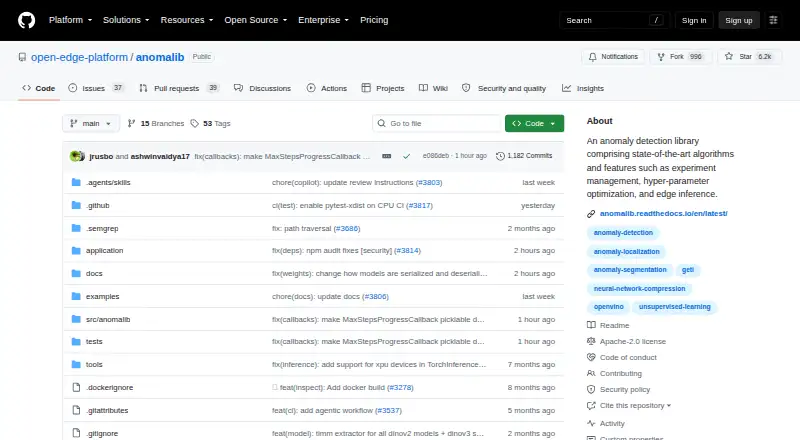
What Anomalib is
Anomalib is a free, Apache-2.0-licensed deep learning library for developing, benchmarking, and deploying algorithms that detect or locate anomalies in images and videos. Its modular Python API and command-line interface support training, inference, and benchmarking, and the project includes ready-to-use algorithms and benchmark datasets. Model implementations are based on Lightning; inference options include Torch, Lightning, Gradio, and OpenVINO. Most models can be exported to OpenVINO Intermediate Representation for accelerated inference on Intel hardware. Installation options include CPU, NVIDIA CUDA on Linux or Windows, AMD ROCm on Linux, and Intel XPU on Linux. Documented experiment-tracking integrations include Weights & Biases, Comet.ml, and TensorBoard through PyTorch Lightning loggers. Anomalib Studio adds a low/no-code web application that accepts USB or IP cameras or image folders and can send output to industrial pipelines through ROS messages or MQTT. Studio is a pre-release offered as a Docker container or standalone application; its features may change, and some functionality may be incomplete or unstable. Intel GPU training currently supports only one GPU.
Good
- Free Apache-2.0 library
- Includes algorithms and benchmark datasets
- Offers Python API and command-line tools
- Supports several hardware installation options
- Studio accepts cameras or image folders
Watch out
- Studio is a pre-release with potentially incomplete functionality
- Intel GPU training supports only one GPU
Who it suits
Anomalib suits developers building or benchmarking image and video anomaly detection, including those deploying inference on supported hardware. Studio may appeal to users seeking a low/no-code web application, provided they can work with pre-release software.
Verdict
Anomalib provides a free toolkit for developing and deploying image and video anomaly detection. Its Studio is still in pre-release, and Intel GPU training has a single-GPU limit.
Plans and prices
From Anomalib's own pricing page, checked 15 Oct 2026.
| Plan | Price | What it gives you |
|---|---|---|
| Open-source Anomalib library | Free | Apache-2.0 licensed · installable from PyPI or source · self-hosted |
| Open-source library | Free | Apache-2.0 licensed library · Install from PyPI or source |
The facts
Each one read from Anomalib's own pages, with the date it was checked.
What it does
- Algorithm collection
- The documentation lists ready-made image models including PatchCore, PaDiM, DRAEM, FastFlow, GANomaly, Reverse Distillation, STFPM and WinCLIP.checked 15 Oct 2026
- Algorithms and datasets
- The project describes its collection as ready-to-use deep learning anomaly detection algorithms and benchmark datasets.checked 4 Oct 2026
- API and CLI
- It provides a modular Python API and command-line interface for training, inference, benchmarking and hyperparameter optimization.checked 15 Oct 2026
- Breaking changes
- The 2.7.0 changelog removes the legacy ONNX exporter, several deprecated APIs and older checkpoint migration support.checked 15 Oct 2026
- Core dependency requirement
- The v2.7.0 README badge states minimum PyTorch 2.10+, Lightning 2.2+ and OpenVINO 2024.0+.checked 15 Oct 2026
- Datasets
- Anomalib includes datamodules for image, video and depth datasets and documents public benchmark datasets.checked 15 Oct 2026
- Deployment
- Inference options include Torch, Lightning, Gradio, and OpenVINO.checked 4 Oct 2026
- Detection scope
- The project targets anomaly detection, anomaly localization and anomaly segmentation for images and videos.checked 15 Oct 2026
- Documentation depth
- The documentation includes reference APIs, CLI, data and model guides, inference, metrics, pipelines, tutorials and developer guides.checked 15 Oct 2026
- Edge inference
- Most models can be exported to OpenVINO Intermediate Representation for accelerated inference on Intel hardware.checked 4 Oct 2026
- Experiment tracking
- Optional logging integrations include Weights & Biases, Comet.ml, TensorBoard and MLflow.checked 15 Oct 2026
- Hardware extras
- Installation extras cover CPU, NVIDIA CUDA 12.6 or 13.0, AMD ROCm and Intel XPU backends.checked 15 Oct 2026
- Hardware support
- Installation options include CPU, CUDA on Linux or Windows with NVIDIA GPUs, ROCm on Linux with AMD GPUs, and Intel XPU on Linux.checked 4 Oct 2026
- Independent distribution evidence
- SourceForge hosts an unaffiliated mirror and lists zero downloads for the displayed release folders.checked 15 Oct 2026
- Independent package status
- PyPI classifies Anomalib 2.7.0 as production/stable software for developers and scientific or engineering use.checked 15 Oct 2026
- Independent research description
- The peer-reviewed project paper describes Anomalib as an open-source, plug-and-play library with experiment trackers, visualizers, hyperparameter optimizers and OpenVINO optimization.checked 15 Oct 2026
- Inference options
- Inference support covers Torch, Lightning, Gradio and OpenVINO workflows.checked 15 Oct 2026
- Installation
- The recommended standard installation is through PyPI using pip or uv, with source installation available for development.checked 15 Oct 2026
- Intel GPU limit
- Training on Intel GPUs currently supports only a single GPU and was tested on Arc 750 and Arc 770.checked 15 Oct 2026
- Licence
- The repository and package metadata identify Apache License 2.0 as the project licence.checked 15 Oct 2026
- License
- The repository identifies its license as Apache-2.0.checked 4 Oct 2026
Money
- Industrial outputs
- Studio can send outputs into industrial pipelines through ROS messages and MQTT.checked 15 Oct 2026
The company
- Maker founding
- Intel was founded by Robert Noyce and Gordon Moore in 1968.checked 15 Oct 2026
- Maker headquarters
- Intel Corporation’s principal executive office is at 2200 Mission College Boulevard, Santa Clara, California.checked 15 Oct 2026
The full review of Anomalib
Anomalib is a free, Apache-2.0 deep-learning toolkit for detecting and localizing anomalies in images and videos. It is best suited to developers and engineering teams building their own inspection, monitoring, or edge-inference workflows. The library is broad and practical; Studio is a less dependable option while it remains pre-release.
Overview
Anomalib combines a modular Python API and command-line interface for training, inference, and benchmarking. Its ready-to-use anomaly-detection algorithms and benchmark datasets provide a useful base for comparing methods and adapting them to a project. This is a development library rather than a finished monitoring service, so teams must assemble the surrounding data, workflow, and deployment choices themselves.
Implementations are based on Lightning, and the project supports machine-learning detection for both images and videos. The Apache-2.0 license permits use without a licensing fee, including installation from PyPI or source.
Key features
The training and benchmarking layer is the main reason to choose Anomalib. A common API and CLI make experiments repeatable across algorithms, while the included datasets reduce the effort needed to establish comparisons. That is valuable for practitioners evaluating inspection approaches; it does not remove the need to prepare suitable data or engineer a production pipeline.
Most models can be exported to OpenVINO Intermediate Representation for accelerated inference on Intel hardware. This creates a clear route to Intel-focused edge deployment, but it should not be read as a general acceleration guarantee for every device. Other inference routes include Torch, Lightning, Gradio, and OpenVINO, allowing a team to match execution to its existing stack.
Experiment logging integrates with Weights & Biases, Comet.ml, and TensorBoard through PyTorch Lightning loggers. Teams already using those services can retain familiar run tracking instead of adopting a separate logging system.
Anomalib Studio is a low/no-code web application that accepts USB or IP cameras and image folders. It can send results into industrial pipelines through ROS messages or MQTT, which makes it relevant to operational prototypes and factory integrations. Studio is offered as a Docker container or standalone application, but it is under active development: features can change and functionality may be incomplete or unstable. Treat it as an evaluation aid, not the dependable foundation of a critical deployment.
Pricing
| Plan | Price | Includes |
|---|---|---|
| Open-source library | free | Apache-2.0 licensed library; install from PyPI or source |
The single free plan fits individual developers, research groups, and teams comfortable operating a self-hosted toolkit. There are no paid tiers, seat charges, renewal terms, or trial deadline attached to the library. The trade-off is that the price covers software access, not a managed service: your team remains responsible for infrastructure, data, model operations, and support.
Platforms
Anomalib supports Linux and Windows, with self-hosted and web deployment options. Hardware installation paths include CPU, CUDA on Linux or Windows with NVIDIA GPUs, ROCm on Linux with AMD GPUs, and Intel XPU on Linux. Intel GPU training currently supports only one GPU; the project notes testing on Arc 750 and Arc 770. That single-GPU ceiling matters to teams planning larger Intel training jobs, even though Intel inference is a notable strength.
Security documentation describes continuous scanning with CodeQL, Semgrep, Bandit, Zizmor, Trivy, and Dependabot, with vulnerability reports directed through Intel's vulnerability-handling guidelines.
Who it's for
Choose Anomalib if you need an open-source foundation for image or video anomaly research, industrial inspection, or a custom monitoring pipeline. It is particularly suitable for Python teams that need benchmarking, multiple inference backends, experiment logging, or OpenVINO deployment on Intel hardware.
Look elsewhere if you want a hosted product that arrives with operational workflows, or if your project depends on a mature low-code interface. Studio's pre-release status and the work required to build the surrounding system make Anomalib a poor fit for buyers seeking turnkey operations.
Pros and cons
Pros
- Free Apache-2.0 library: teams can install from PyPI or source without license fees or recurring plan terms.
- Strong development coverage: training, inference, benchmarking, algorithms, and datasets are provided in one toolkit.
- Flexible execution: Torch, Lightning, Gradio, and OpenVINO support different deployment patterns.
- Intel edge path: OpenVINO export can accelerate most models on Intel hardware.
- Established logging choices: Weights & Biases, Comet.ml, and TensorBoard integrations fit existing experiment practices.
Cons
- Not turnkey: self-hosted teams must build and operate the production workflow around the library.
- Studio is pre-release: changing or incomplete functionality makes it risky for critical operations.
- Intel training limit: current support is restricted to a single GPU.
Alternatives
PyOD is a free open-source Python library and suits teams wanting anomaly detection in a broader cross-platform API-oriented setup; optional capabilities require pip extras.
ManageEngine NetFlow Analyzer is the better choice for network-flow monitoring with a free two-interface edition and paid editions for larger interface counts, rather than image and video model development.
OpenSearch fits teams seeking a free Apache 2.0 open-source platform across API, web, and self-hosted environments.
PySAD is a free open-source Python framework for teams whose anomaly work is centered on its supported cross-platform framework rather than Anomalib's image and video focus.
Soda is a freemium data-quality option with free pipeline testing, metrics observability, alerting, and ticketing integrations.
Metaplane is a freemium monitoring service with a free tier for 10 monitored tables, four users, and three custom SQL monitors.
ObservabilityOS offers free developer and source-available options for service and log observability, including 500MB of logs per month with seven-day retention on its developer tier.
Axomaly provides a free alpha focused on starting with one metric, guided onboarding, and direct support.
For a wider category comparison, see Anomaly Detection Software.
Verdict
Anomalib is a strong choice for developers and engineering teams that want a no-cost, extensible foundation for image and video anomaly detection, especially when benchmarking models or targeting Intel edge inference. Choose it for control and deployment flexibility; look elsewhere when you need a managed service or a stable, production-ready low-code application.
Alternatives to Anomalib
- 1

Soda
Free planWebAPILinuxSelf-hosted7.5From $750 a month - 2

ManageEngine NetFlow Analyzer
Free planAndroidiOSWebLinux7.1From $172 a month - 3

OpenSearch
Free planWebAPILinuxmacOS6.7Free plan - 4

ObservabilityOS
Free planWebAPISelf-hosted6.5From $29 a month - 5

PyOD
Free planAPILinuxmacOSSelf-hosted6.5Free plan - 6
Cisco Catalyst Center
WebAPILinuxmacOS6.2