PWM
PWM is an open source password self-service application for LDAP directories.
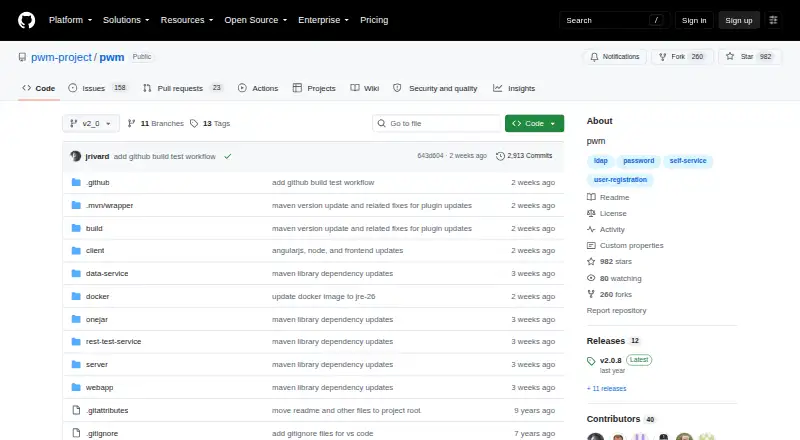
What PWM is
PWM is an open source password self-service application for LDAP directories. Users can change passwords, while administrators configure the application through a web manager with more than 500 settings; configuration can be imported or exported as one file. During password changes, PWM applies password rules as users type and provides strength feedback. Account-recovery verification can use email or SMS tokens, TOTP, remote REST, OAuth, or LDAP attribute values. Supported directory types include Generic LDAP, 389 Directory Server, NetIQ eDirectory, Microsoft Active Directory, and OpenLDAP. Authentication options include Basic Authentication, HTTP-header username injection, CAS, and OAuth client single sign-on. REST APIs cover password setting, recovery, password-policy reading and verification, and user-attribute updates. Deployment formats are a Java WAR, an executable Java JAR with embedded Tomcat, or a Docker image. The project lists Java 17 for PWM 2.1 and Java 11–17 for PWM 2.0, and says Tomcat is not an explicit requirement. Configurable policies include syntax and regex rules, dictionary enforcement, remote REST checks, and shared password history. The project asks users to seek help through its PWM-General Google Group. The listed plan is free.
Good
- Configuration manager has more than 500 settings.
- Recovery supports email, SMS, TOTP, REST, OAuth, and LDAP.
- Supports five listed LDAP directory types.
- Offers WAR, JAR, and Docker deployment formats.
Watch out
- Support questions are directed to a Google Group.
- Question-only GitHub issues are subject to deletion.
- Java requirements vary by PWM version.
Who it suits
PWM may suit organizations that need self-service password changes and recovery for LDAP directories. Administrators should be prepared to configure directory, authentication, and password-policy options.
Verdict
PWM offers password self-service, recovery choices, directory support, and configurable policies in an open source package. Its deployment and runtime requirements vary by version, and the project directs support requests to its Google Group.
Plans and prices
From PWM's own pricing page, checked 7 Oct 2026.
| Plan | Price | What it gives you |
|---|---|---|
| PWM | Free | Open source password self-service application for LDAP directories |
The facts
Each one read from PWM's own pages, with the date it was checked.
What it does
- Account recovery
- Forgotten-password verification can use email or SMS tokens, TOTP, remote REST, OAuth, or LDAP attribute values.checked 7 Oct 2026
- Configuration
- Its web-based configuration manager has over 500 configurable settings, and configuration can be imported and exported in a single file.checked 7 Oct 2026
- Current release shown
- The GitHub releases page marks v2.0.8 as the latest release and lists a fix for reCAPTCHA-related form errors.checked 7 Oct 2026
- Deployment
- PWM is distributed as a Java WAR, an executable Java JAR with embedded Tomcat, or a Docker image.checked 7 Oct 2026
- Directory support
- The README lists Generic LDAP, 389 Directory Server, NetIQ eDirectory, Microsoft Active Directory, and OpenLDAP support.checked 7 Oct 2026
- Integrations
- PWM supports Basic Authentication, HTTP-header username injection, CAS, and OAuth client single sign-on options.checked 7 Oct 2026
- Password management
- The password-change module enforces password rules as users type and displays password-strength feedback.checked 7 Oct 2026
- Purpose
- PWM is an open source password self-service application for LDAP directories.checked 7 Oct 2026
- REST APIs
- REST APIs are available for password setting, forgotten-password flows, password-policy reading and verification, and user-attribute updates.checked 7 Oct 2026
- Runtime requirements
- The README's version table lists Java 17 for PWM 2.1 and Java 11–17 for PWM 2.0; it says Tomcat is not an explicit requirement.checked 7 Oct 2026
- Security controls
- Configurable password policies include syntax and regex rules, dictionary enforcement, remote REST checking, and shared password history.checked 7 Oct 2026
- Support
- The project asks users to seek assistance through the PWM-General Google Group and says question-only GitHub issues will be deleted.checked 7 Oct 2026
The full review of PWM
PWM is a strong fit for organizations that need LDAP-based password self-service without licensing fees, especially when administrators require fine control over policy and recovery. It is less suitable for teams seeking a narrowly scoped, turnkey service with vendor-led support. The deciding advantage is breadth of directory and authentication options; the principal cost is operational complexity.
Overview
PWM provides a web application for password changes and forgotten-account recovery against LDAP directories. Its configuration manager exposes more than 500 settings and can import or export the complete configuration as one file. That level of control accommodates distinct security rules and workflows, but it creates a meaningful administration burden compared with simpler self-service tools.
Directory support covers Generic LDAP, 389 Directory Server, NetIQ eDirectory, Microsoft Active Directory, and OpenLDAP. The package also includes AD auditing and reporting alongside password self-service. Release v2.0.8 is shown as current, with a fix for reCAPTCHA-related form errors.
Key features
Password changes and policy controls
The password-change module evaluates rules as a user types and shows strength feedback, reducing avoidable failed submissions. Administrators can combine syntax and regular-expression requirements, dictionary enforcement, remote REST checks, and shared password history. This suits organizations with formal or unusually specific password standards; teams wanting only basic complexity rules may find the policy surface excessive.
Recovery and identity verification
Forgotten-password flows can verify users with email or SMS tokens, TOTP, remote REST services, OAuth, or LDAP attribute values. The range supports different assurance levels and existing identity infrastructure, while the right choice depends on which channels an organization can operate securely. PWM also exposes REST APIs for password setting, forgotten-password processes, password-policy reading and verification, and user-attribute updates, making it practical to connect self-service to other systems.
Authentication and configuration
Basic Authentication, HTTP-header username injection, CAS, and OAuth client single sign-on are supported. These options help PWM fit environments with established access gateways rather than forcing one sign-in pattern. Configuration import and export in a single file simplifies moving a deliberately designed setup between environments, but administrators still need to govern that file carefully because it represents a large set of security decisions.
Pricing
PWM — free (open source password self-service application for LDAP directories). There is no paid tier or trial period. The zero license cost is particularly attractive for organizations able to provide their own Java, directory, deployment, and operational support. It does not remove the work of running the service or maintaining its configuration.
Platforms
PWM is offered for API, Linux, self-hosted, and web use. Deployment choices include a Java WAR, an executable Java JAR with embedded Tomcat, or a Docker image. The version table calls for Java 17 with PWM 2.1 and Java 11–17 with PWM 2.0; Tomcat is not an explicit requirement. Version selection therefore matters when matching an existing runtime standard.
Who it's for
PWM is aimed at directory administrators who need password self-service across heterogeneous LDAP estates, configurable recovery assurance, and integration with existing authentication or automation layers. It is a good choice when open-source licensing and policy flexibility outweigh the need for a polished, narrowly constrained setup. Organizations without Java and LDAP operational expertise, or those that require direct commercial support, should look elsewhere; assistance is directed to the PWM-General Google Group, and question-only GitHub issues are subject to deletion.
Pros and cons
- Pro: More than 500 settings and single-file configuration import/export support detailed, repeatable administration.
- Pro: Multiple directory targets, recovery methods, SSO choices, and REST APIs allow PWM to fit varied identity architectures.
- Pro: Password feedback and enforceable syntax, dictionary, remote-check, and history controls strengthen the self-service experience.
- Con: The breadth of configuration raises design and maintenance demands for small teams.
- Con: Runtime compatibility differs by release, so Java version planning is part of deployment.
- Con: Support is community-based through Google Group guidance rather than a stated vendor-support channel.
Alternatives
For a wider directory-management suite with a 30-day fully functional evaluation and commercial support, consider Softerra Adaxes; it is paid after evaluation and supports Windows, macOS, web, and self-hosted deployments. ManageEngine ADSelfService Plus is the better fit when you want a freemium product with a no-expiration free edition for 50 users and 10 endpoint MFA users, plus broad desktop and mobile platforms. Choose Blazam for a completely free, MIT-licensed option that also supports Windows. LTB Self Service Password is a simpler self-hosted alternative requiring PHP and LDAP connectivity.
For auditing centered on Windows environments, ManageEngine ADAudit Plus offers a free edition capped at 25 workstations and a 30-day trial. Netwrix Password Secure is a paid self-service option starting at $60 a year with a one-year minimum commitment. Specops uReset suits organizations seeking annual, volume-based subscriptions. Cayosoft Administrator is a quote-based subscription alternative with 12-, 36-, or 72-month terms.
Verdict
Choose PWM when an LDAP-based organization wants capable password self-service, recovery flexibility, and deep policy control at no license cost. Its main reason to choose it is adaptability across directories and integrations; its main reason to look elsewhere is the configuration, runtime, and community-support responsibility that comes with that flexibility.
Alternatives to PWM
- 1

FusionAuth
Free planAndroidiOSWebAPI8.3From $162 a month - 2
Microsoft Defender for Business
AndroidiOSAPImacOS7.5 - 3

Auth0 Guardian
Free planAndroidiOS7.3From $35 a month - 4

IBM Verify
AndroidiOSWebAPI7.3From $15,899.29 a year - 5
Specops uReset
AndroidiOSWebAPI7.0 - 6
JumpCloud Protect
AndroidiOS6.9