Pulse Intelligence
Pulse Intelligence is a free, open-source threat intelligence workspace that organizations host themselves.
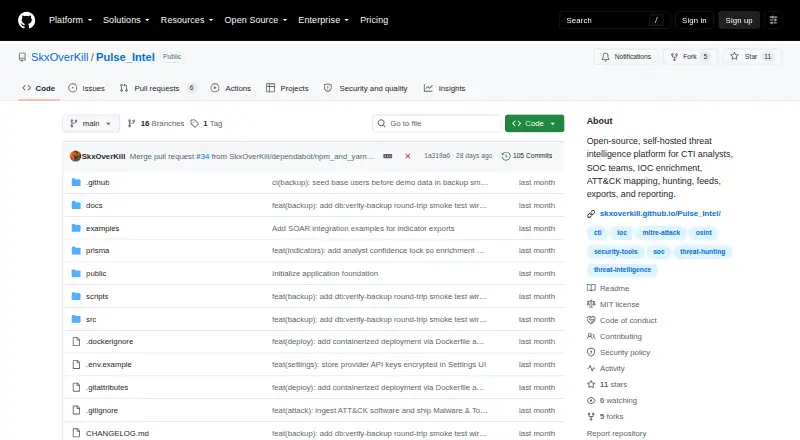
What Pulse Intelligence is
Pulse Intelligence is a free, open-source threat intelligence workspace that organizations host themselves. It brings threat actors, aliases, campaigns, indicators, reports, sources, CVEs, and ATT&CK mappings together for analyst workflows. The platform ingests public feeds from CISA KEV, NVD, FIRST EPSS, abuse.ch, OTX, vendor blogs, and security news, and can enrich indicators with OTX, AbuseIPDB, and VirusTotal. Users can save hunts across indicator fields, receive alerts for new matches, and export filtered indicators as CSV, STIX 2.1, MISP JSON, or Snort and Suricata rules. Scheduled Markdown reports can cover new indicators, KEV additions, hunt alerts, and feed health. A read-only API with scoped keys supports scripts, SOAR playbooks, and internal tools. Its default limit is 120 requests per API key per 60-second window, and indicator pages are capped at 500. Deployment requires Node.js 20.9+, PostgreSQL 17 or compatible PostgreSQL, and a Redis-compatible server; documented options include direct Node deployment and Docker Compose.
Good
- Tracks actors, campaigns, indicators, CVEs, and ATT&CK mappings
- Ingests feeds from CISA KEV, NVD, OTX, and others
- Offers saved hunts, alerts, and multiple export formats
- Generates scheduled Markdown reports
- Scoped read-only API supports integrations
Watch out
- Requires Node.js 20.9+, PostgreSQL, and Redis-compatible service
- API defaults to 120 requests per key per 60 seconds
- Indicator pages are capped at 500
- Project lists phase 8 hardening as not yet implemented
Who it suits
Pulse Intelligence suits analysts, junior CTI teams, and SOC teams seeking a self-hosted threat intelligence workspace. It is intended for teams able to operate the required Node.js, PostgreSQL, and Redis-compatible services.
Verdict
Pulse Intelligence combines threat data, indicator enrichment, hunting, exports, and reporting in a self-hosted workspace. Its deployment requirements and stated project status are important considerations for teams evaluating it.
Plans and prices
From Pulse Intelligence's own pricing page, checked 8 Oct 2026.
| Plan | Price | What it gives you |
|---|---|---|
| Open-source self-hosted | Free | Self-hosted; requires Node.js 20.9+, PostgreSQL 17, and a Redis-compatible server |
The facts
Each one read from Pulse Intelligence's own pages, with the date it was checked.
What it does
- API
- The public API is read-only, supports scoped API keys, and is intended for analyst scripts, SOAR playbooks, internal tools, and integrations.checked 8 Oct 2026
- API limits
- The API defaults to 120 requests per API key per 60-second window, and indicator page size is capped at 500.checked 8 Oct 2026
- API rate limit
- API routes default to 120 requests per API key per 60-second window, configurable by environment variables.checked 8 Oct 2026
- Audience
- The project describes its users as analysts, junior CTI teams, and SOC teams.checked 8 Oct 2026
- Data handling
- Whitelisted indicators are excluded from API responses and exports, and expired indicators are excluded from API results.checked 8 Oct 2026
- Deployment
- The maker documents direct Node deployment and a Docker Compose full-stack deployment, with both the web app and worker kept running.checked 8 Oct 2026
- Deployment requirements
- Deployment requires Node.js 20.9+, PostgreSQL 17, and a Redis-compatible server; the project documents native and Docker deployment paths.checked 8 Oct 2026
- Enrichment
- It enriches indicators through OTX, AbuseIPDB, and VirusTotal, with Redis-backed quota controls.checked 8 Oct 2026
- Exports
- Filtered IOCs can be exported as CSV, STIX 2.1, MISP JSON, and Snort or Suricata rules.checked 8 Oct 2026
- Feeds
- It ingests public feeds from CISA KEV, NVD, FIRST EPSS, abuse.ch, OTX, vendor blogs, and security news.checked 8 Oct 2026
- Hunting
- Users can create saved hunts over indicator fields, receive alerts for new matches, and export hunt matches.checked 8 Oct 2026
- Integrations
- Its public read-only API supports scoped keys and integrations such as analyst scripts, SOAR playbooks, and internal tools.checked 8 Oct 2026
- IOC safeguards
- Whitelisted indicators are never returned by public API or export routes, and expired indicators are also excluded from the API.checked 8 Oct 2026
- Product
- Pulse Intelligence is an open-source, self-hosted threat intelligence platform for analyst workflows.checked 8 Oct 2026
- Project status
- The README says phases 1–7 of 8 are implemented and phase 8 covers hardening, large-table partitioning, and deeper security review.checked 8 Oct 2026
- Purpose
- Pulse Intelligence is an open-source, self-hosted threat intelligence workspace for analysts and junior CTI teams.checked 8 Oct 2026
- Reports
- The platform can generate scheduled Markdown reports from new indicators, KEV additions, hunt alerts, and feed health.checked 8 Oct 2026
- Requirements
- The documented deployment requires Node.js 20.9+, PostgreSQL 17 or compatible PostgreSQL, and a Redis-compatible server.checked 8 Oct 2026
- Security
- The repository lists Argon2id passwords, database-backed session cookies, hashed API keys, and an admin-only audit log.checked 8 Oct 2026
- Security controls
- The README lists Argon2id passwords, database-backed session cookies, hashed API keys, and an admin-only audit log.checked 8 Oct 2026
- Threat data
- It tracks threat actors, aliases, campaigns, indicators, reports, sources, CVEs, and ATT&CK mappings.checked 8 Oct 2026
- Threat tracking
- It tracks threat actors, aliases, campaigns, indicators, reports, sources, CVEs, and ATT&CK mappings.checked 8 Oct 2026
The full review of Pulse Intelligence
Overview
Pulse Intelligence is a self-hosted, open-source workspace for collecting and working with threat intelligence. It is best suited to analysts and junior CTI or SOC teams that can operate its supporting services. Its breadth of tracking, enrichment, hunting, and export tools is appealing, but running both the web app and worker means it is not a turnkey hosted service.
Key features
The platform brings threat actors, aliases, campaigns, indicators, reports, sources, CVEs, and ATT&CK mappings into one workspace. It ingests public data from CISA KEV, NVD, FIRST EPSS, abuse.ch, OTX, vendor blogs, and security news, giving teams several types of intelligence to work with rather than a single feed.
Indicator enrichment through OTX, AbuseIPDB, and VirusTotal can add context to investigations; Redis-backed quota controls help manage usage. Analysts can save hunts over indicator fields, get alerts when new matches appear, and export those matches. Filtered IOCs can also be exported as CSV, STIX 2.1, MISP JSON, or Snort and Suricata rules, making the outputs useful across different analysis and detection workflows.
Scheduled Markdown reports can draw on new indicators, KEV additions, hunt alerts, and feed health. A public read-only API with scoped keys supports analyst scripts, SOAR playbooks, and internal tools. Its default limit is 120 requests per API key per 60-second window, configurable through environment variables, and indicator pages are capped at 500. That is a practical boundary for integrations to account for, not an unrestricted data pipeline.
The repository describes Argon2id passwords, database-backed session cookies, hashed API keys, and an admin-only audit log. Whitelisted indicators are excluded from API responses and exports, while expired indicators are excluded from API results. These safeguards are relevant to teams handling IOC data, though the project says phase 8—covering hardening, large-table partitioning, and deeper security review—remains ahead.
Pricing
Open-source self-hosted: free. The plan is free and open source, with no free trial. There are no paid tiers or seat and quota terms described for the plan; API usage does have the configurable default limit above. The trade-off is operational: teams supply and maintain the deployment environment rather than paying for a hosted option.
Pulse Intelligence requires Node.js 20.9+, PostgreSQL 17 or compatible PostgreSQL, and a Redis-compatible server. The maker documents both direct Node deployment and Docker Compose, and says the web app and worker must both remain running. That is a reasonable fit for teams already able to run these components, but a substantial prerequisite for anyone seeking a quick, managed setup.
Platforms
Pulse Intelligence supports API, Linux, macOS, self-hosted, web, and Windows. These labels describe its reach, not a lower-maintenance hosted deployment: the documented setup still depends on Node.js, PostgreSQL, and Redis, with the app and worker kept running.
Who it's for
Analysts, junior CTI teams, and SOC teams are the clearest fit, especially those that want to combine feed intake, indicator enrichment, saved hunts, and exports in an environment they operate themselves. Teams that need scheduled reports or a read-only API for scripts and internal integrations also have useful workflow components in one place.
It is a weaker choice for organizations that cannot maintain the required services, need a finished deployment with no operating burden, or require a project whose stated implementation work is complete. The README says phases 1–7 of 8 are implemented, with hardening and deeper security review still in phase 8.
Pros and cons
- Pro: Feed ingestion, enrichment, hunting, reporting, and multiple IOC export formats cover a useful span of analyst work in one self-hosted workspace.
- Pro: Scoped API keys and exclusions for whitelisted and expired indicators give integrations defined access and data-handling boundaries.
- Con: Node.js, PostgreSQL, Redis, and continuously running web and worker processes create real deployment and maintenance work.
- Con: The project's own phase plan leaves hardening and deeper security review for phase 8, a relevant caveat for teams assessing operational risk.
- Con: The API's default rate limit and 500-item page cap may constrain high-volume integrations unless teams configure around the limit where possible.
Alternatives
Choose OpenAEV if attack simulation and tabletop exercises are the priority; its free Community Edition is on-premise and includes community support. IBM X-Force Exchange has a free portal tier, but that tier does not include X-Force API access.
IntelOwl is another free, open-source self-hosted option for teams comparing intelligence tools. Kaspersky Threat Intelligence Portal offers free access to curated features, with limits on suspicious files and URLs for Cloud Sandbox. Pick MISP if you want its open-source software released under AGPL; it also offers a yearly support contract at €7.31 a year.
ThreatForge offers a free AGPL-3.0-or-later Community Edition and an Enterprise Edition with a 90-day trial. Security Vision TIP is a paid option with individual pricing calculated through sales. Threat Intelligence Platform has a free subscription with 100 credits after sign-up, where web analysis costs 10 credits per request and API requests cost 1–3 credits.
Browse the Threat Intelligence Platforms list for more options. The Container Monitoring list covers a different category.
Verdict
Pulse Intelligence is a strong candidate for analyst and junior CTI or SOC teams that want an open-source threat-intelligence workspace they can run and integrate themselves. Its combination of feed ingestion, enrichment, hunts, exports, and reporting is the main reason to choose it. Look elsewhere if operating Node.js, PostgreSQL, and Redis is not feasible, or if phase-8 hardening and security review still being in progress is a blocker.
Getting started
- Open the project website on GitHub.
- Choose direct Node deployment or the documented Docker Compose deployment.
- Provide Node.js 20.9 or later, PostgreSQL 17 or compatible PostgreSQL, and a Redis-compatible server.
- Keep both the web app and worker running.
Limits worth knowing
The public API defaults to 120 requests per API key in each 60-second window, and indicator pages are capped at 500. These defaults are configurable through environment variables.
Questions
Is Pulse Intelligence free?
Yes. Its open-source self-hosted plan is free.
What does deployment require?
The documented requirements are Node.js 20.9 or later, PostgreSQL 17 or compatible PostgreSQL, and a Redis-compatible server.
Can it enrich indicators?
Yes. It enriches indicators through OTX, AbuseIPDB, and VirusTotal, with Redis-backed quota controls.
What export formats does it support?
Filtered indicators can be exported as CSV, STIX 2.1, MISP JSON, and Snort or Suricata rules.
Does it provide an API?
Yes. Its public API is read-only, supports scoped keys, and is intended for scripts, SOAR playbooks, and internal tools.
What is its API limit?
The default is 120 requests per API key per 60-second window, and indicator page size is capped at 500.
Alternatives to Pulse Intelligence
- 1

MISP
Free planOpen sourceWebAPILinuxSelf-hosted7.9From €7.31 a year - 2
Google Cloud Secret Manager
Free planWeb6.5From $0.02 a month - 3
Kaspersky Threat Intelligence Portal
Free planWebAPI6.5Free plan - 46.5From $4,550 a year
- 5
IBM X-Force Exchange
Free planWebAPI6.3Free plan - 6
Shodan Monitor
WebAPILinux6.3From $69 a month