Kaspersky Threat Intelligence Portal
Kaspersky Threat Intelligence Portal is a cloud investigation workspace for security teams working with cyberthreat intelligence.
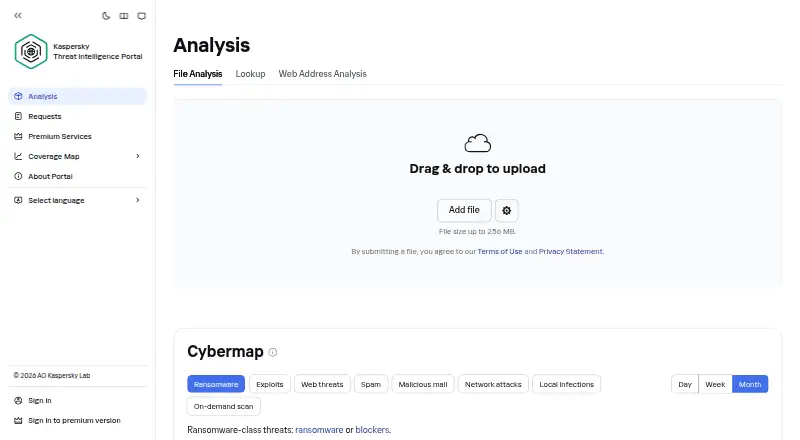
What Kaspersky Threat Intelligence Portal is
Kaspersky Threat Intelligence Portal is a cloud investigation workspace for security teams working with cyberthreat intelligence. Its tools support indicator enrichment, malware analysis, threat actor and campaign tracking, and incident response. Threat Lookup connects related threats in Kaspersky’s knowledge base, while Threat Analysis examines suspicious files using multiple analysis layers. AI features summarize information for triage, provide actor profiles linked to updated tactics, techniques, procedures, campaigns, and indicators in related Kaspersky reports, and support OSINT search and relationship tracing through KIRA. Remote MCP can connect compatible assistants such as Claude and ChatGPT to portal data. Users can look up IP addresses, hashes, domains, and web addresses; registered users can also submit URLs to a sandbox for a report on page activity. The REST API supports URL lookups with an API token and file submissions for sandbox analysis, up to a documented 256 MB maximum. Listed connectors include Maltego, MISP, Splunk Enterprise Security, IBM QRadar, and Elastic SIEM. Free access is available, with limited suspicious-file and URL executions; fuller reports may require demo access.
Good
- Free access to curated threat intelligence.
- Supports indicator enrichment and STIX/TAXII.
- REST API supports URL lookup and file submission.
- Connectors include MISP and Splunk Enterprise Security.
Watch out
- Free sandbox executions are limited.
- Some report sections may have no data.
- Submitted samples must not be confidential or commercially sensitive.
Who it suits
The portal is aimed at SOC teams, threat analysts, and threat hunters handling investigation, incident response, and threat hunting. It may suit security teams that need indicator enrichment and sandbox analysis.
Verdict
The portal combines investigation, lookup, and analysis tools with free access and a demo-request path. Review the access limits and sample-submission terms before submitting material.
Plans and prices
From Kaspersky Threat Intelligence Portal's own pricing page, checked 8 Oct 2026.
| Plan | Price | What it gives you |
|---|---|---|
| Free access | Free | Limited features · limited number of suspicious files and URLs for Cloud Sandbox · Free access to curated features |
The facts
Each one read from Kaspersky Threat Intelligence Portal's own pages, with the date it was checked.
What it does
- Access limits
- General access provides general information about submitted objects, while some report sections may have no data and full reports require demo access.checked 8 Oct 2026
- Actor profiles
- AI-powered actor profiles link updated TTPs, campaigns, and technical indicators when related Kaspersky reports are published.checked 8 Oct 2026
- AI connectivity
- Remote MCP support lets users connect compatible AI assistants such as Claude and ChatGPT to Portal data.checked 8 Oct 2026
- AI features
- KIRA provides AI summarization and OSINT search, and can automatically trace relationships between searched objects and produce a human-readable verdict.checked 8 Oct 2026
- AI integrations
- Remote MCP support connects the portal to compatible assistants such as Claude and ChatGPT.checked 8 Oct 2026
- AI summaries
- AI automation turns threat information into concise, actionable intelligence to help analysts triage and investigate.checked 8 Oct 2026
- API
- The portal provides a REST API for web address lookups using an API token.checked 8 Oct 2026
- File analysis
- File analysis uses dynamic, static, and behavioral analysis technologies and a global cloud reputation system to detect threats.checked 8 Oct 2026
- File analysis API
- The API can submit a file for sandbox analysis and return a basic report; the documented maximum file size is 256 MB.checked 8 Oct 2026
- Indicator lookup
- Users can look up IP addresses, file hashes, domains, and web addresses to validate and prioritize alerts and incidents.checked 8 Oct 2026
- Integrations
- Kaspersky lists out-of-the-box connectors including Maltego, MISP, Splunk Enterprise Security, IBM QRadar, and Elastic SIEM.checked 8 Oct 2026
- Intended users
- Kaspersky presents the portal for SOC teams, threat analysts, and threat hunters.checked 8 Oct 2026
- Investigations
- It supports IOC enrichment, malware analysis, threat actor and campaign tracking, and incident response.checked 8 Oct 2026
- Purpose
- The portal is a centralized investigation workspace that gives security teams access to current cyberthreat intelligence.checked 8 Oct 2026
- Submission terms
- The general access terms say submitted samples must not be confidential or commercially sensitive and restrict use to non-commercial malware detection and prevention.checked 8 Oct 2026
- Terms and sample handling
- The General Access terms say submitted samples must not be confidential or commercially sensitive and grant Kaspersky rights to use, store, edit, reproduce, distribute, and delete their contents.checked 8 Oct 2026
- Threat analysis
- Threat Analysis provides multi-layered analysis of suspicious files to detect previously unknown threats.checked 8 Oct 2026
- Threat Lookup
- Threat Lookup provides access to Kaspersky's cyberthreat knowledge base and connections between related threats.checked 8 Oct 2026
- URL sandbox
- Registered users can submit web addresses to a URL Sandbox and receive a report on page activity, including downloads and JavaScript, without opening the page in their own browser.checked 8 Oct 2026
The company
- Company
- Kaspersky is a global cybersecurity and digital privacy company founded in 1997.checked 8 Oct 2026
- Founded
- 1997checked 28 Sep 2026
Money
- Free access
- Kaspersky describes a free version of the Threat Intelligence Portal that provides access to trusted threat intelligence.checked 8 Oct 2026
- Free access limits
- The free version provides registered users a limited number of suspicious file and URL executions in Kaspersky Cloud Sandbox.checked 8 Oct 2026
- Trial access
- Users can request trial access by submitting contact information and selecting the demo request option.checked 8 Oct 2026
The full review of Kaspersky Threat Intelligence Portal
Kaspersky Threat Intelligence Portal is a cloud-based investigation workspace for examining indicators, files, URLs, and threat activity. It suits SOC teams, threat analysts, and threat hunters that need Kaspersky intelligence alongside sandbox and enrichment tools. The free tier is useful for triage, but restricted reporting and sample-submission terms matter before it becomes part of a sensitive workflow.
Overview
The portal brings IOC enrichment, malware analysis, actor and campaign tracking, and incident-response work into one service. Threat Lookup connects IP addresses, file hashes, domains, and web addresses with Kaspersky's threat knowledge base, helping analysts establish context and prioritize alerts. Cloud deployment and both web and API access make it practical for teams that want a shared workspace rather than a separately maintained intelligence stack.
General access is deliberately limited: submitted objects may show only general information, with some report sections containing no data, while full reports require demo access. That makes the service a good first-pass investigation tool, not a guarantee of complete intelligence on every object.
Key features
Lookup and analysis
Threat Analysis combines static, dynamic, and behavioral file analysis with a global cloud reputation system. The multi-layer approach is intended to expose previously unknown threats, while the Cloud Sandbox can execute suspicious files and URLs. Registered users can submit a web address to the URL Sandbox and review page behavior, including downloads and JavaScript, without opening the page in their own browser. The free version allows only a limited number of suspicious-file and URL executions, so frequent malware triage will need more access.
Investigation and AI
The workspace supports indicator enrichment, report management, STIX/TAXII, and tracking of threat actors and campaigns. KIRA adds AI summaries, OSINT search, relationship tracing between searched objects, and a human-readable verdict. AI-powered actor profiles connect current tactics, techniques, procedures, campaigns, and technical indicators when related Kaspersky reports are published. Remote MCP support can connect Portal data to compatible assistants such as Claude and ChatGPT, which is useful for teams already organizing investigations through those assistants.
Automation and integrations
The REST API handles web-address lookups with an API token and can submit files for sandbox analysis, returning a basic report. The documented maximum file size is 256 MB. Connectors are available for Maltego, MISP, Splunk Enterprise Security, IBM QRadar, and Elastic SIEM, giving established security operations environments a route to feed enrichment into existing workflows.
Pricing
Free access — free. The free plan provides curated, limited features and trusted threat intelligence, including a limited number of Cloud Sandbox executions for suspicious files and URLs. It is a sensible fit for occasional checks, learning, and small-team triage, but the execution cap and partial general-access reports reduce its usefulness for continuous operations.
Trial access is available by submitting contact information and choosing the demo-request option. Full reports therefore depend on a demo path rather than the free tier alone. Before submitting material, note that general-access terms prohibit confidential or commercially sensitive samples and permit Kaspersky to use, store, edit, reproduce, distribute, and delete submitted contents. The terms also restrict use to non-commercial malware detection and prevention. Organizations handling proprietary evidence should look for a workflow with terms that match their data-handling requirements.
Platforms
The portal is delivered as a cloud service through the web and a REST API. It supports STIX/TAXII, indicator enrichment, report management, and integrations with major security-analysis platforms, so it is best suited to teams that want hosted access rather than self-hosted deployment.
Who it's for
SOC teams can use the portal to enrich alerts, inspect suspicious files and URLs, and support incident response. Threat analysts and hunters benefit from connected indicators, actor and campaign context, AI summaries, and relationship searches. It is less suitable for organizations that must submit confidential samples, need unrestricted sandbox volume on a free plan, or require complete reports without requesting demo access.
Pros and cons
- Pro: Lookup covers IPs, hashes, domains, and web addresses, giving analysts several common investigation starting points in one place.
- Pro: Static, dynamic, behavioral, and reputation analysis provide broader file triage than a simple reputation lookup.
- Pro: REST API, STIX/TAXII, and connectors for Maltego, MISP, Splunk Enterprise Security, IBM QRadar, and Elastic SIEM support operational integration.
- Pro: KIRA, actor profiles, and MCP connectivity can reduce manual correlation and present findings in analyst-friendly form.
- Con: Free access limits Cloud Sandbox executions, making it unsuitable as an unrestricted daily analysis service.
- Con: General access may omit report sections, and full reports require demo access.
- Con: Submission terms rule out confidential or commercially sensitive samples and grant broad rights over submitted contents.
Alternatives
For a broader directory of products, see Threat Intelligence Platforms.
Pulse Intelligence is the better choice when an open-source, self-hosted platform is preferred; its free deployment requires Node.js 20.9+, PostgreSQL 17, and a Redis-compatible server.
Choose OpenAEV instead when on-premise attack simulation and tabletop exercises are the priority, with a free Community Edition and optional enterprise route.
IBM X-Force Exchange suits teams wanting a freemium exchange portal, although its free access does not include X-Force API access.
IntelOwl is an open-source, self-hosted alternative for teams that want control of deployment.
MISP is a free AGPL threat-sharing platform, with optional yearly paid support.
ThreatForge offers an open-source community edition and a separate commercial enterprise edition.
Security Vision TIP is a paid option priced through an individual sales calculation.
Threat Intelligence Platform is worth considering when a credit-based free plan with 100 signup credits is a better fit for web and API analysis.
Verdict
Kaspersky Threat Intelligence Portal is a strong choice for SOC teams, analysts, and hunters who want Kaspersky intelligence, connected lookups, sandbox analysis, and API integrations in a hosted workspace. Choose it for broad investigation coverage and AI-assisted correlation; look elsewhere if your evidence is sensitive, your sandbox workload is heavy, or you need complete reports without demo-gated access.
Alternatives to Kaspersky Threat Intelligence Portal
- 1

MISP
Free planOpen sourceWebAPILinuxSelf-hosted7.9From €7.31 a year - 2
Pulse Intelligence
Free planWebAPILinuxmacOS6.8Free plan - 3
Google Cloud Secret Manager
Free planWeb6.5From $0.02 a month - 46.5From $4,550 a year
- 5
IBM X-Force Exchange
Free planWebAPI6.3Free plan - 6
Shodan Monitor
WebAPILinux6.3From $69 a month