Pulsar
Pulsar monitors machine learning models in production, focusing on model drift, concept drift, and performance.
What Pulsar is
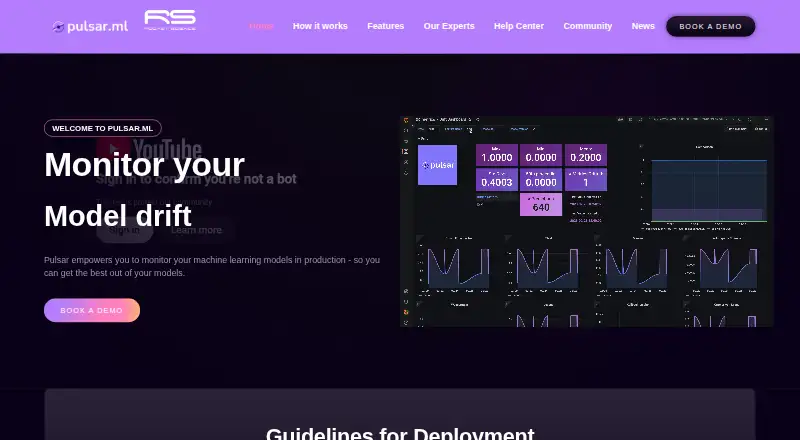
Pulsar monitors machine learning models in production, focusing on model drift, concept drift, and performance. It ingests model inputs and outputs into a time series database, supporting both historical and real-time data. An SDK and containerised ingestion service can be integrated into a user's machine; the current database integration is InfluxDB. Pulsar uses training data as a baseline to calculate drift and performance metrics, and its scheduler can trigger standard or customised alerts when metrics reach thresholds. A Grafana dashboard displays drift measures across time ranges and user-defined features. Listed drift measures include Kullback-Leibler divergence, Kolmogorov-Smirnov, Levene, and Wasserstein tests; performance measures include accuracy, recall, F1 score, Brier score, mean squared error, and R2 score. The features page says it is designed for large ingestion volumes without degraded performance. Pulsar is a free, open-source community edition for software engineers, data scientists, and machine learning engineers. It supports self-hosted deployment, and its homepage displays integrations including Flask, FastAPI, TensorFlow Extended, Seldon, AWS, Azure, Google Cloud, and Grafana.
Good
- Monitors model drift, concept drift, and performance.
- Supports historical and real-time data.
- Provides configurable threshold alerts.
- Includes Grafana views for drift metrics.
- Free and open source.
Watch out
- Current time series database integration is InfluxDB.
- Deployment is self-hosted.
Who it suits
Pulsar suits software engineers, data scientists, and machine learning engineers who need to monitor production models. Its self-hosted deployment and drift alerts may fit teams managing their own machine learning pipelines.
Verdict
Pulsar combines production drift monitoring, performance metrics, and alerts in a free, open-source offering. Its current database integration is InfluxDB, and the listed deployment option is self-hosted.
The facts
Each one read from Pulsar's own pages, with the date it was checked.
What it does
- Additional integrations
- The homepage displays Flask, FastAPI, TensorFlow, Seldon, AWS, Azure, Google Cloud, and Grafana as deployment integration logos.checked 4 Oct 2026
- Alerts
- Pulsar describes scheduled monitoring that can trigger standard and customized alerts when metrics reach thresholds.checked 7 Oct 2026
- Audience
- The maker identifies software engineers, data scientists, and machine learning engineers as users of Pulsar.checked 7 Oct 2026
- Capacity
- The features page says Pulsar is built to handle large volumes of ingested data without degraded performance.checked 4 Oct 2026
- Cloud marketplaces
- The FAQ says Pulsar is being developed to augment Azure and AWS marketplaces.checked 4 Oct 2026
- Community edition
- The site describes Pulsar as a 100% community edition.checked 7 Oct 2026
- Dashboard
- Pulsar includes Grafana for visualising data drift metrics over different time ranges for user-defined features.checked 4 Oct 2026
- Database integration
- The site says its current time series database integration is InfluxDB, with support for other time series databases planned.checked 7 Oct 2026
- Data ingestion
- Pulsar ingests model inputs and outputs into a time series database and supports historical and real-time data.checked 7 Oct 2026
- Deployment
- Pulsar provides an SDK and a containerized data ingestion service for integration with a user's machine and production code.checked 7 Oct 2026
- Deployment integrations
- The homepage displays Flask, FastAPI, TensorFlow Extended, Seldon, AWS, Azure, Google Cloud, and Grafana as deployment integration logos.checked 7 Oct 2026
- Drift metrics
- Listed data drift metrics include Kullback-Leibler divergence, Kolmogorov-Smirnov, Levene, Wasserstein, and other statistical tests.checked 7 Oct 2026
- Expert services
- Pulsar Experts are described as machine learning engineers who can help users learn Pulsar or build machine learning pipelines.checked 7 Oct 2026
- Metrics
- Pulsar calculates data drift and model performance metrics using training data as a baseline.checked 4 Oct 2026
- Metrics dashboard
- Pulsar includes Grafana for visualizing data drift metrics over time ranges and user-defined features.checked 7 Oct 2026
- Performance metrics
- Listed performance metrics include accuracy, recall, F1 score, Brier score, mean squared error, and R2 score.checked 7 Oct 2026
- Purpose
- Pulsar monitors machine learning models in production, including data and model drift and model performance.checked 7 Oct 2026
- Security
- The homepage says production data is stored in a safe and reliable environment.checked 4 Oct 2026
- Support
- The help center links to a quick-start guide, how-to guides, contact support, a user community, and expert help.checked 7 Oct 2026
The company
- Maker
- Rocket Science Development is identified as Pulsar.ml's maker, and its site lists an address in Longueuil, Québec, Canada.checked 7 Oct 2026
Alternatives to Pulsar
- 1

Opik
Free planOpen sourceWebAPILinuxmacOS8.4From $19 a month - 2

Evidently AI
Free planOpen sourceWebAPILinuxmacOS8.3From $80 a month - 3

Deepchecks
Free planOpen sourceWebAPILinuxmacOS8.1Free plan - 4

NannyML
Free planOpen sourceWebAPILinuxSelf-hosted7.9From $99 a month - 5

SUPERWISE
Free planWebAPIExtensionLinux7.8From $9 a month - 6

Galileo
Free planWebAPISelf-hosted6.9From $100 a month