postmarketOS
postmarketOS, now called Nura, is a free, open-source operating system project focused on extending the life of consumer electronics.
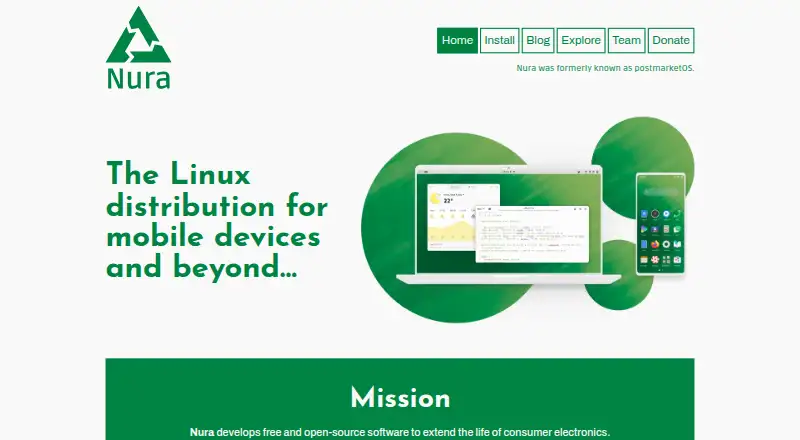
What postmarketOS is
postmarketOS, now called Nura, is a free, open-source operating system project focused on extending the life of consumer electronics. It is based directly on Alpine Linux and uses Linux mobile components including ModemManager. Interface options include GNOME, KDE, Phosh and Sxmo. Install images are listed for phones, tablets, Chromebooks, laptops and other devices, with support varying by device and category; listed hardware also includes single-board computers and x86_64 EFI systems. The project offers stable and edge release channels, with Nura v26.06 listed as the latest stable release. It says users can customize the system, install software and update at their own pace, and describes privacy and user control as goals. The project says usability and stability issues remain and advises against it for people seeking an operating system as usable as iOS or Android. Community-category devices may lack important features, while testing-category devices may have limited functionality or maintenance. There is no support contract, though community members may help when available. Installation guidance and a Matrix/IRC channel are offered for questions.
Good
- Free and open-source operating system.
- Offers GNOME, KDE, Phosh and Sxmo interfaces.
- Install images cover phones, tablets and computers.
- Users can customize the system and update at their own pace.
Watch out
- Usability and stability issues remain.
- Device functionality and support vary by category.
- No support contract is offered.
Who it suits
Nura may suit people willing to learn how the system works and contribute to development or testing. It is less suited to users looking for an operating system as usable as iOS or Android.
Verdict
Nura offers a customizable Linux-based system for a range of device types, but readiness and maintenance depend on the device. Consider its limitations and community support model before choosing it.
Plans and prices
From postmarketOS's own pricing page, checked 8 Oct 2026.
| Plan | Price | What it gives you |
|---|---|---|
| Nura (formerly postmarketOS) | Free | Free and open-source operating system; device support and stability vary |
The facts
Each one read from postmarketOS's own pages, with the date it was checked.
What it does
- Contributions
- Anyone can contribute patches and participate in discussions, according to the project team page.checked 8 Oct 2026
- Former name
- Nura was formerly known as postmarketOS.checked 8 Oct 2026
- Hardware support
- Install images are listed for phones, tablets, Chromebooks, laptops, and other devices, with support varying by device category.checked 8 Oct 2026
- Help
- The project directs installation questions to its Nura Matrix/IRC channel.checked 8 Oct 2026
- Installation help
- The install page links to an installation guide and invites users with questions to join the project’s Matrix/IRC channel.checked 8 Oct 2026
- Intended audience
- The project says users get the best experience after learning how the system works and contributing to development or testing.checked 8 Oct 2026
- Interfaces
- The project lists GNOME, KDE, Phosh, and Sxmo among its user interface options.checked 8 Oct 2026
- Kernel
- The install page says all listed images use close-to-mainline kernels.checked 8 Oct 2026
- Maintainers
- The project is a community-built free and open-source software project that accepts contributions through patches and discussions.checked 8 Oct 2026
- Privacy
- The project says its operating system has no surveillance, upselling, or walled gardens.checked 8 Oct 2026
- Privacy and control
- The project says its operating system has no surveillance, upselling, or walled gardens, and lets users customize it, install software, and update at their own pace.checked 8 Oct 2026
- Project history
- The project announced on September 27, 2026 that the operating system formerly known as postmarketOS would henceforth be called Nura.checked 8 Oct 2026
- Purpose
- Nura develops free and open-source software to extend the life of consumer electronics.checked 8 Oct 2026
- Readiness
- The project says usability and stability issues remain and advises against Nura for people seeking an operating system as usable as iOS or Android.checked 8 Oct 2026
- Release
- The latest stable release listed is Nura v26.06; development builds are labeled edge.checked 8 Oct 2026
- Security posture
- The project describes privacy and user control as goals, but the pages reviewed do not state a security certification or compliance program.checked 8 Oct 2026
- Software base
- Nura is based directly on Alpine Linux and uses Linux mobile components including ModemManager.checked 8 Oct 2026
- Support
- The project says it has no support contract and community members may help with issues when they have time.checked 8 Oct 2026
- Support limits
- The site says community-category devices may lack important features and testing-category devices may have limited functionality or maintenance.checked 8 Oct 2026
- Technical base
- Nura is based directly on Alpine Linux and uses the mainline Linux kernel and components including ModemManager.checked 8 Oct 2026
Where it runs
- Device control
- The project says users can adjust the system, install what they want, and update at their own pace.checked 8 Oct 2026
- Device limits
- The project says functionality depends on the device and that testing-category devices may have limited functionality or may not be well maintained.checked 8 Oct 2026
- Device support
- The install page lists release images for phones, tablets, Chromebooks, laptops, and other hardware, with community, testing, stable, and edge categories.checked 8 Oct 2026
The company
- Founded
- 2017checked 28 Sep 2026
The full review of postmarketOS
postmarketOS, now named Nura, is a free, open-source Linux system for people who want to keep using and customizing supported devices. It is best suited to technically curious users prepared to troubleshoot and contribute, not to anyone who needs a polished replacement for iOS or Android.
Overview
The project’s aim is to extend the useful life of consumer electronics. It gives users control over system changes, installed software and update timing, and describes its approach as free of surveillance, upselling and walled gardens. Those priorities are compelling for people who want more say over their devices; they do not remove the practical compromises of running Linux on varied hardware.
Nura is built directly on Alpine Linux, with mobile components such as ModemManager and close-to-mainline kernels in its install images. GNOME, KDE, Phosh and Sxmo are among the interface options. The underlying system and choice of interfaces offer flexibility, but neither guarantees that a particular device’s hardware is fully functional.
Key features
- Multiple interfaces: GNOME, KDE, Phosh and Sxmo let users choose an environment. That range is useful for people who want to shape their setup, but device-specific support still determines how well it works.
- Stable and edge channels: Stable releases are distinct from edge development builds. Stable kernel packages are kept current while a release is supported, but there is no fixed support duration, so users should not assume a uniform maintenance window.
- Alpine packages and application options: Alpine apk packages provide the system’s package base. Flatpak is the primary application distribution for Duranium, while kernel and system package upgrades are built in. These channels offer ways to manage software, though the stated application arrangement differs for Duranium.
- Broad device and architecture targets: Images cover phones, tablets, laptops, Chromebooks, single-board computers and x86_64 EFI systems, across aarch64, armv7, x86_64 and riscv64. The breadth is a notable ambition, not a promise of equal functionality: support varies by device category and maintainer.
- Community participation: Users can contribute patches and join discussions. Installation questions go to the project’s Matrix/IRC channel, where community members may help when they have time rather than under a support contract.
Pricing
Nura is free and open source. The Nura (formerly postmarketOS) plan costs nothing and includes the operating system; device support and stability vary. There is no free trial because the software is already free. No paid tier or support contract is offered, so users must be comfortable relying on community help and the maintenance available for their device.
Platforms
The project targets Android and Linux platforms, with physical-device installation images for phones, tablets, laptops, Chromebooks, single-board computers and x86_64 EFI systems. Device categories include stable, community, testing and edge, and the experience can differ substantially between them. Community devices may miss important features; testing devices may have limited functionality or maintenance. Check the specific device’s category before choosing Nura, particularly if you depend on it as a daily-use device.
Who it's for
Nura makes the most sense for users who value open-source software, device control and the chance to extend hardware life, and who are willing to learn how the system works. The project explicitly says the best experience comes with learning, testing or contributing to development. It is a poor fit for people who need predictable, fully maintained hardware support or an experience as usable as iOS or Android. The project also describes privacy and control as goals, but does not state a security certification or compliance program; organizations that require one should look elsewhere.
Pros and cons
- Pro — User control is central: Users can customize the system, install software and choose when to update, without the surveillance, upselling or walled gardens the project rejects.
- Pro — Many device targets and interfaces: Support spans several device types and architectures, with multiple interface choices for users willing to match their setup to their hardware.
- Pro — Open participation: Contributors can submit patches and join discussions, which gives technically engaged users a way to improve the project.
- Con — Functionality varies by device: Community and testing categories can mean missing features, limited operation or weaker maintenance, so broad image availability is not equivalent to dependable support.
- Con — Stability and usability gaps remain: The project advises against Nura for people seeking an operating system as usable as iOS or Android.
- Con — Support is informal: There is no support contract, and help depends on community members having time.
- Con — No fixed support term: Kernel packages are maintained while a release is supported, but that period has no stated duration and device support also depends on category and maintainers.
Alternatives
Consider Kali Linux instead if you want a free, open-source distribution available across Android, Linux, macOS, self-hosted and Windows platforms. Choose Nix if you need a free, open-source package manager for Linux, macOS, Windows or self-hosted use rather than a mobile operating system. Raspberry Pi Imager is a free desktop imaging utility for Linux, macOS and Windows, with its source code published publicly. For a free Linux distribution with Xfce, KDE and Fluxbox editions, consider MX Linux.
pfSense is another option, with a free Community Edition and a Plus software offering. Rocky Linux may suit readers seeking a free, community-supported system with a 10-year support lifecycle. Solus is a free Linux operating system with four desktop editions. Ubuntu Server offers a freemium model and a free community plan for up to 50 machines.
For more options, see the Operating Systems directory.
Verdict
Choose Nura if extending a device’s life through a free, customizable Linux system matters more to you than consistent hardware support, and you are ready to learn and troubleshoot. Its open approach and range of targets are the main reasons to try it; variable functionality, remaining stability issues and informal support are strong reasons to look elsewhere if you need a dependable everyday system.
Getting started
- Check the Nura installation page for your device category
- Select a listed physical-device image
- Choose a stable or edge release channel
- Follow the linked installation guide
- Ask installation questions in the Nura Matrix/IRC channel
Limits worth knowing
Device support, functionality, and maintenance depend on the device category and its maintainers. Community devices may lack important features, while testing devices may have limited functionality or maintenance; the project also notes remaining usability and stability issues.
Questions
Is postmarketOS free?
Yes. The Nura (formerly postmarketOS) plan is listed as free, and the project describes it as free and open source.
What devices can run it?
Install images are listed for phones, tablets, Chromebooks, laptops, single-board computers, and x86_64 EFI systems. Support varies by device and category.
Which processor architectures are listed?
The listed architectures are aarch64, armv7, x86_64, and riscv64.
What software base does it use?
Nura is based directly on Alpine Linux and uses the mainline Linux kernel with components including ModemManager.
Which user interfaces are available?
The project lists GNOME, KDE, Phosh, and Sxmo among its interface options.
Where can I get installation help?
The installation page links to a guide and directs questions to the Nura Matrix/IRC channel.
Alternatives to postmarketOS
- 1

OPNsense
Free planOpen sourceAndroidiOSWebAPI8.6Free plan - 2
OpenWrt
Free planOpen sourceAndroidWebAPILinux7.8Free plan - 3
Kali Linux
Free planOpen sourceAndroidLinuxmacOSSelf-hosted7.6Free plan - 4
Apache NuttX
Free planOpen sourceAPILinuxmacOSSelf-hosted7.3Free plan - 5
AlmaLinux OS
Free planOpen sourceAPILinuxSelf-hostedWindows7.1Free plan - 6
pfSense
Free planWebLinuxSelf-hosted7.0Free plan