Ubuntu Server
Ubuntu Server is a Linux server operating system for enterprise data centers, public and private clouds, Kubernetes clusters and render farms.
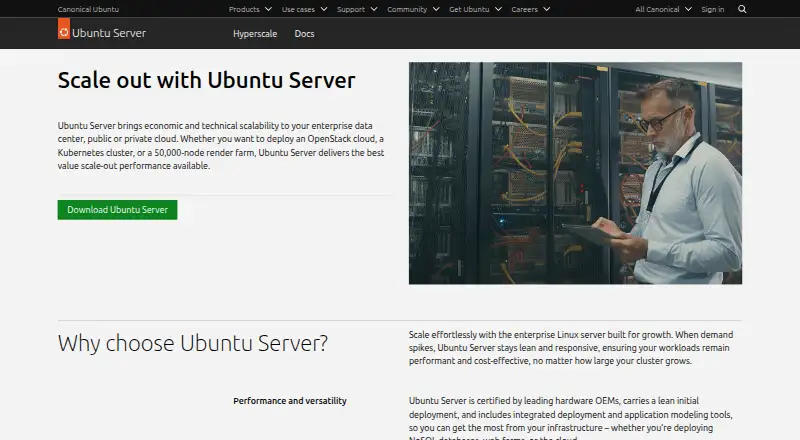
What Ubuntu Server is
Ubuntu Server is a Linux server operating system for enterprise data centers, public and private clouds, Kubernetes clusters and render farms. It can be deployed on physical servers, virtual machines, cloud instances and IoT or edge devices. The server page describes a lean initial deployment, integrated deployment and application modeling tools, and hardware OEM certification. LTS releases receive five years of standard security updates for thousands of open-source packages in the Ubuntu Main repository. Ubuntu Server is offered for Intel or AMD 64-bit systems as well as ARM, IBM POWER, IBM Z and RISC-V architectures. Listed installation requirements include 1.5 GB of system memory, 5 GB of free disk space, and a USB port or DVD drive for installer media. Ubuntu Pro extends LTS security maintenance to ten years, with a Legacy add-on extending it to 15. Pro also includes kernel live patching, security hardening features for named compliance frameworks, and Landscape fleet management.
Good
- Free LTS standard security maintenance lasts five years.
- Available for several CPU architectures.
- Ubuntu Pro extends maintenance up to 15 years.
- Landscape provides centralized estate management.
Watch out
- The listed Intel or AMD download is 3GB.
- Listed installation requires 1.5 GB memory and 5 GB disk.
- Some Pro and support options have per-machine charges.
Who it suits
Ubuntu Server suits organizations deploying workloads on physical servers, virtual machines, clouds or edge devices. Teams needing extended security maintenance, fleet administration or enterprise support can consider Ubuntu Pro options.
Verdict
Ubuntu Server covers a broad set of server and cloud deployments, with five years of standard security maintenance for LTS releases. Ubuntu Pro adds longer maintenance and administration features, with paid options for selected plans and support.
Plans and prices
From Ubuntu Server's own pricing page, checked 3 Oct 2026.
| Plan | Price | What it gives you |
|---|---|---|
| Ubuntu Server | Free | Five years of free security and maintenance updates for LTS; extended to up to 15 years with Ubuntu Pro |
| Ubuntu Pro Personal | Free | Up to 5 machines |
| Ubuntu Pro Community | Free | Up to 50 machines for active Ubuntu community members |
| Ubuntu Pro Workstation | $25 a year | Ubuntu Pro; does not include knowledge base access, certified Windows drivers for KVM guests, or Ubuntu Assurance Program · per machine per year |
| Ubuntu Pro with 24/7 Enterprise support — Workstation | $300 a year | Weekday support is 50% of the price of 24/7 support · full support per machine per year |
| Ubuntu Pro Server with unlimited VMs | $500 a year | Server with unlimited VMs; does not include knowledge base access, certified Windows drivers for KVM guests, or Ubuntu Assurance Program · per machine per year |
| Ubuntu Pro with 24/7 Enterprise support — Server with unlimited VMs | $3,400 a year | Weekday support is 50% of the price of 24/7 support · full support per machine per year |
The facts
Each one read from Ubuntu Server's own pages, with the date it was checked.
What it does
- Cloud and deployment tools
- Canonical describes Juju for deploying workloads across AWS, Microsoft Azure, OpenStack private clouds, or bare metal via MAAS, and MAAS for bare metal provisioning.checked 3 Oct 2026
- Compliance
- Ubuntu Pro includes security hardening features for frameworks and standards including FIPS 140, DISA-STIG, CIS, FedRAMP, CMMC, PCI-DSS, and Cyber Essentials.checked 3 Oct 2026
- Current download
- The download page lists Ubuntu Server 26.04.1 LTS for Intel or AMD 64-bit systems as a 3GB download.checked 3 Oct 2026
- Fleet management
- Ubuntu Pro includes access to Landscape for centralized administration, staggered updates, asset inventory, hardening, and audit functions.checked 3 Oct 2026
- Hardware and workloads
- The server page describes a lean initial deployment, integrated deployment and application modeling tools, and certification by hardware OEMs.checked 3 Oct 2026
- Live patching
- Ubuntu Pro Kernel Livepatch automates patching of high and critical kernel vulnerabilities while systems run, allowing maintenance windows to be deferred.checked 3 Oct 2026
- LTS maintenance
- Ubuntu Server LTS releases receive five years of standard security updates for thousands of open source packages in the Ubuntu Main repository by default.checked 3 Oct 2026
- Other architectures
- Ubuntu Server is also offered for ARM, IBM POWER, IBM Z (s390x), and multiple RISC-V platforms.checked 3 Oct 2026
- Product integrations
- Ubuntu Pro is described as integrated with AWS, Azure, and Google Cloud marketplaces, where customers can activate features and receive billing through their cloud provider.checked 3 Oct 2026
- Purpose
- Ubuntu Server is designed to scale across enterprise data centers and public or private clouds, including OpenStack clouds, Kubernetes clusters, and large render farms.checked 3 Oct 2026
- Security coverage
- Ubuntu Pro extends LTS security maintenance from five years to ten years for the full Ubuntu Archive, and the Legacy add-on extends it to 15 years.checked 3 Oct 2026
- Support
- Ubuntu Pro plus Support offers 24/7 expert support with break-fix and bug-fix coverage for infrastructure and applications.checked 3 Oct 2026
- System requirements
- The listed installation requirements include 1.5 GB system memory, 5 GB of free hard drive space, and a USB port or DVD drive for installer media.checked 3 Oct 2026
- Virtualization
- The download page links Multipass for creating Ubuntu virtual machines on Windows, Mac, and Linux, and lists VirtualBox, Hyper-V, HyperKit, or KVM.checked 3 Oct 2026
The company
- Maker
- Canonical says it has nurtured a community around Ubuntu since 2004.checked 3 Oct 2026
The full review of Ubuntu Server
Ubuntu Server is a Linux platform for physical servers, virtual machines, cloud infrastructure and edge devices. It is best suited to teams deploying across more than one of those environments. Its strongest advantage is a free LTS foundation with paid options for longer security coverage and enterprise administration.
Overview
Ubuntu Server is designed to scale from lean installations to enterprise data centers, public and private clouds, OpenStack, Kubernetes clusters and large render farms. Integrated deployment and application modeling tools, cloud images and hardware OEM certification support that range. For organizations standardizing across varied infrastructure, this breadth is more compelling than a platform tied to one deployment model.
LTS releases receive five years of standard security updates for thousands of open-source packages in the Ubuntu Main repository. Ubuntu Pro extends security maintenance across the full Ubuntu Archive to ten years; its Legacy add-on extends coverage to 15 years. The free term will suit many deployments, while longer-lived systems benefit from a defined path to broader, longer coverage.
Key features
Juju deploys workloads across AWS, Microsoft Azure, OpenStack private clouds and bare metal through MAAS, which provides bare-metal provisioning. These tools suit teams coordinating deployments across cloud and physical infrastructure, though they are most relevant to operators managing that range rather than a single small server.
Ubuntu Pro adds Kernel Livepatch, which automates patching for high and critical kernel vulnerabilities while systems continue running, allowing maintenance windows to be deferred. It also includes security hardening features for frameworks and standards such as FIPS 140, DISA-STIG, CIS, FedRAMP, CMMC, PCI-DSS and Cyber Essentials. Landscape provides centralized administration, staggered updates, asset inventory, hardening and audit functions. Together, these additions address operational and compliance needs that the base LTS maintenance term does not cover.
For organizations that need direct assistance, Ubuntu Pro plus Support offers 24/7 expert break-fix and bug-fix coverage for infrastructure and applications. Ubuntu Pro also integrates with AWS, Azure and Google Cloud marketplaces, where customers can activate features and receive billing through their cloud provider.
Pricing
Ubuntu Server is free, with five years of standard LTS security and maintenance updates. Ubuntu Pro extends coverage to as long as 15 years with the Legacy add-on. The free Ubuntu Pro Personal plan covers up to five machines; Ubuntu Pro Community is free for up to 50 machines for active Ubuntu community members.
| Plan | Price | What it includes |
|---|---|---|
| Ubuntu Pro Workstation | $25 a year | Ubuntu Pro, billed per machine per year. Excludes knowledge base access, certified Windows drivers for KVM guests and the Ubuntu Assurance Program. |
| Ubuntu Pro with 24/7 Enterprise support — Workstation | $300 a year | Full support per machine per year; weekday support is 50% of the 24/7 support price. |
| Ubuntu Pro Server with unlimited VMs | $500 a year | Server with unlimited VMs, billed per machine per year. Excludes knowledge base access, certified Windows drivers for KVM guests and the Ubuntu Assurance Program. |
| Ubuntu Pro with 24/7 Enterprise support — Server with unlimited VMs | $3,400 a year | Full support per machine per year; weekday support is 50% of the 24/7 support price. |
The paid Pro plans make most sense when longer security maintenance or Pro capabilities justify a per-machine charge. The support tiers suit organizations that need expert break-fix and bug-fix coverage; weekday support costs half the corresponding 24/7 support price. The workstation and server Pro subscriptions exclude several extras, so buyers who need knowledge base access, certified Windows KVM guest drivers or Ubuntu Assurance should account for those exclusions.
Platforms
Ubuntu Server supports Linux and self-hosted deployments, including physical servers, virtual machines, public, private and hybrid clouds, cloud images, and IoT or edge devices. Architectures include amd64, arm64, armhf, ppc64el, riscv64 and s390x. The current Intel or AMD 64-bit LTS download is 3GB; installation requirements include 1.5GB of system memory, 5GB of free drive space and a USB port or DVD drive for installer media.
For virtual machines, Multipass creates Ubuntu VMs on Windows, Mac and Linux. The download page also lists VirtualBox, Hyper-V, HyperKit and KVM. This gives administrators several virtualization routes, while the range of supported architectures helps accommodate hardware beyond standard x86-64 systems.
Who it's for
Ubuntu Server is a strong fit for infrastructure teams that want one Linux platform spanning cloud, data center, virtualization and edge workloads, especially when LTS maintenance or Ubuntu Pro's fleet management, live patching and compliance features matter. A single-machine user can start with the free server edition or the five-machine Ubuntu Pro Personal plan. Teams without a need for extended coverage or centralized administration may have little reason to pay for Pro.
Pros and cons
- Pro: Five years of standard LTS security updates are free, with Pro and its Legacy add-on extending coverage to ten and 15 years.
- Pro: Support for multiple deployment models and CPU architectures suits mixed infrastructure.
- Pro: Pro combines live kernel patching, security hardening and Landscape estate management for organizations with operational or compliance requirements.
- Con: Paid Pro and support plans are charged per machine per year, which can add up across a large fleet.
- Con: The standard Pro workstation and server subscriptions exclude knowledge base access, certified Windows drivers for KVM guests and Ubuntu Assurance.
Alternatives
AlmaLinux OS is a free enterprise Linux distribution with commercial support available separately, making it an option when a free distribution and separately sourced support are preferred. Debian is free to use and redistribute, a straightforward alternative for readers prioritizing those terms. Rocky Linux is free and community supported, with a 10-year support lifecycle for those seeking that stated term.
CentOS Stream is a free software distribution. Fedora Linux may suit readers whose hardware budget accommodates the 40GB disk and 4GB RAM recommended by most variants. MX Linux is a free Linux distribution with Xfce, KDE and Fluxbox editions. Amazon Linux is another free Linux option; Oracle Solaris offers a freemium model.
Verdict
Choose Ubuntu Server if you need a flexible Linux base across cloud, on-premises and edge deployments, with five years of free LTS maintenance and optional Pro coverage and administration. Its breadth and upgrade path are the main reasons to choose it; per-machine paid plans and exclusions on standard Pro subscriptions are reasons to compare alternatives when those services are not needed.
Alternatives to Ubuntu Server
- 1
AlmaLinux OS
Free planOpen sourceAPILinuxSelf-hostedWindows7.1Free plan - 2

Nix
Free planLinuxmacOSSelf-hostedWindows6.7Free plan - 3
OmniOS
Free planLinuxSelf-hosted6.5From $500 a year - 4
FreeBSD gpart
Free planSelf-hosted6.4Free plan - 5
Rocky Linux
Free planLinuxSelf-hostedWindows6.1Free plan - 6
Amazon Linux
Free planLinuxSelf-hosted6.0Free plan