AlmaLinux OS
AlmaLinux OS is a free, open-source, community-owned enterprise Linux distribution that is binary compatible with RHEL.
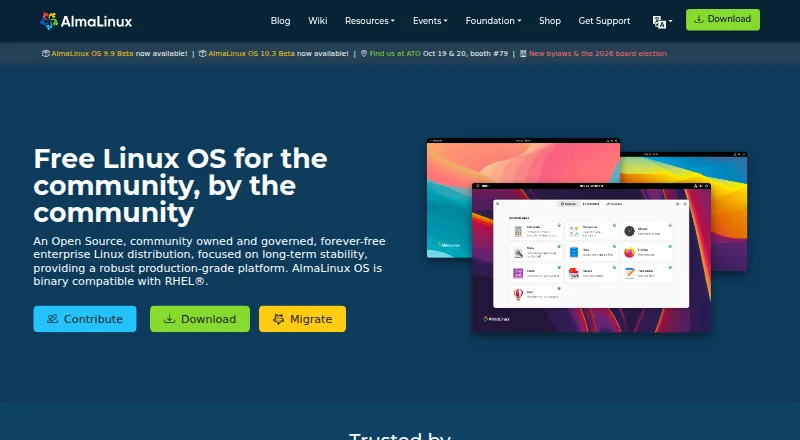
What AlmaLinux OS is
AlmaLinux OS is a free, open-source, community-owned enterprise Linux distribution that is binary compatible with RHEL. The project positions it for people who want an enterprise-grade Linux system without a commercial license agreement, including users looking for a CentOS Linux replacement. It can run on servers, workstations, virtual machines, cloud instances, containers, Raspberry Pi devices, and Windows Subsystem for Linux environments. ISO downloads are available for x86_64, aarch64, ppc64le, and s390x, and official cloud images cover AWS, Google Cloud, Azure, Oracle Cloud Infrastructure, and other listed environments. The project also provides container and Vagrant images, plus live media with GNOME, KDE, XFCE, MATE, and other desktop options. Its Foundation publishes security and bug-fix errata; installed packages are GPG-signed and verified by default. OpenSCAP, SCAP Workbench, OVAL streams, and CIS tooling are available for auditing or hardening systems. Community help is available through forums, chat, and Reddit, while commercial support is offered separately. The project plans updates for 8.x until 2029 and 9.x until 2032.
Good
- Free and open-source.
- Binary compatible with RHEL.
- Offers images for four listed CPU architectures.
- Packages are GPG-signed and verified by default.
- Community support is available through forums, chat, and Reddit.
Watch out
- Commercial support is offered separately.
- Minor versions reach end of life when the next minor version releases.
Who it suits
AlmaLinux OS suits users seeking an enterprise Linux distribution without a commercial license agreement, including those replacing CentOS Linux. Its images and deployment options cover physical, virtual, cloud, container, and WSL environments.
Verdict
AlmaLinux OS provides a free enterprise Linux option with a wide range of installation and image formats. Users who need support beyond community channels can consider the separately offered commercial support.
Plans and prices
From AlmaLinux OS's own pricing page, checked 15 Oct 2026.
| Plan | Price | What it gives you |
|---|---|---|
| AlmaLinux OS | Free | enterprise Linux distribution · RHEL binary compatibility · no license fees or usage charges · forever |
The facts
Each one read from AlmaLinux OS's own pages, with the date it was checked.
What it does
- Architectures
- Supported primary architectures are x86_64, aarch64, ppc64le and s390x.checked 15 Oct 2026
- Certifications
- The project states that AlmaLinux OS 9.2 is FIPS 140-3 validated and Common Criteria certified.checked 29 Sep 2026
- Cloud images
- Official cloud images are provided for Amazon AWS, Generic Cloud, Google Cloud, Microsoft Azure, OpenNebula, and Oracle Cloud Infrastructure.checked 29 Sep 2026
- Cloud integrations
- Official images are provided for AWS, Google Cloud, Microsoft Azure, OpenNebula and Oracle Cloud Infrastructure.checked 15 Oct 2026
- Compliance
- AlmaLinux OS 9.2 is stated to have FIPS 140-3 validation and to appear on the NIST active list.checked 15 Oct 2026
- Compliance tools
- AlmaLinux provides OpenSCAP, SCAP Workbench, OVAL streams, and CIS tooling to audit or harden systems.checked 29 Sep 2026
- Container integrations
- The project publishes OCI, Docker and UBI-compatible container images through Docker Hub, Quay.io and GitHub.checked 15 Oct 2026
- Desktop media
- Live images are offered with GNOME, GNOME Mini, KDE, XFCE and MATE.checked 15 Oct 2026
- Desktop options
- Live Media images are offered with GNOME, GNOME Mini, KDE, XFCE, and MATE desktop options.checked 29 Sep 2026
- Documentation and support
- Documentation covers installation, migration, security, cloud images, containers, WSL, repositories and troubleshooting, with forums, chat and mailing lists for community support.checked 15 Oct 2026
- Governance
- The AlmaLinux OS Foundation is a US 501(c)(6) nonprofit that owns and manages the project.checked 15 Oct 2026
- Installation formats
- Boot, minimal and DVD ISO images are available for each supported architecture, with checksum and signature verification instructions.checked 15 Oct 2026
- License
- The distribution compilation is licensed under GPLv2, while included packages retain their individual upstream licenses; unique non-OS software may use GPLv3 and libraries may use MIT.checked 15 Oct 2026
- Limit: beginner usability
- G2 reviewers report that installation and configuration can be CLI-focused and require prior Linux knowledge.checked 15 Oct 2026
- Limit: ecosystem size
- PhoenixNAP’s comparison says AlmaLinux has slower access to new software, fewer AlmaLinux-specific packages and less cloud-tooling dominance than Ubuntu.checked 15 Oct 2026
- Limit: software freshness
- G2 reviewers say the stability-first approach can delay newer packages and require manual hardware or configuration work.checked 15 Oct 2026
- Migration
- The project supplies almalinux-deploy for migrations from several Enterprise Linux distributions and ELevate for major-version upgrades.checked 15 Oct 2026
- Package policy
- Packages are generally limited to what is in RHEL, while additional software is expected to come from repositories such as EPEL.checked 15 Oct 2026
- Package verification
- AlmaLinux packages are GPG-signed and verified by default when installed.checked 29 Sep 2026
The company
- Company size
- LinkedIn lists AlmaLinux as a nonprofit software-development organization with 2–10 employees.checked 15 Oct 2026
- Founded
- The Foundation says it was founded in March 2021 to own and manage AlmaLinux OS.checked 15 Oct 2026
- Headquarters
- LinkedIn lists headquarters in Fort Myers, Florida.checked 15 Oct 2026
Where it runs
- Containers and virtual machines
- The project provides OCI, Docker, and UBI-compatible container images, plus Vagrant images for Libvirt, VirtualBox, Hyper-V, VMware, and Parallels.checked 29 Sep 2026
- Notable news: AlmaLinux 10.3 beta
- The project announced AlmaLinux 10.3 beta on September 10, 2026, including ModSecurity and OWASP Core Rule Set return, Podman 6 changes and new toolchains.checked 15 Oct 2026
The full review of AlmaLinux OS
AlmaLinux OS is a free, community-owned Linux distribution built for binary compatibility with RHEL. It is best suited to users who want an enterprise-oriented system across servers, cloud environments, or virtual machines without a commercial license. Its wide deployment range is a strength; readers who need provider-backed support should budget for that separately.
Overview
Stewarded by a nonprofit foundation with a community-elected board, AlmaLinux has offered an enterprise Linux option since 2021. RHEL binary compatibility makes it especially relevant to organizations seeking a CentOS Linux replacement, while its free distribution avoids a commercial license agreement. That combination is useful for building or maintaining a Linux estate, but does not remove the need to assess support and operational requirements.
The system spans servers, workstations, virtual machines, cloud instances, containers, Raspberry Pi devices, and Windows Subsystem for Linux. That makes it practical to carry one distribution across varied environments. The project plans stable, tested updates and security patches for 8.x through 2029 and 9.x through 2032; major versions have about a 10-year support lifecycle, while minor versions reach end of life when the next minor release arrives.
Key features
Broad deployment options
ISO downloads are available for x86_64, aarch64, ppc64le, and s390x, with some releases also offering x86_64_v2 and i686 userspace. Official cloud images cover Amazon AWS, Generic Cloud, Google Cloud, Microsoft Azure, OpenNebula, and Oracle Cloud Infrastructure. OCI, Docker, and UBI-compatible images serve container deployments, while Vagrant images cover Libvirt, VirtualBox, Hyper-V, VMware, and Parallels. Live Media offers GNOME, GNOME Mini, KDE, XFCE, and MATE, and a WSL image brings the terminal environment to Windows. This breadth is compelling for mixed infrastructure; users who need a narrowly specialized appliance should look to software designed for that role.
Security and administration
Packages are GPG-signed and verified by default at installation. Foundation errata explain security issues and bug fixes and assess their significance, giving administrators useful context for update decisions. DNF handles package updates and updateinfo errata, while cloud images support cloud-init. OpenSCAP, SCAP Workbench, OVAL streams, and CIS tooling support auditing and hardening, which helps teams with compliance work without turning AlmaLinux itself into a substitute for their security process.
The project states that AlmaLinux OS 9.2 is FIPS 140-3 validated and Common Criteria certified. Those credentials can matter in regulated settings, though readers should confirm that a specific deployment and version meet their requirements.
Pricing
AlmaLinux OS — free. The distribution has no fees or charges, and there is no free trial because the free plan is the product. It fits individuals and organizations that can rely on community support or handle operations internally. Community help is available through forums, chat, and Reddit; commercial support is offered separately by providers including Cybertrust Japan and TuxCare. Choose paid provider support when community channels do not meet your support needs; the distribution itself remains free.
Platforms
AlmaLinux supports Linux and self-hosted environments, with a WSL image for Windows use. Its deployment choices range from bare-metal installation and live media to virtual machines, cloud images, containers, Incus/LXC, Vagrant boxes, Raspberry Pi, and WSL. The architecture coverage is useful for diverse server estates, while the specific desktop options make it viable for workstations without promising a tailored desktop experience.
Who it's for
AlmaLinux is a strong fit for organizations and individuals who want an enterprise-oriented Linux distribution without a commercial license, particularly those moving from CentOS Linux. It also suits teams deploying across cloud, container, and virtual-machine environments, and administrators who value signed packages, errata, and compliance tooling. It is less suitable for readers who need included commercial support or a purpose-built firewall platform.
Pros and cons
- Pro: Free distribution with RHEL binary compatibility, a useful combination for users seeking an enterprise Linux option without a commercial license.
- Pro: Numerous cloud, container, VM, desktop, and hardware options make it adaptable to varied deployments.
- Pro: Planned support through 2029 for 8.x and 2032 for 9.x gives organizations a substantial maintenance horizon.
- Con: Commercial support is separate, so users who require provider-backed help must consider an additional cost.
- Con: Minor versions reach end of life when the next minor version releases, requiring administrators to keep up with the release cycle.
Alternatives
- Rocky Linux is another free, community-supported Linux option with a 10-year support lifecycle; consider it if that is the fit you prefer.
- CentOS Stream is a free Linux distribution available for download, another option for users comparing enterprise-oriented distributions.
- Ubuntu Server offers a free community plan for up to 50 machines; consider it if that cap suits your deployment.
- Debian is free to use and redistribute, a straightforward alternative for readers comparing free operating systems.
- Fedora Linux is free; consider it if its stated disk and memory recommendations suit your hardware.
- Nix is a free, open-source package manager for readers seeking package management rather than a Linux distribution.
- pfSense offers free open-source firewall and router software alongside a Plus edition.
- OPNsense has a free Community Edition and paid Business Editions; consider it for a firewall-focused alternative.
Verdict
Choose AlmaLinux OS if you need a free, RHEL-compatible distribution with broad infrastructure support and a long planned maintenance horizon. Its main advantage is the combination of compatibility and deployment flexibility without a distribution fee. Look elsewhere if commercial support must be included or if your need is a dedicated firewall or router platform.
Alternatives to AlmaLinux OS
- 1

Nix
Free planLinuxmacOSSelf-hostedWindows6.7Free plan - 2
Ubuntu Server
Free planLinuxSelf-hosted6.6From $25 a year - 3
OmniOS
Free planLinuxSelf-hosted6.5From $500 a year - 4
FreeBSD gpart
Free planSelf-hosted6.4Free plan - 5
Rocky Linux
Free planLinuxSelf-hostedWindows6.1Free plan - 6
Amazon Linux
Free planLinuxSelf-hosted6.0Free plan