PostgreSQL Anonymizer
PostgreSQL Anonymizer is a PostgreSQL extension for masking personally identifiable or commercially sensitive data.
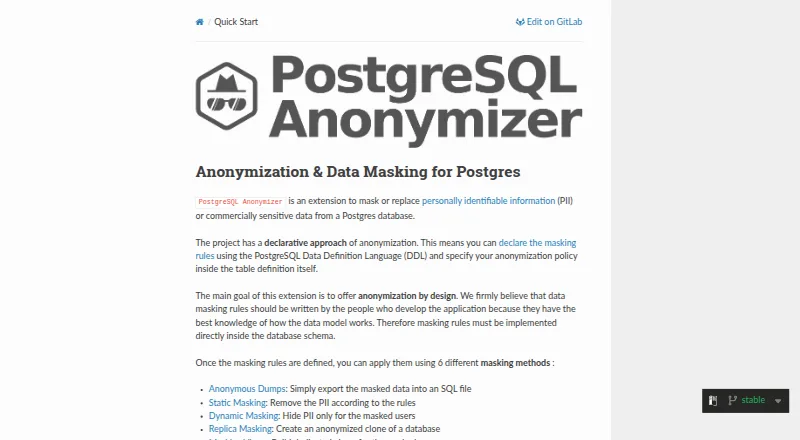
What PostgreSQL Anonymizer is
PostgreSQL Anonymizer is a PostgreSQL extension for masking personally identifiable or commercially sensitive data. You can define masking rules in SQL with PostgreSQL DDL and keep them in the database schema. Its documented approaches include anonymous dumps, static or dynamic masking, replica masking, masking views and data wrappers. Functions can randomize, fake, partially scramble or shuffle values, add noise, generalize data, or apply custom transformations. A masked database role can export anonymized data with pg_dump; the resulting dump should have its masking rules removed. Identifier detection searches for common names using English and French dictionaries, though it can return false positives or miss identifiers. Installation instructions cover Linux and self-hosted PostgreSQL, with source builds on macOS and use within PostgreSQL on WSL2 for Windows. The extension is free under a license that permits use, modification and distribution; commercial support is available separately.
Good
- SQL masking rules are stored in the database schema.
- Offers static, dynamic, replica and dump masking.
- Includes several built-in masking function types.
- Supports synthetic data and data subsetting.
Watch out
- Installation requires superuser privileges.
- Windows has no native build; WSL2 is described.
- Community support for macOS is not provided.
- Dynamic masked roles cannot use EXPLAIN.
Who it suits
It suits PostgreSQL teams that need to mask or export sensitive data while retaining SQL-defined rules. Cloud database customers need a provider that adds the extension to its catalog.
Verdict
PostgreSQL Anonymizer provides multiple masking approaches and SQL-based rule configuration without a license fee. Check provider support and platform constraints before planning a deployment.
Plans and prices
From PostgreSQL Anonymizer's own pricing page, checked 29 Sep 2026.
| Plan | Price | What it gives you |
|---|---|---|
| PostgreSQL Anonymizer | Free | Use, copy, modify, and distribute under the PostgreSQL License; commercial support available separately |
The facts
Each one read from PostgreSQL Anonymizer's own pages, with the date it was checked.
What it does
- Anonymous exports
- A masked database role can be used with pg_dump to export anonymized data, and the documentation says masking rules should be removed from the resulting dump.checked 29 Sep 2026
- Cloud limitation
- Installation requires superuser privileges, so a DBaaS provider must add the extension to its catalog for customers to use it.checked 29 Sep 2026
- Declarative rules
- Masking rules can be declared in SQL using PostgreSQL DDL and stored in the database schema.checked 29 Sep 2026
- Dynamic masking limitation
- Masked roles are not allowed to use EXPLAIN, and masking rules can break data integrity, for example when masking a UNIQUE column to NULL.checked 29 Sep 2026
- Identifier detection
- Its detection function searches for common identifier names using English and French dictionaries, and the documentation warns that detection can produce false positives and false negatives.checked 29 Sep 2026
- Integrations
- Installation documentation includes Ansible, Docker, and Django, and lists compatible PostgreSQL forks and cloud database providers.checked 29 Sep 2026
- License
- The project license permits use, copying, modification, and distribution without a fee, while disclaiming any obligation to provide maintenance, support, or updates.checked 29 Sep 2026
- Masking functions
- Available function types include randomization, faking, partial scrambling, shuffling, noise, generalization, and custom functions.checked 29 Sep 2026
- Masking methods
- The documentation describes anonymous dumps, static masking, dynamic masking, replica masking, masking views, and masking data wrappers.checked 29 Sep 2026
- Purpose
- A PostgreSQL extension for masking or replacing personally identifiable or commercially sensitive data.checked 29 Sep 2026
- Support
- The project invites users to join its Matrix or Discord communities or open a public GitLab issue; enterprise support is available by contacting Dalibo.checked 29 Sep 2026
- Supported deployment
- The extension has installation instructions for Linux distributions and self-hosted PostgreSQL; it can also be built from source on macOS, but community support for macOS is not provided.checked 29 Sep 2026
Where it runs
- Windows support
- There is no native Windows build; the documentation describes running PostgreSQL Anonymizer inside PostgreSQL on WSL2.checked 29 Sep 2026
The full review of PostgreSQL Anonymizer
Overview
PostgreSQL Anonymizer is a PostgreSQL extension for masking personally identifying and commercially sensitive data. It suits database teams that can manage extensions and want to define masking rules in SQL. Its multiple masking approaches and free license make it useful for preparing safer data, but installation requirements and rule-related integrity risks deserve close attention.
Key features
Rules are declared with PostgreSQL DDL and stored in the database schema, which suits teams that want masking logic managed alongside database definitions. The extension offers anonymous dumps, static and dynamic masking, replica masking, masking views, and data wrappers. That range supports both creating sanitized copies and controlling what masked roles can see.
Functions cover randomization, faking, partial scrambling, shuffling, noise, generalization, and custom transformations. Synthetic data, data subsetting, and referential integrity support add practical options for preparing development and test datasets. These capabilities still depend on sound rules: masking a UNIQUE column to NULL, for example, can break data integrity. Dynamic masking also has a specific operational limit: masked roles cannot use EXPLAIN.
Identifier detection searches common field names using English and French dictionaries. It can flag ordinary fields incorrectly or miss identifiers, so it should not replace a review of sensitive columns. A masked database role can export anonymized data with pg_dump; the masking rules should be removed from the resulting dump.
Pricing
The PostgreSQL Anonymizer plan costs nothing. The PostgreSQL License permits use, copying, modification, and distribution without a fee, making it a fit for teams seeking an open-source masking extension without a license charge. Commercial support is available separately. The license does not require the project to provide maintenance, support, or updates, so teams needing guaranteed assistance should account for that separately.
Platforms
Installation instructions cover Linux distributions and self-hosted PostgreSQL. The extension can be built from source on macOS, but community support for macOS is not provided. Windows has no native build; the documented route is to run it within PostgreSQL on WSL2.
Cloud deployment depends on the provider: installation requires superuser privileges, so a DBaaS provider must add the extension to its catalog before customers can use it. Installation documentation also includes Ansible, Docker, and Django, and names compatible PostgreSQL forks and cloud database providers. Support is available through Matrix and Discord communities or public GitLab issues; enterprise support can be arranged through Dalibo.
Who it's for
PostgreSQL Anonymizer is best for teams with control over their PostgreSQL installation that need SQL-defined masking for development, testing, or controlled data sharing. Its different masking modes and synthetic-data support give those teams room to shape workflows around their database. It is a weaker fit for users who depend on a DBaaS provider that has not added the extension, need native Windows support, or require guaranteed maintenance bundled with the license.
Pros and cons
- Pros: SQL-based rules live in the database schema, which makes masking configuration part of PostgreSQL's own definitions.
- Pros: Several masking modes and function types support both sanitized exports and role-based masking workflows.
- Pros: The license allows use and modification without a fee, with synthetic data and subsetting useful for test-data preparation.
- Cons: Superuser installation requirements put cloud availability in the hands of the DBaaS provider.
- Cons: Windows use requires WSL2 rather than a native build, and macOS lacks community support.
- Cons: Detection can miss identifiers or produce false alarms, and careless rules can break integrity.
Alternatives
Data Masking Software is the broader category for comparing masking tools. Choose MySQL instead if you need a freemium database platform with SQL and NoSQL applications plus replication and high-availability components. ARX Data Anonymization Tool is another free, Apache-licensed option for readers who want a standalone anonymization tool rather than a PostgreSQL extension. Jailer is a free Apache-licensed database tool to consider as a different approach.
Data Mask Studio is a free, open-source Windows desktop app, a possible alternative for Windows users who prefer a native desktop application. DataVeil offers a free Community License that never expires for databases up to 10GB, with free dataset and user SQL masks; it may suit smaller databases seeking a tool with a defined size cap. Greenmask is a free open-source utility with PostgreSQL support, worth considering when a utility-based option is preferred. MOSTLY AI has a free plan for users considering a different kind of data tool. Oracle Cloud Infrastructure Secret Management is a free secrets-management option rather than a direct PostgreSQL masking counterpart.
Verdict
Choose PostgreSQL Anonymizer if your team controls a PostgreSQL installation and wants a free, SQL-configured way to mask data across several workflows. Its strongest case is the combination of flexible masking methods and rules kept in the database schema. Look elsewhere if your provider cannot install it, native Windows support is essential, or your deployment requires guaranteed maintenance and support under the license.
Alternatives to PostgreSQL Anonymizer
- 1

MySQL
Free planAPILinuxmacOSSelf-hosted7.9Free plan - 2
DataVeil
Free planLinuxSelf-hostedWindows7.5From $5,690 a year - 3

Tonic Fabricate
Free planWebAPISelf-hosted6.8$29 usage-based - 4

Automic Continuous Delivery Automation
WebAPILinuxSelf-hosted6.5 - 5

MOSTLY AI
Free planWebAPILinuxSelf-hosted6.4Free plan - 6

ARX Data Anonymization Tool
Free planAPILinuxmacOSSelf-hosted6.3Free plan