
ARX Data Anonymization Tool
ARX Data Anonymization Tool is open-source software for anonymizing sensitive personal data and evaluating privacy risk and data utility.
What ARX Data Anonymization Tool is
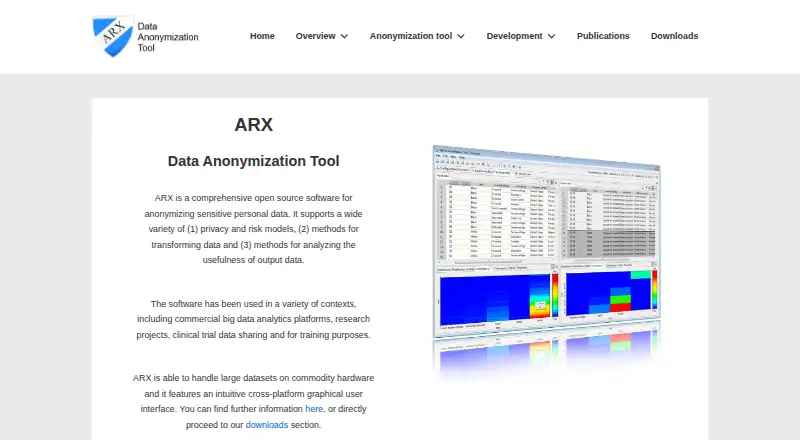
ARX Data Anonymization Tool is open-source software for anonymizing sensitive personal data and evaluating privacy risk and data utility. Its graphical application supports importing and cleansing data, setting transformation rules, tailoring anonymized datasets, and examining utility and residual re-identification risks. It imports CSV, MS Excel, and relational database data, including MS SQL, DB2, MySQL, and PostgreSQL. Listed methods include k-anonymity, l-diversity, t-closeness, δ-presence, risk-based criteria, and semantic models such as differential privacy. ARX exports displayed tables to CSV and compares original and transformed data using information-loss models, descriptive statistics, and application-specific analyses. Its risk analysis reports prosecutor, journalist, and marketer attack risks, estimates population uniqueness, and can identify HIPAA Safe Harbor identifiers and additional quasi-identifiers. A Java library and API are available for adding anonymization to Java programs. The software is free under Apache License 2.0 and supports Linux, macOS, Windows, API, and self-hosted options. The maker says downloads can be checked against PGP/GPG-signed checksums. The download page states the software is supplied without warranties or conditions, and the API documentation is described as outdated as of March 2018.
Good
- Imports CSV, Excel, and relational database data.
- Supports multiple privacy models, including differential privacy.
- Reports several re-identification risk scenarios.
- Provides a Java library and API.
- Free under Apache License 2.0.
Watch out
- API documentation was described as outdated as of March 2018.
- The download page provides no warranties or conditions.
- The listed deployment option is on-premises.
Who it suits
It suits analysts and developers who need to anonymize personal data and assess privacy risk or data utility. The graphical application serves data workflows, while the Java library supports integration into Java programs.
Verdict
ARX provides both a graphical anonymization workflow and a Java API, with data utility and risk analysis included. Its stated documentation limitation and no-warranty terms are worth considering before adoption.
Plans and prices
From ARX Data Anonymization Tool's own pricing page, checked 3 Oct 2026.
| Plan | Price | What it gives you |
|---|---|---|
| ARX Data Anonymization Tool | Free | Open-source software · Apache License 2.0 |
The facts
Each one read from ARX Data Anonymization Tool's own pages, with the date it was checked.
What it does
- Data preparation
- The import wizard can rename, remove, and reorder columns, automatically detect data types, and replace values that do not match a specified type with null values.checked 3 Oct 2026
- Data sources
- The graphical tool imports CSV, MS Excel, and relational database data, including MS SQL, DB2, MySQL, and PostgreSQL.checked 3 Oct 2026
- Documentation limitation
- The API page says its documentation was quite outdated as of March 2018 and that functionality added since then was not yet documented there.checked 3 Oct 2026
- Java library
- ARX provides a Java software library with a clean API for adding data anonymization capabilities to Java programs.checked 3 Oct 2026
- License and warranty
- ARX is licensed under Apache License 2.0, and the download page states that the software is provided “AS IS” without warranties or conditions.checked 3 Oct 2026
- Output and utility
- ARX exports displayed tabular data to CSV and can compare input and transformed data using information-loss models, descriptive statistics, and application-specific analyses such as machine-learning tasks.checked 3 Oct 2026
- Privacy models
- The maker lists k-anonymity, l-diversity, t-closeness, δ-presence, risk-based criteria, and semantic models including differential privacy among its supported methods.checked 3 Oct 2026
- Purpose
- ARX is open-source software for anonymizing sensitive personal data and supports privacy and risk models, data transformation methods, and utility analysis.checked 3 Oct 2026
- Risk analysis
- The tool reports re-identification risks for prosecutor, journalist, and marketer attacks, estimates population uniqueness, and can identify HIPAA Safe Harbor identifiers and further quasi-identifiers.checked 3 Oct 2026
- Security and integrity
- The maker provides checksums for downloads signed with its PGP/GPG key so users can verify download integrity.checked 3 Oct 2026
- Support contact
- The maker invites users to contact the ARX team by email at [email protected].checked 3 Oct 2026
- Use cases
- The maker says ARX has been used for commercial big data analytics, research projects, clinical trial data sharing, and training.checked 3 Oct 2026
Where it runs
- Graphical application
- The graphical tool supports data import and cleansing, transformation-rule wizards, tailoring anonymized datasets, and analysis of utility and residual re-identification risks.checked 3 Oct 2026
- Platforms
- The maker offers 64-bit installers and runnable JAR files for Windows, MacOS, and Linux/GTK, and describes the graphical application as platform-independent Java/SWT software.checked 3 Oct 2026
The company
- Headquarters
- Berlinchecked 28 Sep 2026
The full review of ARX Data Anonymization Tool
ARX is open-source software for anonymizing sensitive personal data, offered as both a graphical application and a Java library. It is best suited to teams that need to assess privacy risk alongside the usefulness of data they plan to share or analyze. Its breadth of privacy models and built-in risk and utility analysis make it a strong option, though teams relying on the Java API should account for its documentation gap.
Overview
ARX brings data preparation, anonymization, and assessment into one workflow. Users can import and clean data, define transformations, tailor anonymized output, then examine how much analytical value remains and what re-identification risk persists. That makes it a better fit for governed data release and analysis than a tool focused only on applying a mask.
The maker says ARX has been used in commercial big data analytics, research, clinical-trial data sharing, and training. It is licensed under Apache License 2.0, and the download page provides PGP/GPG-signed checksums to verify file integrity. The software is supplied “AS IS,” without warranties or conditions, so adopters should be prepared to evaluate and support it themselves. The maker invites questions by email.
Key features
Privacy models and risk analysis
ARX supports k-anonymity, l-diversity, t-closeness, δ-presence, risk-based criteria, and semantic models including differential privacy. Its reports examine prosecutor, journalist, and marketer attack scenarios, estimate population uniqueness, and can identify HIPAA Safe Harbor identifiers along with additional quasi-identifiers. This range helps teams reason about disclosure risk from several angles, but selecting and configuring an appropriate model still requires privacy expertise.
Import, transformation, and output
The graphical application imports CSV and Excel files, as well as relational data from MS SQL, DB2, MySQL, and PostgreSQL. Its import wizard can rename, remove, or reorder columns, detect data types, and replace values that fail a specified type check with nulls. That preparation is useful for shaping source data before anonymization, though replacing invalid values with nulls can affect downstream analysis.
ARX exports displayed tabular data to CSV. Utility comparisons can use information-loss models, descriptive statistics, and application-specific analyses such as machine-learning tasks. That lets teams consider whether an anonymized dataset remains useful for its intended purpose rather than treating privacy transformation as the only success criterion.
Java API and documentation
The Java library offers a clean API for adding anonymization capabilities to Java programs, and API access is included. The API page warns that its documentation was quite outdated as of March 2018 and did not yet cover functionality added since then. Java teams should weigh that maintenance burden against the benefit of integrating anonymization into their own software.
Pricing
ARX Data Anonymization Tool — free. The plan is open-source software under Apache License 2.0, with no paid tier or trial. The graphical application, Java API, static masking, on-premises deployment, and data subsetting are part of the offering. There are no stated seat or usage caps; the main adoption considerations are the no-warranty terms and the dated API documentation.
Platforms
ARX supports API use, Linux, macOS, Windows, and self-hosted deployment. Its on-premises option suits organizations that need to keep data processing within their own environment; the Java library also supports integration into Java programs.
Who it's for
ARX is a strong match for privacy, research, analytics, and data-engineering teams that need to prepare personal data, compare transformed data utility, and assess residual re-identification risk. It is particularly relevant when teams need several established privacy models or want a Java integration path. It is less suitable for organizations that require current, comprehensive API guidance or vendor warranty commitments as a condition of adoption.
Pros and cons
- Pros: Broad privacy-model support, including differential privacy, gives privacy teams several approaches to evaluate.
- Pros: Risk reporting and utility analysis help teams judge both disclosure exposure and the analytical value retained after transformation.
- Pros: CSV, Excel, and relational database imports plus an integrated preparation wizard support varied starting datasets.
- Pros: Apache-licensed, free software with both a graphical workflow and Java API offers flexibility for desktop and programmatic use.
- Cons: The API documentation warning dates to March 2018, which can leave Java adopters to bridge gaps for newer functionality.
- Cons: The software is provided without warranties or conditions, placing evaluation and operational responsibility on the adopting team.
Alternatives
For a broader set of options, browse Data Masking Software.
- MySQL is worth considering when the need is a freemium SQL and NoSQL application with replication and high-availability components, rather than ARX's dedicated anonymization workflow.
- Jailer is a free Apache-licensed database tool for readers seeking a database-focused alternative.
- PostgreSQL Anonymizer is a free option for teams working with PostgreSQL; commercial support is available separately.
- DataVeil may suit readers who want a freemium masking product with a free community license, a stated 10GB database limit, and SQL masks.
- Greenmask is a free open-source utility to consider for PostgreSQL; MySQL support is in progress.
- MOSTLY AI offers a free plan for readers who prefer a freemium option with API, self-hosted, or web platforms.
- Oracle Cloud Infrastructure Secret Management is another free option, with API and web platforms.
- Tonic Fabricate offers a free monthly plan and a paid Plus plan for readers considering a freemium alternative.
Verdict
Choose ARX if your team needs a free, self-hostable anonymization workflow that weighs privacy risk against data utility, particularly across research, analytics, or Java-based projects. Its model breadth and integrated assessment are its clearest advantages. Look elsewhere if dependable up-to-date API documentation or warranty coverage is essential.
Getting started
- Visit https://arx.deidentifier.org/
- Choose the Linux, macOS, or Windows application, or use its API or self-hosted option
- For a Java integration, use the Java library and API
- Verify download integrity with the checksums and the maker's PGP/GPG key
Questions
How much does ARX cost?
ARX is free: its plan is free. It is open-source software under Apache License 2.0.
Is there a free plan or trial?
The free plan is available. There is no free trial.
Which platforms does ARX support?
It supports Linux, macOS, and Windows, plus API and self-hosted options.
What data sources can the graphical application import?
It imports CSV, MS Excel, and relational database data, including MS SQL, DB2, MySQL, and PostgreSQL.
What license does ARX use?
ARX is licensed under Apache License 2.0.
Who makes ARX, and how can users contact the team?
The maker is headquartered in Berlin and invites users to email the ARX team at [email protected].
Alternatives to ARX Data Anonymization Tool
- 1

MySQL
Free planAPILinuxmacOSSelf-hosted7.9Free plan - 2
DataVeil
Free planLinuxSelf-hostedWindows7.5From $5,690 a year - 3

Tonic Fabricate
Free planWebAPISelf-hosted6.8$29 usage-based - 4

Automic Continuous Delivery Automation
WebAPILinuxSelf-hosted6.5 - 5

MOSTLY AI
Free planWebAPILinuxSelf-hosted6.4Free plan - 6

Data Mask Studio
Free planWindows6.3Free plan