Jailer
Jailer is a free database tool for producing small data samples that retain referential integrity and for exploring tables through their relationships.
What Jailer is
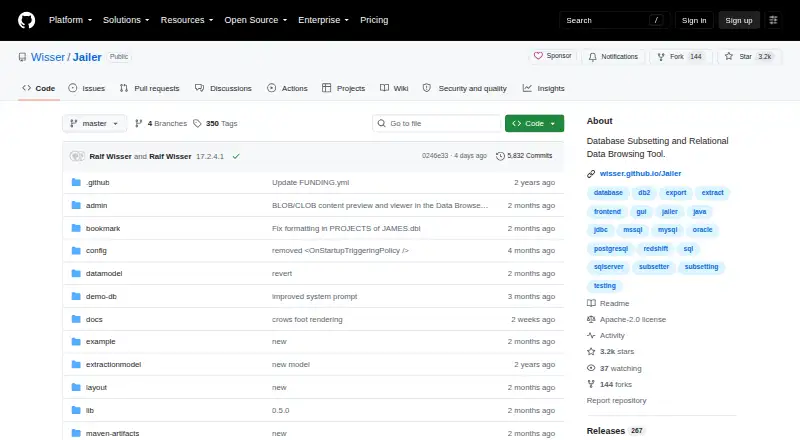
Jailer is a free database tool for producing small data samples that retain referential integrity and for exploring tables through their relationships. The project describes test datasets and investigating local issues with relevant production data as intended uses. Its exports include topologically sorted SQL, JSON, YAML, XML, and DbUnit datasets. The Data Browser follows foreign-key or user-defined links between tables in either direction. In the SQL Console, users get code completion, syntax highlighting, database metadata views, and interactive charts with 11 chart types. AI features can help subset databases using natural language, generate SQL, and analyze, explain, or refactor queries. The AI Query Assistant works with Anthropic or OpenAI-compatible APIs, including examples such as Azure, Groq, Ollama, and OpenRouter. Jailer uses JDBC and lists support features for PostgreSQL, Oracle, MySQL, SQL Server, SQLite, Redshift, Snowflake, and ClickHouse. It also offers a programmatic API for import and export, and Liquibase integration for generating DDL scripts. Jailer is available for Linux, macOS, and Windows under the Apache License 2.0.
Good
- Creates referentially intact data subsets.
- Exports SQL, JSON, YAML, XML, and DbUnit.
- Browses table relationships in both directions.
- SQL Console includes 11 interactive chart types.
- Programmatic import and export API.
Watch out
- Database connectivity uses JDBC.
- No security certifications or compliance claims are stated.
Who it suits
Jailer suits developers and database teams who need representative samples for testing or investigation while retaining table relationships. It also fits users who want to browse or query supported databases and export data in several formats.
Verdict
Jailer combines database subsetting, relationship-based browsing, SQL tools, and multiple export formats in a free tool. Its AI Query Assistant supports Anthropic or OpenAI-compatible APIs, while deployment is on-premises.
Plans and prices
From Jailer's own pricing page, checked 30 Sep 2026.
| Plan | Price | What it gives you |
|---|---|---|
| Jailer | Free | Apache License 2.0 · Database tool |
The facts
Each one read from Jailer's own pages, with the date it was checked.
What it does
- AI features
- AI features include natural language database subsetting, SQL generation, and assistance analyzing, explaining, and refactoring SQL queries.checked 30 Sep 2026
- AI integrations
- The AI Query Assistant supports Anthropic or OpenAI compatible APIs, with examples including OpenAI, Azure, Groq, Ollama, and OpenRouter.checked 30 Sep 2026
- Database support
- Jailer uses JDBC and lists support features for databases including PostgreSQL, Oracle, MySQL, SQL Server, SQLite, Redshift, Snowflake, and ClickHouse.checked 30 Sep 2026
- Exports
- Jailer can generate topologically sorted SQL, JSON, YAML, XML, and DbUnit datasets.checked 30 Sep 2026
- Other integration
- The project says Liquibase integration can generate DDL scripts for creating database objects.checked 30 Sep 2026
- Programmatic access
- The API provides programmatic access to data export and import through the Subsetter and Importer classes.checked 30 Sep 2026
- Purpose
- Jailer creates small, referentially intact database slices and lets users browse data through table relationships.checked 30 Sep 2026
- Security and license
- The repository contains an Apache License, Version 2.0; the pages reviewed do not state security certifications or compliance claims.checked 30 Sep 2026
- SQL console
- The SQL Console includes code completion, syntax highlighting, database metadata visualization, and interactive charts with 11 chart types.checked 30 Sep 2026
- Support
- The project directs users to GitHub Discussions for questions and GitHub Issues for bug reports and feature requests, and provides a legacy SourceForge forum.checked 30 Sep 2026
- Use case
- The project describes creating small test data samples and analyzing local problems with relevant production data as intended uses.checked 30 Sep 2026
Where it runs
- Data browser
- The Data Browser navigates bidirectionally through foreign key based or user defined relationships between tables.checked 30 Sep 2026
- Platforms
- The project documents Windows installers and Linux installers, and says the platform independent archive can be run on Unix, Linux, or macOS.checked 30 Sep 2026
The full review of Jailer
Jailer is a free database tool for extracting related data, browsing table relationships, and working with SQL. It is best suited to developers and database teams preparing representative test samples or investigating production-data issues locally. Its breadth is a strength, but it is a database utility rather than a dedicated, end-to-end data-masking product.
Overview
Jailer’s central job is to make smaller database slices without breaking referential integrity. That makes it useful when a test environment needs related records rather than disconnected sample rows, or when a developer wants a focused subset of production data to investigate locally. It supports static masking methods, but its wider emphasis on subsetting and database work may not suit teams looking for a specialized masking workflow.
The tool runs on-premises and is available for Linux, macOS, and Windows, with API access. Its JDBC-based database support includes PostgreSQL, Oracle, MySQL, SQL Server, SQLite, Redshift, Snowflake, and ClickHouse. The Apache License 2.0 makes it an open-source option; questions and bug reports go through GitHub Discussions and Issues, with a legacy SourceForge forum as another community channel.
Key features
Subset and browse related records
Jailer can extract smaller datasets while retaining relationships between records. The Data Browser then lets users navigate in both directions through foreign-key or user-defined table relationships. Together, these capabilities suit test-data preparation and local investigation, where following related records can be more useful than examining isolated tables.
SQL tools and exports
The SQL Console combines code completion and syntax highlighting with database metadata visualization and interactive charts in 11 chart types. That gives users a place to inspect and explore data as well as write queries, though the stated chart selection is not a substitute for a dedicated analytics platform. Exports include topologically sorted SQL, JSON, YAML, XML, and DbUnit datasets, offering several ways to move a subset into another workflow.
AI and programmatic access
AI features cover natural-language database subsetting, SQL generation, and help analyzing, explaining, or refactoring queries. The AI Query Assistant works with Anthropic or OpenAI-compatible APIs; examples include OpenAI, Azure, Groq, Ollama, and OpenRouter. That choice of integrations can accommodate different API setups, while users who do not want to configure an AI connection can still use the database tools. The API exposes export and import through the Subsetter and Importer classes. Liquibase integration can generate DDL scripts for creating database objects.
Pricing
Jailer costs nothing under the Jailer plan, which is described as an Apache License 2.0 database tool. There is one free plan and no paid tier to weigh against it. No seat or usage cap is stated for the plan; the practical trade-off is that support is community-oriented rather than a stated commercial support offering.
Platforms
Jailer supports Linux, macOS, and Windows, as well as API access. Its on-premises deployment is a fit for teams that want to run database work in their own environment rather than rely on a hosted service.
Who it's for
Choose Jailer if you need referentially intact subsets for testing, a relationship-aware browser for tracing records, or flexible SQL and export tools in a free, on-premises package. It is less compelling if your main requirement is a purpose-built data-masking product or commercial support. Its static masking methods make masking relevant, but the strongest case is the combination of subsetting, browsing, and database utility features.
Pros and cons
- Pro: Referentially intact data subsetting keeps related records together, making extracts more useful for testing and investigation.
- Pro: Multiple export formats, import and export API access, and broad JDBC database support give teams options for fitting Jailer into existing database workflows.
- Pro: Free, on-premises use avoids a subscription cost and supports teams that want to run the tool locally.
- Con: Its broad database-tool focus may be a poor fit for teams seeking a dedicated masking workflow.
- Con: Support is directed to community channels, which may not meet teams that require a commercial support arrangement.
Alternatives
For a broader database and application platform, consider MySQL, which has a freemium model and a free Community Edition with replication and high-availability components. If anonymization is the priority, ARX Data Anonymization Tool is another free, Apache-licensed option. PostgreSQL-focused masking is the more specific case for PostgreSQL Anonymizer, a free tool under the PostgreSQL License, with commercial support available separately.
Data Mask Studio is a free, open-source Windows desktop app. DataVeil offers a free Community License that never expires, with database support up to 10GB. For a free PostgreSQL utility, Greenmask supports PostgreSQL, with MySQL support in progress. MOSTLY AI has a free plan and supports API, Linux, self-hosted, and web platforms. Oracle Cloud Infrastructure Secret Management is a free alternative focused on secret management, with 5,000 secrets per tenancy.
Browse more options in Data Masking Software.
Verdict
Jailer is a strong choice for developers and database teams who need free, locally run subsetting that preserves relationships, backed by useful SQL, browsing, export, and API tools. Its main reason to choose it is that combination in one open-source utility; look elsewhere if dedicated masking or commercial support is the deciding requirement.
Getting started
- Open the Jailer GitHub website
- Install it on Linux, macOS, or Windows
- Connect to a supported JDBC database
- Use the Data Browser or SQL Console to inspect relationships and data
- Create slices and export them through the available formats or API
Questions
Is Jailer free?
Yes. The listed Jailer plan costs 0.00 USD and is free under the Apache License 2.0.
Which platforms does Jailer support?
It is available for Linux, macOS, and Windows, with API access also provided.
Which databases can it use?
Jailer uses JDBC and lists support features for PostgreSQL, Oracle, MySQL, SQL Server, SQLite, Redshift, Snowflake, and ClickHouse.
Can it export data programmatically?
Yes. The Subsetter and Importer classes provide programmatic data export and import, alongside SQL, JSON, YAML, XML, and DbUnit exports.
Which AI services can the Query Assistant use?
It supports Anthropic or OpenAI-compatible APIs, with examples including OpenAI, Azure, Groq, Ollama, and OpenRouter.
Alternatives to Jailer
- 1

MySQL
Free planAPILinuxmacOSSelf-hosted7.9Free plan - 2
DataVeil
Free planLinuxSelf-hostedWindows7.5From $5,690 a year - 3

Tonic Fabricate
Free planWebAPISelf-hosted6.8$29 usage-based - 4

Automic Continuous Delivery Automation
WebAPILinuxSelf-hosted6.5 - 5

MOSTLY AI
Free planWebAPILinuxSelf-hosted6.4Free plan - 6

ARX Data Anonymization Tool
Free planAPILinuxmacOSSelf-hosted6.3Free plan