
Planbook
Planbook is a lesson planning and assessment service for teachers and schools, available on the web, Android, and iOS.
What Planbook is
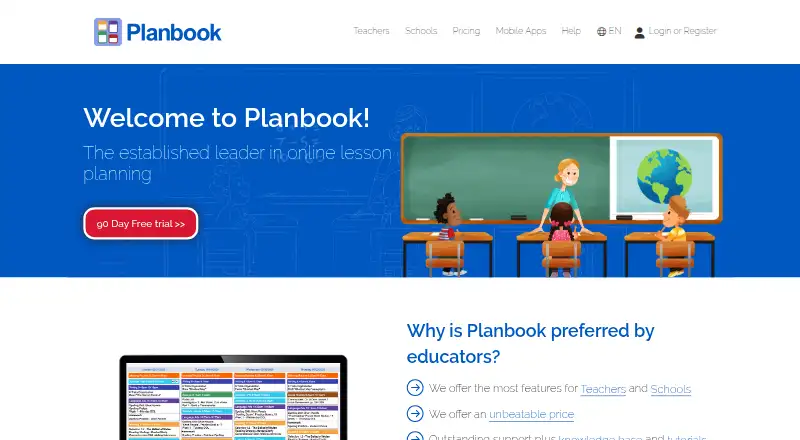
Planbook is a lesson planning and assessment service for teachers and schools, available on the web, Android, and iOS. Teachers can organize classes, lessons, units, schedules, and school events, then use student accounts to record attendance, grades, performance, and standards achievement. Plans can be shared and developed collaboratively without a school account; school accounts add shared school items and administrator oversight. Planbook connects with Google Classroom and can sync selected Google Calendars and classes. Users can attach files from Google Drive or Planbook Resources, up to 500 MB per file. Sign-in options include Apple, ClassLink, Clever, Google, and Microsoft. Exports include PDF, Microsoft Word, Google Calendar, and Google Docs. A free plan and 90-day trial are listed. Individual teacher plans are $16 a year for three years, $18 a year for two years, or $20 a year for one year. School and district licenses cost $14 a year for 250+ accounts, $16 a year for 50–249 accounts, or $18 a year for 1–49 accounts. Student accounts are free.
Good
- Organizes classes, lessons, units, schedules, and events
- Tracks attendance, grades, performance, and standards
- Supports collaboration without a school account
- Connects with Google Classroom and selected calendars
- Exports to PDF, Word, Google Calendar, and Google Docs
Watch out
- Attachments are limited to 500 MB per file
- School accounts are needed for shared school items and oversight
Who it suits
Planbook suits teachers who want to organize lessons and assess student progress, as well as school and district administrators managing shared school workflows. Its mobile apps also suit users who want access on Android or iOS.
Verdict
Planbook brings lesson organization, student assessment, and plan collaboration into one service. Its free plan, mobile apps, Google connections, and listed exports cover a range of teacher and school workflows.
Plans and prices
From Planbook's own pricing page, checked 30 Sep 2026.
| Plan | Price | What it gives you |
|---|---|---|
| School & District — 250+ accounts | $14 a year | 250+ accounts · Per License |
| Individual Teacher — 3 Years | $16 a year | 3 years · Per Year |
| School & District — 50–249 accounts | $16 a year | 50–249 accounts · Per License |
| Individual Teacher — 2 Years | $18 a year | 2 years · Per Year |
| School & District — 1–49 accounts | $18 a year | 1–49 accounts · Per License |
| Individual Teacher — 1 Year | $20 a year | 1 year · Per Year |
The facts
Each one read from Planbook's own pages, with the date it was checked.
What it does
- Collaboration
- Teachers can share and collaborate on plans without a school account, while school accounts add shared school items and administrator oversight.checked 30 Sep 2026
- File attachments
- Users can attach files from Google Drive or Planbook Resources, with a 500 MB limit per file and no stated total storage limit.checked 30 Sep 2026
- Integrations
- Planbook supports Google Classroom connections and syncing selected Google Calendars and classes.checked 30 Sep 2026
- Purpose
- Planbook is a web-based lesson planning and assessment service for teachers and schools.checked 30 Sep 2026
- Security and privacy
- Planbook's privacy policy says its safeguards include physical, electronic, and procedural measures, regular security reviews, and electronic backups, and describes its systems as designed in accordance with FERPA.checked 30 Sep 2026
- Sign-in
- Planbook supports single sign-on through Apple, ClassLink, Clever, Google, and Microsoft.checked 30 Sep 2026
- Student assessment
- Teachers can track student attendance, grades, performance, and standards achievement using student accounts.checked 30 Sep 2026
- Support
- Planbook offers a help center, video tutorials, free training webinars, and support by email and phone.checked 30 Sep 2026
- Who it serves
- Planbook describes teacher, administrator, district administrator, and student account types for educator and school workflows.checked 30 Sep 2026
The company
- Company history
- Planbook says Rod Hall and his brother Jeff officially launched the service in August 2010.checked 30 Sep 2026
- Founded
- 2010checked 23 Sep 2026
- Headquarters
- Bloomington, Illinois, United Stateschecked 23 Sep 2026
Money
- Free accounts
- Student accounts are free, and the help article also describes manager accounts as free for schools and districts.checked 30 Sep 2026
- Planning
- Teachers can create and organize classes, lessons, units, schedules, and school events.checked 30 Sep 2026
Where it runs
- Mobile apps
- The Planbook companion app is available for iOS and Android and uses existing Planbook account credentials.checked 30 Sep 2026
The full review of Planbook
Overview
Planbook combines lesson planning with student assessment for teachers and schools. It suits educators who want classes, schedules, standards progress, and shared plans together; its strongest case is linking preparation to classroom records, though school-level oversight requires a school account.
Teachers can arrange classes, lessons, units, schedules, and school events, then use student accounts to track attendance, grades, performance, and standards achievement. Planbook supports individual teachers as well as administrator and district workflows, but its planning-and-recordkeeping focus is less suited to educators seeking a tool centered on lesson generation.
Key features
Planning and assessment
Calendar view and standards alignment connect lesson organization with the timetable and learning goals. Student accounts extend that workflow to attendance, grades, performance, and standards achievement, and those accounts are free. This breadth is useful when teachers want planning and assessment in one service rather than separate tools.
Collaboration and school oversight
Teachers can share and collaborate on plans without a school account, making collaboration possible for colleagues who are not part of a centrally managed setup. School accounts add shared school items and administrator oversight, so schools needing those controls should consider the school-and-district licenses rather than treating the individual plan as equivalent.
Connections, files, and access
Google Classroom connections and syncing for selected Google Calendars and classes can reduce friction for teachers already using Google services. Files can be attached from Google Drive or Planbook Resources, with a 500 MB limit per file and no stated total storage limit. Apple, ClassLink, Clever, Google, and Microsoft single sign-on are supported.
Companion apps for iOS and Android use existing Planbook credentials, while the service is also web-based. Exports include PDF, Microsoft Word, Google Calendar, and Google Docs, offering several ways to carry plans into other workflows. Support includes a help center, video tutorials, free training webinars, email, and phone. Its privacy policy describes physical, electronic, and procedural safeguards, regular security reviews, backups, and systems designed in accordance with FERPA.
Pricing
Planbook is freemium, with a free plan and a 90-day trial. Student accounts are free, and manager accounts are also free for schools and districts. Paid pricing is organized either by individual teacher term or by school and district account count:
- Individual Teacher — 1 Year: $20 a year, billed Per Year for 1 year.
- Individual Teacher — 2 Years: $18 a year, billed Per Year for 2 years.
- Individual Teacher — 3 Years: $16 a year, billed Per Year for 3 years.
- School & District — 1–49 accounts: $18 a year, billed Per License.
- School & District — 50–249 accounts: $16 a year, billed Per License.
- School & District — 250+ accounts: $14 a year, billed Per License.
The longer individual terms lower the annual price but commit a teacher for two or three years. School pricing falls as the account band rises, making larger deployments less costly per license; the per-license structure means schools should match the tier to their account count. Paid plans are the clearer fit for longer-term individual use or school administration.
Platforms
Planbook runs on the web and has companion apps for Android and iOS. That combination suits teachers who plan at a computer and want mobile access using the same account.
Who it's for
Planbook is a strong fit for teachers who want lesson organization, calendar scheduling, student assessment, and standards alignment in one place. It also suits schools that need shared school items and administrator oversight, with manager accounts free for schools and districts. A teacher who only needs an individual account can collaborate without a school account, but should not expect school-level controls from that setup.
Pros and cons
- Pro: Planning, calendar views, standards alignment, and student assessment sit together, helping teachers connect lesson preparation with progress tracking.
- Pro: Free student accounts and collaboration without a school account lower barriers to involving learners and colleagues.
- Pro: Google connections, multiple sign-in options, mobile apps, and four export formats support varied school workflows.
- Con: School shared items and administrator oversight require school accounts, so an individual teacher setup does not cover centrally managed needs.
Alternatives
Lesson Planning Software is the broader category to browse when comparing lesson-planning tools.
- Planboard is another freemium option for Android, iOS, and web; consider it if you want a free digital lesson-planning option for teachers.
- PlanbookEdu is worth considering if free access to unlimited weekly plans, rotation schedules, word-processor editing, and iPad and phone support matters most.
- SchEDU may suit a teacher seeking auto-planning and automated activity or exam generation, with its free plan limited to two lifetime lesson plans and two subjects.
- Common Planner is a web-based alternative for teachers who want an AI-powered lesson assistant, multi-period planning, and posting up to 50 lessons to Google Classroom on its free plan.
- Lesson Maker Pro is a web option for educators seeking generated lessons and teaching-assistant messages, with its free plan capped at five generated lessons and one unit plan per month.
- LessonSmith is a web alternative whose paid Pro plan offers 40 lesson plans a month and subject assistants for $8 a month.
- LessonApp is a freemium web, iOS, and Android alternative.
- Lessonly is a web-based option with a free-forever plan.
Verdict
Choose Planbook if you want lesson planning, student assessment, and collaboration joined in a web-and-mobile service, especially when standards tracking or school oversight matters. Its free student accounts and range of paid seat bands strengthen the case. Look elsewhere if lesson generation is your priority or if multi-year individual pricing does not fit your budget horizon.
Alternatives to Planbook
- 1

Common Planner
Free planAndroidiOSWebAPI8.0From $5.59 a month - 2
LessonApp
Free planAndroidiOSWeb7.9From $99 a year - 3

PlanbookEdu
Free planAndroidiOSWeb7.8From $30 a year - 4
SchEDU
Free planAndroidWeb7.5From $4.99 a month - 5

Lesson Maker Pro
Free planWeb7.3From $72.50 a year - 6

Daytical
AndroidiOSWeb6.8From $144 a year