Pentesterra
Pentesterra is a security orchestration platform combining vulnerability management, automated network and web pentesting, breach and attack simulation, and …
What Pentesterra is
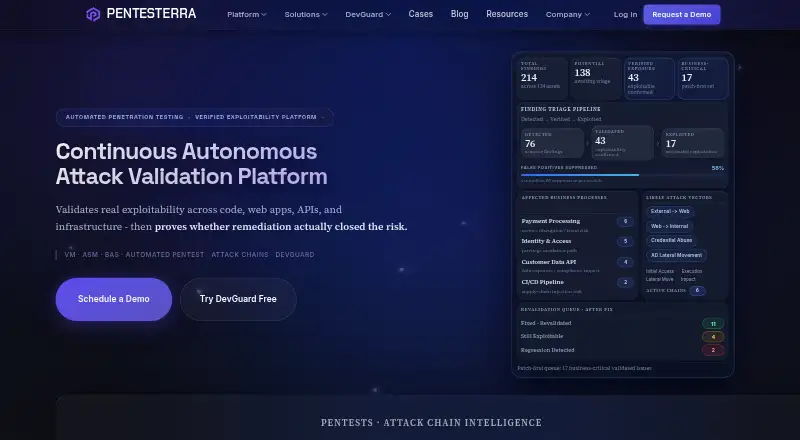
Pentesterra is a security orchestration platform combining vulnerability management, automated network and web pentesting, breach and attack simulation, and AI-assisted exploit verification. Its workflow links attack-surface mapping, breach simulation, and controlled exploitation, with evidence-first prioritization. Web testing covers modern web applications, single-page applications, and APIs through public or private proxies and Tor, including authentication flows, CSRF, JWT, and WAF evasion. Safe exploit validation uses real-world tools in non-malicious modes and is described as involving no malware or ransomware. Attack Chain Analysis turns web, network, and DevGuard findings into directed kill-chain graphs, with up to 20 paths at depth five or less. Deployment options include SaaS, dedicated PaaS, and fully air-gapped on-premises installations. Jira ticket creation from verified findings and a REST API for scans, results, and reporting are available. Enterprise integrations include SIEM export, Jira and ServiceNow auto-ticketing, and SAML 2.0 or OIDC SSO; enterprise plans provide compliance evidence packages. Pricing includes a free DevGuard Free plan and Vibe Coding at €23 a month. Pentesterra targets internal teams, MSSPs, and regulated environments.
Good
- Supports SaaS, dedicated PaaS, and air-gapped deployment.
- Tests web applications, single-page apps, and APIs.
- REST API supports scan and reporting automation.
- Free DevGuard plan is available.
- Enterprise plans include compliance evidence packages.
Watch out
- Vibe Coding limits use to 3 projects.
- Vibe Coding allows 20 scans per month.
- Enterprise pricing is custom and not listed.
Who it suits
Pentesterra is aimed at internal security teams, MSSPs, and organizations in regulated environments. Its deployment choices and mix of web, network, vulnerability, and attack-simulation workflows may suit teams seeking to orchestrate those activities in one platform.
Verdict
Pentesterra combines several security assessment workflows and offers multiple deployment options. Review the tier limits and deployment fit against the needs of your security team.
Plans and prices
From Pentesterra's own pricing page, checked 15 Oct 2026.
| Plan | Price | What it gives you |
|---|---|---|
| DevGuard Free | Free | 1 project · 3 scans/mo · CLI, IDE plugin and web console · community support |
| Vibe Coding | €23 a month | 3 projects · 20 scans/mo · 300 dependencies/scan · 14-day raw-data retention · limited network scanning · €23/ month |
| Vibe Coding Pro | €75 a month | 5 projects · 40 scans/mo · 500 dependencies · 90-day retention · limited web pentest · 1 report/day and 4/week · performance scanner node · €75/ month |
| Small Team | €299 a month | Full web pentest · 10 network hosts · 10 network launches/week · 12 DevGuard projects · 60 scans/mo · 4 reports/day and 10/week · limited CI/CD integration · SOC 2, ISO 27001, PCI DSS and NIST packs · €299/ month |
| Team (SMB) | €1,299 a month | 100 network hosts · 20 web-pentest launches/week · 20 DevGuard projects · 140 scans/mo · 900 dependencies · 2 scanner nodes · internal scanning · gray/white-box, proxy and TOR support · €1,299/ month |
| Enterprise | Priced on request | Unlimited modules, targets, nodes and seats · single-tenant or on-prem deployment · custom SLA · dedicated CSM · white-label and multi-tenant orchestration · SIEM hooks · API webhooks · SSO · Custom |
The facts
Each one read from Pentesterra's own pages, with the date it was checked.
What it does
- Active Directory testing
- The platform automates AD enumeration, ACL analysis, credential-abuse simulation and safe lateral-movement validation.checked 15 Oct 2026
- Attack-chain analysis
- Pentesterra correlates code, web and network findings into directed attack paths mapped to kill-chain phases.checked 15 Oct 2026
- Automated network pentesting
- Its network pentest module performs controlled exploit validation for internal and external exposure with operational guardrails.checked 15 Oct 2026
- Breach and attack simulation
- BAS scenarios test whether defensive controls work and expose realistic attack paths.checked 15 Oct 2026
- Build extensibility
- The extension is described as TypeScript orchestrating a Python CLI and Pentesterra API, and it can be built into a VSIX from source.checked 15 Oct 2026
- CLI requirement
- The DevGuard CLI requires Python 3.9 or newer and installs with pip as pentesterra-devguard.checked 15 Oct 2026
- Compliance evidence
- Enterprise plans provide per-cycle evidence packages for SOC 2, ISO 27001, PCI-DSS and NIST CSF, including per-finding proofs of concept and delta reports.checked 1 Oct 2026
- Core workflow
- Pentesterra combines vulnerability management, attack-surface mapping, breach simulation and controlled exploitation into a continuous workflow with evidence-first prioritization.checked 1 Oct 2026
- Data protection
- Pentesterra states that it uses end-to-end encryption, credential-vault isolation, per-scope processing isolation and distributed scanner isolation.checked 1 Oct 2026
- Deployment
- The platform is deployable as SaaS, dedicated PaaS, or fully air-gapped on-premises.checked 1 Oct 2026
- Deployment options
- Deployments include managed SaaS, dedicated PaaS, hybrid scanner nodes, full on-premises operation and an air-gapped GOV edition.checked 15 Oct 2026
- Developer extension
- The VS Code Marketplace extension supports VS Code, Cursor and Windsurf and can install the CLI automatically.checked 15 Oct 2026
- DevGuard privacy
- DevGuard does not upload source code or transmit raw secrets; it sends metadata and redacted findings for cloud analysis.checked 1 Oct 2026
- Documentation
- The public DevGuard guide covers API-key creation, CLI installation, project initialization, scans, JSON output, IDE use, privacy, ecosystems and troubleshooting.checked 15 Oct 2026
- Dynamic Rule Security Engine
- DRSE is a programmable rule layer that can trigger rescans, alerts or enrichment workflows from scan events.checked 15 Oct 2026
- Enterprise integrations
- Enterprise integrations include SIEM export in CEF or JSON, Jira and ServiceNow auto-ticketing, SAML 2.0 or OIDC SSO, and a REST API.checked 1 Oct 2026
- Exploit validation
- Safe exploit validation uses real-world tools in non-malicious modes and is described as having no malware or ransomware.checked 1 Oct 2026
- Exploit verification
- Findings can be validated with non-destructive verify-only or exploit-mode scripts and evidence is attached to reports.checked 15 Oct 2026
- Founder
- Pentesterra identifies Olesia Shelestova as founder and CEO and places headquarters in Italy.checked 15 Oct 2026
- Independent package record
- The piwheels mirror lists pentesterra-devguard version 1.4.24 released 2026-07-06, with 13 files and 16 all-time downloads recorded on that page.checked 15 Oct 2026
The company
- Company facts
- LinkedIn lists Pentesterra as a computer and network security company founded in 2021 with 2–10 employees and public-company status.checked 15 Oct 2026
- Founded
- 2021checked 23 Sep 2026
- Headquarters
- Italychecked 23 Sep 2026
Where it runs
- DevGuard platforms
- DevGuard offers a pre-built binary CLI for Linux, macOS Intel, macOS Apple Silicon and Windows, plus extensions for VS Code, Cursor and Windsurf.checked 1 Oct 2026
The full review of Pentesterra
Overview
Pentesterra is a security assessment platform that brings vulnerability management, web and network penetration testing, breach simulation and exploit verification into one workflow. It best suits security teams that need to connect findings to attack paths and evidence, especially internal teams, MSSPs and regulated organizations. Its breadth and deployment choices are compelling, but the lower tiers impose firm project, scan and testing limits.
Key features
The platform links vulnerability management and attack-surface mapping with breach simulation and controlled exploitation, prioritizing findings with evidence. That joined-up workflow can help teams focus on findings that contribute to plausible attack paths rather than treating each scan as a separate queue.
Web testing covers modern sites, single-page applications and APIs, with support for public or private proxies and Tor, as well as authentication flows, CSRF, JWT and WAF evasion. Safe exploit validation uses real-world tools in non-malicious modes and is described as having no malware or ransomware. This makes validation more concrete than a finding alone, though the product’s security scope calls for teams to match testing capabilities to their own authorization and controls.
Attack Chain Analysis turns web, network and DevGuard findings into directed kill-chain graphs, with up to 20 paths at depth five or less. Jira ticket creation from verified findings and a REST API for scans, results and reporting support operational follow-through. Enterprise tiers add SIEM export in CEF or JSON, Jira and ServiceNow auto-ticketing, SAML 2.0 or OIDC single sign-on, and a REST API. Enterprise evidence packages cover SOC 2, ISO 27001, PCI-DSS and NIST CSF, with per-finding proofs of concept and delta reports.
DevGuard offers CLI and IDE integrations for Linux, macOS Intel and Apple Silicon, and Windows, plus extensions for VS Code, Cursor and Windsurf. It does not upload source code or send raw secrets; metadata and redacted findings go to cloud analysis. Pentesterra also states that it uses end-to-end encryption and isolates credentials, scope processing and distributed scanners.
Pricing
The free DevGuard Free plan costs €0.00 and allows one project and three scans per month, with CLI, IDE plugin and web console access plus community support. It is a useful starting point for a small, code-focused evaluation, but not a broad testing allowance.
Vibe Coding costs €23.00 per month for three projects, 20 scans per month and 300 dependencies per scan, with 14-day raw-data retention and limited network scanning. Vibe Coding Pro costs €75.00 per month and raises the caps to five projects, 40 scans and 500 dependencies, with 90-day retention; reports are limited to one per day and four per week. The Pro tier makes more sense when longer retention and higher scan capacity matter, but its reporting ceiling remains material.
Small Team costs €299.00 per month and includes full web app pentesting, 10 network hosts, 10 launches per week, 12 projects, 60 scans per month, and SOC 2, ISO 27001 and PCI DSS packs. Team (SMB), at €1,299.00 per month, increases capacity to 100 network hosts, 20 web pentest launches per week, 20 projects and 140 scans per month, with 900 dependencies and two scanner nodes; it also includes internal network scanning. These tiers suit teams whose workload fits the stated caps, while larger or less predictable operations may need Enterprise, which has custom pricing and offers unlimited modules, nodes, targets and seats, single-tenant or on-prem deployment, custom SLA, dedicated CSM, white-label and multi-tenant orchestration, SIEM hooks, API webhooks and SSO. The licensing matrix lists 24x7 support for VM, ANPT, BAS, Web pentesting, MSSP and GOV tiers.
Platforms
Pentesterra supports API, browser extension, Linux, macOS, self-hosted, web and Windows use. SaaS, dedicated PaaS and fully air-gapped on-premises deployment give organizations with different hosting and isolation requirements meaningful choice. The breadth is useful, but teams should choose a deployment and tier that match their scanning scope and operational limits.
Who it's for
Pentesterra is a strong fit for internal security teams and MSSPs seeking a continuous workflow across vulnerability management, attack simulation, web and network testing, and evidence capture. Its compliance evidence and air-gapped deployment options also suit regulated environments. It is a weaker fit for a user who only needs a standalone scanner or a team whose testing volume regularly exceeds the lower tiers’ project, host, scan or launch quotas.
Pros and cons
- Pros: Combines vulnerability management, attack simulation and controlled exploit validation, helping teams connect findings to attack paths.
- Pros: Offers SaaS through air-gapped on-premises deployment, accommodating different isolation needs.
- Pros: Enterprise evidence packages include finding-level proofs of concept and delta reports, which can support compliance work.
- Cons: Lower-priced plans cap projects, scans, dependencies, retention or reports, so growing workloads can require a substantial tier increase.
- Cons: Full web app pentesting appears at Small Team pricing, while internal network scanning is included at Team (SMB), limiting what cheaper plans cover.
Alternatives
For a broader category comparison, see Penetration Testing Software. Choose Caido if its free Basic plan’s limits of two projects, seven workflows and one pipeline session at a time suit your needs. Dradis is an option for teams that want its open-source Community Edition, limited to one project at a time. Choose RedAmon for a free, MIT-licensed self-hosted Docker stack. Aircrack-ng is a free software suite for readers who want that alternative. Faraday offers Always On and Pentest on Demand plans with custom pricing. OWASP ZAP is a free, open-source option for teams that prefer a community-contributed project. Revelion offers a free starting allocation of 10,000 credits and an MSP Basic plan at £99.00 per month. Kali Linux is a free alternative for Linux, Windows, macOS and Android.
Verdict
Choose Pentesterra if your security team needs coordinated vulnerability, web and network assessment with attack-chain analysis, evidence capture and deployment flexibility. Its integrated workflow is the central reason to choose it; its tier-specific quotas and the jump to higher-priced plans are the reasons to look elsewhere if your needs are narrow or your volume outgrows those caps.
Getting started
- Visit the Pentesterra website.
- Choose the free DevGuard plan or a paid plan.
- Use the available web console, CLI or IDE plugin on the free plan.
- For DevGuard, install the CLI for Linux, macOS or Windows, or use an extension for VS Code, Cursor or Windsurf.
- For broader deployments, choose SaaS, dedicated PaaS or air-gapped on-premises.
Limits worth knowing
DevGuard Free allows one project and three scans per month, with community support. Vibe Coding, the €23-per-month plan, allows three projects and 20 scans monthly, caps scans at 300 dependencies, retains raw data for 14 days and limits network scanning.
Questions
Is there a free plan?
Yes. DevGuard Free costs €0 and includes one project, three scans per month, CLI, IDE plugin and web console access, plus community support.
What does the cheapest paid plan cost?
Vibe Coding costs €23 per month. It includes three projects and 20 scans monthly, among other limits.
Which platforms does Pentesterra support?
The listed platforms are API, extension, Linux, macOS, self-hosted, web and Windows. DevGuard provides CLI binaries for Linux, macOS Intel, macOS Apple Silicon and Windows, along with extensions for VS Code, Cursor and Windsurf.
What integrations are available?
Pentesterra offers Jira ticket creation from verified findings and a REST API. Enterprise integrations include SIEM export in CEF or JSON, Jira and ServiceNow auto-ticketing, SAML 2.0 or OIDC SSO, and a REST API.
Does Pentesterra provide compliance evidence?
Enterprise plans provide per-cycle evidence packages for SOC 2, ISO 27001, PCI-DSS and NIST CSF, including per-finding proofs of concept and delta reports.
Who makes Pentesterra?
Pentesterra was founded in 2021 and is headquartered in Italy.
Alternatives to Pentesterra
- 1
Kali Linux
Free planOpen sourceAndroidLinuxmacOSSelf-hosted7.6Free plan - 2
OWASP ZAP
Free planOpen sourceAPIExtensionLinuxmacOS7.6Free plan - 3
Dradis
Free planWebAPILinuxmacOS7.1From $3,600 a year - 4
w3af
Free planWebAPILinuxmacOS6.8Free plan - 5
Caido
Free planWebAPILinuxmacOS6.6Free plan - 6
PenPeeper
Free planLinuxmacOSWindows6.5Free plan