Dradis
Dradis is a security assessment platform for organizing work from engagement kickoff through collaboration, reporting, remediation, and workflow automation.
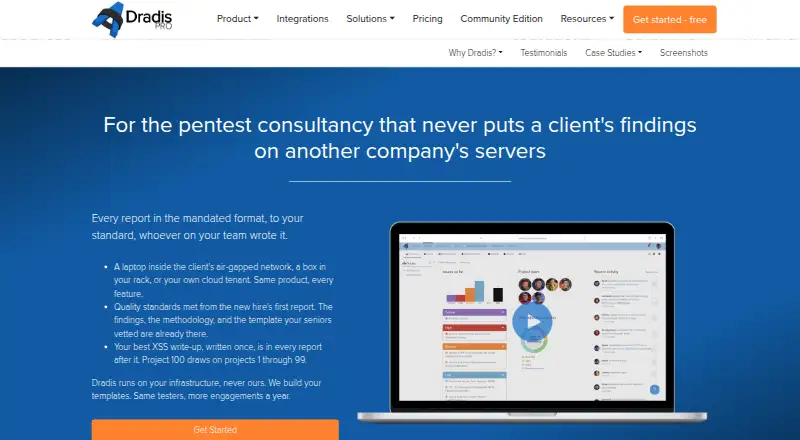
What Dradis is
Dradis is a security assessment platform for organizing work from engagement kickoff through collaboration, reporting, remediation, and workflow automation. It uses structured assessment data, templates, and automation to create consistent deliverables, and its quality-review feature supports PR-style reviews before findings reach a report. Risk tools include CVSSv4, DREAD, and MITRE ATT&CK calculators, alongside methodologies such as OWASP, PTES, OSCP, HIPAA, PCI, and custom approaches. Dradis lists more than 47 integrations for scanners, ticketing, and single sign-on, including Nessus, Burp Suite, Nmap, Qualys, Jira, and Okta. A REST API, webhooks, and rules engine can connect tools and automate workflows. Community Edition is open source and supports one project at a time. Assess is aimed at teams that deliver findings; Remediate is intended for internal security teams that also track fixes. Dradis is self-hosted, can operate without an internet connection, and the maker says it cannot access customer data. The listed platforms are API, Linux, macOS, self-hosted, web, and Windows.
Good
- Structured data and templates support consistent assessment reports.
- PR-style reviews help catch mistakes before reporting.
- Risk calculators cover CVSSv4, DREAD, and MITRE ATT&CK.
- More than 47 scanner, ticketing, and SSO integrations are listed.
- Self-hosted operation can run without an internet connection.
Watch out
- Community Edition is limited to one project at a time.
- Paid plans require at least three individual seats.
- Remediation tracking is added in the Remediate plan.
Who it suits
Dradis suits security assessment teams that need to collaborate on findings, apply defined methodologies, and produce structured reports. Internal security teams that also need to track remediation can consider Remediate, while teams delivering assessments can consider Assess.
Verdict
Choose Dradis if your team needs structured security assessment reporting, quality review, and tool integrations, with self-hosting available. Assess fits teams delivering findings; internal teams tracking fixes should look at Remediate, which adds remediation tracking and related ticketing integrations.
Plans and prices
From Dradis's own pricing page, checked 28 Sep 2026.
| Plan | Price | What it gives you |
|---|---|---|
| Community Edition | Free | Open source · one project at a time · community forum support · Free forever |
| Assess | $3,600 a year | 3-seat minimum · unlimited projects · 47+ integrations · email and live chat support · $3,600/yr; billed yearly in advance; starts at 3 seats; $1,200 per seat/year |
| Remediate | $7,200 a year | 3-seat minimum · includes Assess features · remediation tracking · Azure DevOps, Jira, and ServiceNow integrations · $7,200/yr; billed yearly in advance; starts at 3 seats; $2,400 per seat/year |
| Enterprise | Priced on request | 5-seat minimum · includes Remediate features · audit logging · identity integrations · priority support · Contact for pricing |
The facts
Each one read from Dradis's own pages, with the date it was checked.
What it does
- Automation
- Dradis provides a REST API, webhooks, and a rules engine for integrating tools and automating workflows.checked 28 Sep 2026
- Encryption
- The security page states that the Dradis VM is full-disk encrypted, traffic uses TLS, and sensitive application data such as OAuth tokens is encrypted with AES-256-GCM.checked 28 Sep 2026
- Guarantee
- Every paid plan includes a 30-day money-back guarantee.checked 28 Sep 2026
- Integrations
- Dradis lists 47+ scanner, ticketing, and SSO integrations, including Nessus, Burp Suite, Nmap, Qualys, Jira, and Okta.checked 28 Sep 2026
- Intended users
- Assess is presented for teams that deliver findings, while Remediate is for internal security teams that also track fixes.checked 28 Sep 2026
- Notable limit
- Every paid plan starts at three seats, and each seat covers one person rather than concurrent users or an installation.checked 28 Sep 2026
- Purpose
- Dradis supports security assessment work from engagement kickoff and collaboration through reporting, remediation, and workflow automation.checked 28 Sep 2026
- Quality review
- Its quality assurance feature supports PR-style reviews to catch mistakes before they reach a report.checked 28 Sep 2026
- Remediation
- The Remediate plan adds remediation tracking and Jira, Azure DevOps, and ServiceNow ticketing integrations.checked 28 Sep 2026
- Reporting
- Dradis uses structured data, templates, and automation to produce consistent assessment deliverables.checked 28 Sep 2026
- Risk and methodology
- Features include CVSSv4, DREAD, and MITRE ATT&CK risk calculators, plus OWASP, PTES, OSCP, HIPAA, PCI, and custom methodologies.checked 28 Sep 2026
- Security
- Dradis is self-hosted, can run without an internet connection, and the maker says it does not have access to customer data.checked 28 Sep 2026
- Support
- Paid plans include email and live chat support, and Community Edition users can ask questions on the forum.checked 28 Sep 2026
The company
- Founded
- 2007checked 28 Sep 2026
- Headquarters
- London, United Kingdomchecked 28 Sep 2026
The full review of Dradis
Dradis is a self-hosted security assessment platform that organizes findings, review, reporting, and remediation workflows. It suits consultancies and internal security groups running repeatable engagements; the main trade-off is that every paid tier starts at three named seats.
Choose it when controlled, consistent deliverables and integrations matter as much as testing itself. Teams that only need a focused scanner or a lightweight free utility will find broader workflow features and paid seat commitments harder to justify.
Overview
Dradis carries an engagement from kickoff and collaboration through evidence and finding management, report production, remediation, and workflow automation. Structured data, reusable templates, and automation reduce variation between assessments, while PR-style quality reviews let colleagues catch errors before a report is released. That combination is valuable for teams whose reputation depends on repeatable, reviewable deliverables rather than on running scans alone.
Risk calculations cover CVSSv4, DREAD, and MITRE ATT&CK. Methodology support includes OWASP, PTES, OSCP, HIPAA, PCI, and custom approaches, so teams can align assessments with different client or compliance requirements. Dradis lists more than 47 scanner, ticketing, and SSO integrations, including Nessus, Burp Suite, Nmap, Qualys, Jira, and Okta. A REST API, webhooks, and rules engine provide additional ways to connect tools and automate hand-offs.
Deployment is on-premises and the platform can operate without an internet connection. The maker says it cannot access customer data. The Dradis VM uses full-disk encryption, traffic is protected with TLS, and sensitive application data such as OAuth tokens uses AES-256-GCM. Those controls suit organizations that must keep assessment material inside their own environment, although self-hosting places more responsibility for infrastructure and operations on the customer.
Key features
Reporting and quality control
Structured findings and templates make report output more consistent across contributors and engagements. PR-style review is a practical safeguard for consultancies: reviewers can challenge incomplete or incorrect work before it reaches a client. It is less compelling for a solo tester who does not need an internal approval step.
Risk, methodology, and evidence
Multiple risk calculators and named methodologies let teams standardize how they score and frame findings. Support for web-application and network testing, evidence capture, and finding management keeps assessment material together rather than scattered across separate tools.
Integrations and automation
The integration catalog spans scanners, ticketing, and identity systems, with familiar options such as Burp Suite, Nessus, Jira, and Okta. The API, webhooks, and rules engine are useful when an established security process needs automated data movement. Integration breadth is a strength, but teams should confirm that their exact workflow is covered before committing.
Remediation workflow
Remediate adds remediation tracking and ticketing connections for Azure DevOps, Jira, and ServiceNow. That makes it the more natural fit for internal security teams responsible for following fixes through closure; assessment teams focused on delivering findings can stay with Assess.
Pricing
Community Edition
Community Edition costs 0.00 USD, is free forever, and is open source. It supports one project at a time and includes community forum support. This is the sensible starting point for individuals or teams evaluating the workflow, but the single-project limit restricts concurrent engagements.
Assess
Assess costs $3,600 a year, billed yearly in advance, at $1,200 per seat per year with a three-seat minimum. That is $100 per user per month when paid annually, or $3,600 per year at the minimum, and it includes unlimited projects, 47+ integrations, email support, and live chat. It is aimed at teams delivering findings. The mandatory three individual seats mean a small two-person practice still pays for three people; seats are people, not concurrent users or installations.
Remediate
Remediate costs $7,200 a year, billed yearly in advance, at $2,400 per seat per year with a three-seat minimum. It includes Assess features plus remediation tracking and Azure DevOps, Jira, and ServiceNow integrations. Choose it when tracking corrective work is central; otherwise its doubled minimum cost is difficult to defend.
Enterprise
Enterprise uses custom pricing with a five-seat minimum. It includes Remediate features, audit logging, identity integrations, and priority support, making it the tier for larger organizations with governance and support requirements.
Paid plans include a 14-day trial and a 30-day money-back guarantee. Community Edition users rely on the forum, while paid customers receive email and live chat support.
Platforms
Dradis is available as a web application with API access and supports Linux, macOS, and Windows environments through self-hosted, on-premises deployment.
Who it's for
Assess fits penetration-testing consultancies and security teams that need a controlled path from findings to polished reports. Remediate is better for internal security teams that also own fix tracking and ticket workflows. Community Edition suits a free, open-source evaluation or a single active project. Teams seeking only a scanner, or unwilling to operate self-hosted software, should look elsewhere.
Pros and cons
- Pros: Structured reporting and templates support consistent deliverables.
- Pros: PR-style review adds a defined quality gate before release.
- Pros: Risk calculators, recognized methodologies, and 47+ integrations cover varied assessment programs.
- Pros: Self-hosting, offline operation, and layered encryption support strict data-control policies.
- Cons: Every paid plan starts at three named seats, raising the entry cost for very small teams.
- Cons: Community Edition permits only one project at a time.
- Cons: Remediate costs twice the annual minimum of Assess, so its value depends on needing remediation tracking and ticketing links.
Alternatives
Pentesterra is a freemium option with a free DevGuard tier limited to one project and three scans per month, plus CLI, IDE plugin, and web console access.
Caido offers a free Basic plan for two projects with limits on workflows, plugins, presets, and one pipeline session at a time.
Kali Linux is a free, open-source distribution for teams that want a broad security-tool environment rather than an assessment reporting platform.
OWASP Amass is a free Apache-licensed open-source framework focused on attack-surface discovery.
PenPeeper is free for personal or professional use, subject to restrictions on resale and paid SaaS hosting.
RedAmon is a free MIT-licensed Docker-based self-hosted option for commercial or personal use.
w3af is a free open-source web application security scanner.
Aircrack-ng is a free software suite with no license fee.
For a broader category comparison, see Penetration Testing Software.
Verdict
Dradis is a strong choice for assessment teams that need repeatable reporting, formal quality review, integrations, and on-premises data control. Choose Assess for finding delivery and Remediate for internal fix ownership. Look elsewhere if you need a standalone testing tool, a cloud-first service, or a paid plan without the three-seat minimum.
Getting started
- Visit the Dradis website.
- Choose Community Edition, Assess, or Remediate based on project and remediation needs.
- Use Community Edition for one project at a time, or select a paid plan with its three-seat minimum.
- Use the 14-day trial if evaluating a paid plan.
- Deploy Dradis on-premises or use its listed web and operating-system platforms.
Limits worth knowing
Community Edition supports one project at a time. Paid plans have a three-seat minimum, with each seat assigned to one person. Assess is $3,600 per year and Remediate is $7,200 per year, both billed yearly in advance; the free Community Edition has community forum support, while paid plans include email and live chat support.
Questions
Does Dradis have a free plan?
Yes. Community Edition is free forever, open source, and supports one project at a time.
How much do the paid plans cost?
Assess is $3,600 per year and Remediate is $7,200 per year, billed yearly in advance. Paid plans start at three seats; Enterprise pricing is available by contacting Dradis.
Is there a free trial?
Yes, Dradis lists a 14-day trial.
Which platforms does Dradis support?
The listed platforms are API, Linux, macOS, self-hosted, web, and Windows.
What integrations does Dradis offer?
Dradis lists more than 47 scanner, ticketing, and SSO integrations, including Nessus, Burp Suite, Nmap, Qualys, Jira, and Okta. Remediate includes Jira, Azure DevOps, and ServiceNow integrations.
Is Dradis self-hosted?
Yes. Dradis is self-hosted, can run without an internet connection, and the maker says it does not have access to customer data.
Alternatives to Dradis
- 1
Pentesterra
Free planWebAPIExtensionLinux7.7From €23 a month - 2
Kali Linux
Free planOpen sourceAndroidLinuxmacOSSelf-hosted7.6Free plan - 3
OWASP ZAP
Free planOpen sourceAPIExtensionLinuxmacOS7.6Free plan - 4
w3af
Free planWebAPILinuxmacOS6.8Free plan - 5
Caido
Free planWebAPILinuxmacOS6.6Free plan - 6
PenPeeper
Free planLinuxmacOSWindows6.5Free plan