RedAmon
RedAmon is a free, open-source framework for automating red-team reconnaissance, exploitation, and post-exploitation operations.
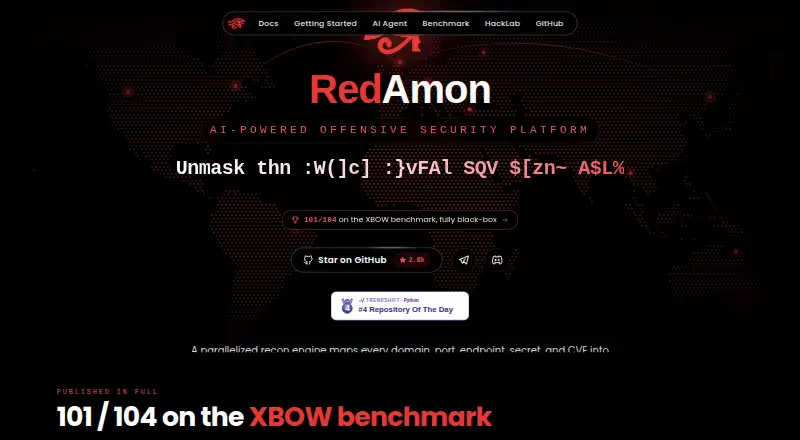
What RedAmon is
RedAmon is a free, open-source framework for automating red-team reconnaissance, exploitation, and post-exploitation operations. It maps attack surfaces from domains, IP/CIDR targets, or batches of domains, then combines findings in a Neo4j graph its AI agent can query for planning and exploitation. GVM/OpenVAS integration provides network vulnerability scanning, while its Secret Multiscanner checks for secrets and its supply-chain scanning checks packages against a local OSV database. RedAmon supports twelve AI providers and more than 400 language models, and its MCP server lets external agents drive the framework. The Dockerized application runs on Linux, macOS, and Windows and is intended for authorized security testing, education, and research. Tools and agents use separate containers, per-job ephemeral filesystems, and network namespaces. Rules of Engagement, approval gates, scope controls, and a guardrail blocking government, military, and intergovernmental targets govern operations. On macOS, SYN-based scanners cannot see the local LAN because they run inside Docker Desktop's LinuxKit VM. The project warns that configured API keys and credentials are stored unencrypted in PostgreSQL, leaving database security to the user.
Good
- Maps domains, IP/CIDR targets, and domain batches
- Combines findings in a Neo4j attack-surface graph
- Supports twelve AI providers and over 400 models
- Includes scope controls and approval gates
- Free, open-source, and available for on-premises deployment
Watch out
- Configured API keys and credentials are stored unencrypted
- macOS SYN-based scanners cannot see the local LAN
- Intended only for authorized security testing, education, and research
Who it suits
RedAmon is for security teams and researchers conducting authorized red-team work, education, or research. It suits users prepared to deploy a Dockerized, self-hosted tool and secure its PostgreSQL database.
Verdict
RedAmon combines attack-surface mapping, scanning, and agent-driven operations with scope controls. Its unencrypted credential storage and macOS LAN scanning limitation are important considerations before deployment.
Plans and prices
From RedAmon's own pricing page, checked 1 Oct 2026.
| Plan | Price | What it gives you |
|---|---|---|
| Open-source self-hosted | Free | MIT license · Docker stack · commercial and personal use |
The facts
Each one read from RedAmon's own pages, with the date it was checked.
What it does
- AI providers
- RedAmon supports twelve AI providers and more than 400 language models through one interface.checked 1 Oct 2026
- Attack-surface graph
- Recon findings are merged into a Neo4j attack-surface graph that the AI agent queries for planning and exploitation.checked 1 Oct 2026
- Authorized use
- The documentation says RedAmon is intended only for authorized security testing, education and research.checked 1 Oct 2026
- Credential storage limit
- The project disclaimer states that configured API keys and credentials are stored unencrypted in PostgreSQL and securing the database is the user's responsibility.checked 1 Oct 2026
- Governance
- Rules of Engagement, approval gates, non-bypassable scope controls and a guardrail blocking government, military and intergovernmental targets are provided.checked 1 Oct 2026
- Isolation
- Tools, scanners and agents run in separate containers with per-job ephemeral filesystems and network namespaces.checked 1 Oct 2026
- MCP integration
- Its MCP Server lets external agents such as Claude Code, Claude Desktop, Codex CLI, Cursor, Windsurf, Cline, Goose and Gemini CLI drive RedAmon.checked 1 Oct 2026
- Network scanning
- GVM/OpenVAS integration provides network vulnerability scanning with more than 170,000 NVTs.checked 1 Oct 2026
- Purpose
- RedAmon is an AI-powered agentic red-team framework that automates reconnaissance, exploitation and post-exploitation operations.checked 1 Oct 2026
- Recon pipeline
- Its parallelized reconnaissance pipeline maps attack surfaces from domains, IP/CIDR targets or domain batches.checked 1 Oct 2026
- Secret detection
- The Secret Multiscanner provides 1,060 detectors across 14 sources and optional live API verification.checked 1 Oct 2026
- Supply-chain scanning
- Supply-chain scanning detects malicious and vulnerable packages offline against a local OSV database.checked 1 Oct 2026
- Support
- The maintainers list [email protected] for questions, feedback and collaboration, plus Telegram contacts @samsamtx and @L4stPL4Y3R.checked 1 Oct 2026
- Supported operating systems
- The Dockerized application runs on Linux, macOS and Windows.checked 1 Oct 2026
Where it runs
- macOS limitation
- On macOS, SYN-based scanners cannot see the local LAN because they run inside Docker Desktop's LinuxKit VM.checked 1 Oct 2026
The full review of RedAmon
Overview
RedAmon is a self-hosted framework for security teams that want AI agents to help coordinate authorized red-team work. It suits practitioners comfortable operating a Docker stack; its broad workflow is compelling, but credential handling and a macOS scanning constraint call for care.
Reconnaissance results feed an attack-surface graph that an agent can use to plan operations. From there, RedAmon brings together network, secret and supply-chain scanning, with governance controls intended to keep activity within approved boundaries.
RedAmon is intended for authorized security testing, education and research. Rules of Engagement, approval gates and non-bypassable scope controls provide useful safeguards, and a guardrail blocks government, military and intergovernmental targets. These controls do not replace the operator’s responsibility to secure authorization.
Key features
Reconnaissance and planning
The parallelized pipeline accepts domains, IP/CIDR targets and domain batches. Findings are merged into a Neo4j attack-surface graph for the AI agent to query during planning and exploitation. This connected workflow is useful for teams that need to move from mapping into agent-driven operations rather than manage those stages separately.
Scanning and detection
GVM/OpenVAS integration brings network vulnerability scanning with more than 170,000 NVTs. The Secret Multiscanner has 1,060 detectors across 14 sources, with optional live API verification. Supply-chain scanning checks for malicious and vulnerable packages offline against a local OSV database, which enables package checks without relying on an online lookup.
Agent ecosystem and isolation
One interface supports twelve AI providers and more than 400 language models. The MCP Server lets external agents—including Claude Code, Claude Desktop, Codex CLI, Cursor, Windsurf, Cline, Goose and Gemini CLI—drive RedAmon. Tools, scanners and agents run in separate containers with per-job ephemeral filesystems and network namespaces, a useful isolation design for operational work.
Pricing
RedAmon’s Open-source self-hosted plan costs nothing. It includes the MIT-licensed Docker stack and permits commercial and personal use. With no paid tier described, it is a strong fit for teams able to host and operate the software themselves; organizations seeking a vendor-managed service should look elsewhere.
The plan covers web app, API and network testing, with on-prem deployment. No seat or scan quota is stated. The trade-off is operational responsibility: configured API keys and credentials are stored unencrypted in PostgreSQL, and securing that database is the user’s responsibility.
Platforms
The Dockerized application runs on Linux, macOS and Windows, and the platform list also includes API, web and self-hosted. macOS users should note that SYN-based scanners run inside Docker Desktop’s LinuxKit VM and cannot see the local LAN. That makes the host platform a poor fit when local-network scanning is central to the job.
Who it's for
RedAmon is best suited to authorized security practitioners who want a self-hosted, agent-driven red-team workflow spanning reconnaissance, scanning and post-exploitation, and who can enforce scope and protect the database themselves. It is less suitable for teams that need local-LAN SYN scanning from macOS or are not prepared to manage unencrypted credentials responsibly.
Pros and cons
- Pros: Reconnaissance findings feed an attack-surface graph the agent can query, connecting mapping with planning.
- Pros: Network, secret and offline supply-chain scanning cover distinct parts of an assessment in one framework.
- Pros: Scope controls, approval gates and container isolation help structure potentially high-impact operations.
- Pros: The free MIT-licensed plan allows commercial as well as personal use.
- Cons: API keys and credentials are stored unencrypted in PostgreSQL, leaving database security to the operator.
- Cons: macOS SYN-based scanners cannot reach the local LAN through Docker Desktop’s LinuxKit VM.
- Cons: Self-hosting means teams must run and secure the Docker deployment themselves.
Alternatives
For a project-based security tool with a capped free allowance, Pentesterra offers one project and three scans per month in its free DevGuard plan, alongside a CLI, IDE plugin and web console.
OWASP ZAP is a free, open-source alternative for readers who want a project anyone can contribute to.
Choose Pentera Platform if you want to pursue a commercial platform and are prepared to contact the vendor for pricing and a personalized demo.
Burp Suite DAST is another paid option, with tailored pricing based on portfolio and a free trial.
NodeZero is a paid alternative with a free trial; its Core plan includes continuous autonomous penetration testing, scheduling and threat-informed perspectives.
Dradis suits readers looking for a reporting-focused community option: its free Community Edition is open source, supports one project at a time and includes community forum support.
Penti is a paid, web-based alternative.
Caido offers a free Basic plan for readers who want a bounded workflow: it allows two projects, seven workflows, three plugins, five filter presets and one pipeline session at a time.
Browse more options in Penetration Testing Software or AI Red Teaming Tools.
Verdict
Choose RedAmon if you want a free, self-hosted framework that connects attack-surface mapping and scanning to AI-agent operations, and can manage its deployment and database securely. Look elsewhere if unencrypted credential storage is unacceptable or macOS local-LAN scanning is a requirement.
Alternatives to RedAmon
- 1
Pentesterra
Free planWebAPIExtensionLinux7.7From €23 a month - 2
Kali Linux
Free planOpen sourceAndroidLinuxmacOSSelf-hosted7.6Free plan - 3
OWASP ZAP
Free planOpen sourceAPIExtensionLinuxmacOS7.6Free plan - 4
Dradis
Free planWebAPILinuxmacOS7.1From $3,600 a year - 5
w3af
Free planWebAPILinuxmacOS6.8Free plan - 6
Caido
Free planWebAPILinuxmacOS6.6Free plan