PacketForge
PacketForge is a paid traffic generator for validating network and device performance, scalability, and reliability.
What PacketForge is
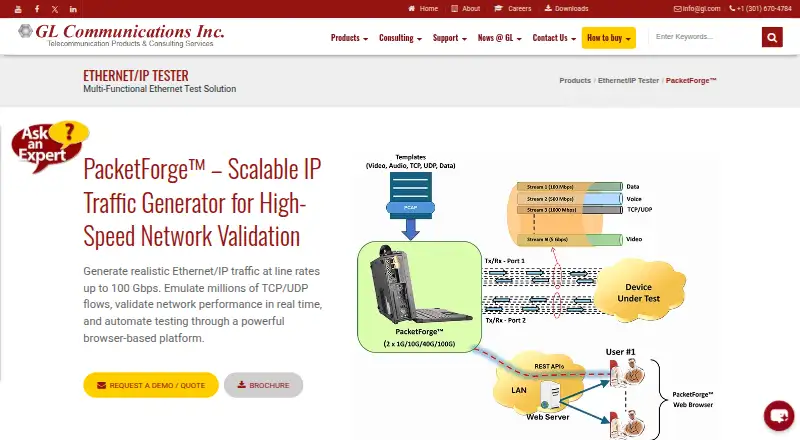
PacketForge is a paid traffic generator for validating network and device performance, scalability, and reliability. It can emulate thousands to millions of concurrent TCP, UDP, or mixed flows, with generation at 1G, 10G, 40G, or 100G depending on hardware and interface configuration. Tests can use PCAP templates or custom TCP, UDP, mixed, and BERT profiles. Supported traffic includes Ethernet, IPv4, TCP, UDP, RTP, VoIP, HTTP, DNS, video, and 5G. Results cover throughput, latency, jitter, packet loss, and session behavior in tables and graphs. REST APIs support remote control, automation, CI/CD integration, and third-party systems. Deployment ranges from appliances and portable systems to PCIe cards and software on PCs or laptops. Windows deployments and browser access are supported; pricing is available on request.
Good
- Emulates thousands to millions of concurrent flows
- Supports 1G through 100G line rates
- Provides PCAP and custom traffic profiles
- Reports throughput, latency, jitter, and packet loss
- REST APIs support automation and CI/CD
Watch out
- Pricing is available only on request
- Line rates depend on hardware and interface configuration
- Windows-based deployments are specified
Who it suits
PacketForge suits service providers, enterprises, equipment vendors, government organizations, and research laboratories validating networks. It is relevant when active tests, listed protocols, and REST automation are required.
Verdict
PacketForge offers broad traffic generation, protocol coverage, measurement, and automation options for network validation. Buyers should match the required rates and deployment hardware before requesting a quote.
Plans and prices
From PacketForge's own pricing page, checked 8 Oct 2026.
| Plan | Price | What it gives you |
|---|---|---|
| PacketForge | Priced on request | Pricing by quote; hardware and software deployment options |
The facts
Each one read from PacketForge's own pages, with the date it was checked.
What it does
- Access controls
- The product page describes role-based permissions and multi-user operation with centralized management and resource reservations.checked 8 Oct 2026
- Automation
- REST APIs enable remote control, test automation, CI/CD pipeline integration, and interaction with third-party management systems.checked 8 Oct 2026
- Deployment
- Deployment options include rack-mount appliances, portable systems, PCIe NIC cards, and software-based deployments on standard PCs and laptops.checked 8 Oct 2026
- Intended users
- The product page identifies service providers, enterprises, equipment vendors, government organizations, and research laboratories as intended users.checked 8 Oct 2026
- Line rates
- It supports traffic generation at 1G, 10G, 40G, and 100G depending on the hardware platform and network interface configuration.checked 8 Oct 2026
- Management
- A centralized web server manages configuration, monitoring, and reporting while distributed agents generate and analyze traffic across test systems.checked 8 Oct 2026
- Monitoring
- Statistics include throughput, latency, jitter, packet loss, and session behavior, with tabular and graphical views.checked 8 Oct 2026
- One-way delay
- PacketForge measures one-way delay over TCP and UDP profiles, and an optional GNSS timing module synchronizes geographically separated endpoints.checked 8 Oct 2026
- Protocols
- Supported protocols and traffic types include Ethernet, IPv4, TCP, UDP, RTP, VoIP, HTTP, DNS, video, and 5G.checked 8 Oct 2026
- Purpose
- PacketForge generates Ethernet/IP traffic to validate the performance, scalability, and reliability of networks and network devices.checked 8 Oct 2026
- Traffic profiles
- It supports PCAP-based templates and custom profiles, including TCP, UDP, mixed, and BERT traffic.checked 8 Oct 2026
- Traffic scale
- It can emulate thousands to millions of concurrent TCP, UDP, or mixed traffic flows.checked 8 Oct 2026
The company
- Company support
- GL Communications lists its headquarters in Gaithersburg, Maryland, and says the company provides products and consulting services to customers worldwide.checked 8 Oct 2026
- Founded
- 1986checked 28 Sep 2026
- Headquarters
- Gaithersburg, Maryland, USAchecked 28 Sep 2026
Where it runs
- Platform requirement
- The product page says PacketForge supports Windows-based deployments and browser access through standard web browsers.checked 8 Oct 2026
Alternatives to PacketForge
- 1

PingPlotter
Free planiOSWebAPILinux8.2From $6.99 a month - 2
iPerf2
Free planOpen sourceAndroidiOSLinuxmacOS7.8Free plan - 3

GitHub CodeQL
Free planWebExtensionLinuxmacOS7.5From $30 a month - 4
Avidemux
Free planOpen sourceWebLinuxmacOSWindows7.3Free plan - 5

EVE-NG
Free planWebLinuxmacOSSelf-hosted7.0Free plan - 6

Netpicker
Free planWebAPILinuxSelf-hosted6.8From $7,500 a year