
EVE-NG
EVE-NG is a clientless network emulation platform for network, security, and DevOps professionals.
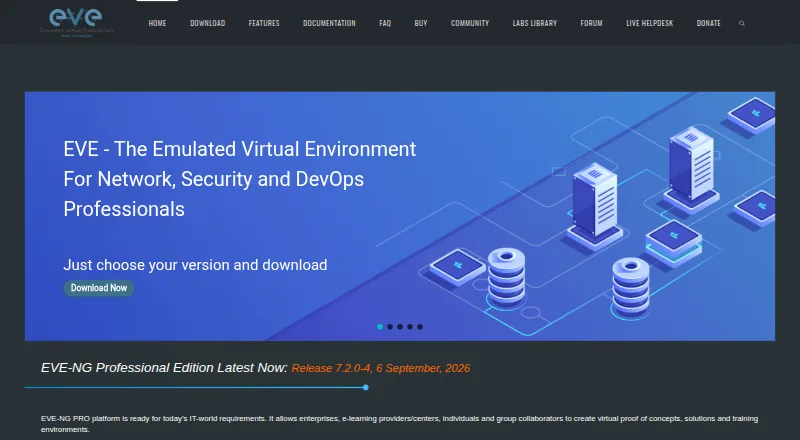
What EVE-NG is
EVE-NG is a clientless network emulation platform for network, security, and DevOps professionals. It is presented for building virtual proof-of-concept projects, solutions, and training environments. A topology designer supports lab creation, configuration import and export, XML lab files, and picture or map imports. Running nodes can connect through hot links, including to real networks. Professional features include KVM hardware acceleration, Docker and custom Docker support, and up to 1024 nodes per lab. Listed integrations include RADIUS and Microsoft Active Directory authentication, Docker-integrated Wireshark, and an integrated NAT cloud. Hosting options include Proxmox, VMware products, and Google Cloud platform VMs. The free plan allows 7 nodes per EVE instance and 63 per lab, with the Admin role only. EVE-NG Base and RBL are listed at €150 per contact; RBL adds multiple roles, with additional roles priced separately. Community Edition support and end of life ended in June 2026.
Good
- Topology designer supports configuration and map imports.
- Running nodes can connect to real networks.
- Professional supports up to 1024 nodes per lab.
- Offers RADIUS and Active Directory authentication.
Watch out
- Free plan allows only 7 nodes per instance.
- Free plan is limited to the Admin role.
- Community Edition support and end of life ended in June 2026.
Who it suits
EVE-NG suits network, security, and DevOps professionals building virtual labs for design or training. Its listed use cases also include enterprises, e-learning providers, individuals, and collaborators.
Verdict
EVE-NG provides lab design and network emulation features, with larger labs and additional roles listed for paid plans. Community Edition is no longer supported, so review the current plan limits and terms before choosing it.
Plans and prices
From EVE-NG's own pricing page, checked 28 Sep 2026.
| Plan | Price | What it gives you |
|---|---|---|
| Freemium | Free | 7 nodes per EVE instance · 63 nodes per lab · Admin role only |
| EVE-NG Base | Priced on request | Admin role only · 1024 nodes per lab |
| EVE-NG RBL | Priced on request | Multi roles: admins, editors, users · 1024 nodes per lab · Added roles priced separately |
The facts
Each one read from EVE-NG's own pages, with the date it was checked.
What it does
- Authentication
- The feature comparison lists multi-server RADIUS support and Microsoft Active Directory support for EVE user authentication.checked 28 Sep 2026
- Community edition status
- The Community page states that Community Edition support and end of life ended in June 2026.checked 28 Sep 2026
- Emulation
- The listed Professional features include KVM hardware acceleration, Docker container support, custom Docker support, and up to 1024 nodes per lab.checked 28 Sep 2026
- Hosting
- Supported platforms include Proxmox, VMware ESXi, Workstation, Fusion and Player, and Google Cloud platform VMs.checked 28 Sep 2026
- Integrations
- The feature comparison lists RADIUS and Microsoft Active Directory authentication, Docker-integrated Wireshark, and an integrated NAT cloud.checked 28 Sep 2026
- License validation
- The rehosting instructions say a Professional license periodically validates online and can be used offline for 24 hours after receiving a validity token.checked 28 Sep 2026
- Network connections
- The site says users can connect running nodes through hot links and interact with real networks.checked 28 Sep 2026
- Pricing terms
- The Buy page says the displayed price is informational and the actual price appears in the buyer’s location currency, with a preferred currency selectable.checked 28 Sep 2026
- Product
- EVE-NG describes itself as a clientless multivendor network emulation platform for network, security, and DevOps professionals.checked 28 Sep 2026
- Support
- The EULA says EVE-NG LTD provides live chat support at no additional cost, at its discretion and without guaranteeing it.checked 28 Sep 2026
- Topology design
- Features include a click-and-play topology designer, configuration import and export, XML lab files, and picture or map imports.checked 28 Sep 2026
- Use cases
- The platform is presented for creating virtual proof of concepts, solutions, and training environments for enterprises, e-learning providers, individuals, and group collaborators.checked 28 Sep 2026
Where it runs
- Platforms
- The download page offers client packs for Windows, Apple macOS, and Linux, and says version 7.0.1-1 and later can download the client directly from the EVE-NG server.checked 28 Sep 2026
The full review of EVE-NG
EVE-NG is a server-based network emulation platform for building virtual labs and connecting simulated nodes to real networks. It suits network, security, and DevOps professionals who need flexible topology design or training environments. Its free tier can help with small, single-admin labs, but shared roles and larger lab capacity require a paid plan.
Overview
EVE-NG combines topology design, node emulation and connections to real networks, with intended uses spanning enterprise proofs of concept, solutions and training. Its clientless approach and support for web access sit alongside Linux, macOS, Windows and self-hosted platforms; deployments are server-based. Hosting options include Proxmox, VMware ESXi, Workstation, Fusion and Player, and Google Cloud platform VMs.
It is a stronger fit for users who want to assemble and connect lab topologies than for those seeking a lightweight desktop-only simulator. Real-time emulation and hardware-in-the-loop support broaden its use beyond isolated diagrams, while its paid tiers make role requirements and node limits important buying considerations.
Compare it with other tools in Network Simulation Software and Network Testing Software.
Key features
Topology design and connectivity
The click-and-play topology designer is paired with configuration import and export, XML lab files, and picture or map imports. Those options support building and exchanging lab layouts, while hot links connect running nodes and enable interaction with real networks. An automation API adds a route for programmatic workflows.
Emulation and integrations
Professional features include KVM hardware acceleration, Docker containers and custom Docker support, with up to 1024 nodes per lab. That ceiling suits substantial lab designs, but the free tier's 63-node lab cap and 7-node-per-instance cap make it a more constrained starting point. Integrations include Docker-integrated Wireshark and an integrated NAT cloud; RADIUS and Microsoft Active Directory authentication support multi-server RADIUS and directory-based user authentication.
Pricing
EVE-NG uses a freemium model. Freemium costs nothing and permits 7 nodes per EVE instance and 63 nodes per lab, with the Admin role only. It is useful for individual or small administrative labs, but the instance cap can bind well before the per-lab ceiling in multi-lab use. Community Edition support and end of life ended in June 2026, so it should not be treated as a supported alternative to the current free plan.
EVE-NG Base costs from €150 (priced on request), offers the Admin role only and raises the per-lab limit to 1024 nodes. It fits users who need larger labs but do not need separate editor or user roles. EVE-NG RBL also costs from €150 (priced on request) and includes admins, editors and users, alongside the 1024-node lab limit; added roles are priced separately. That makes RBL the more suitable choice for collaborative environments, though role expansion can add cost.
The Buy page says displayed pricing is informational: the actual price appears in the buyer's location currency, with a preferred currency selectable. Professional licensing periodically validates online and can be used offline for 24 hours after a validity token is received. Live chat support is provided at EVE-NG LTD's discretion without a guarantee. These conditions matter for deployments with restricted connectivity or support expectations.
Platforms
EVE-NG supports Linux, macOS, Windows, web and self-hosted use, with server deployment. Hosting support spans Proxmox, VMware ESXi, Workstation, Fusion, Player and Google Cloud platform VMs. The breadth of hosting options is useful for teams fitting labs into existing infrastructure, though the server model is less suited to someone looking only for a standalone local desktop application.
Who it's for
Network, security and DevOps professionals can use EVE-NG for virtual proofs of concept, solution environments and training. Enterprises and e-learning providers can build labs around those workflows, while individuals and groups can choose a tier based on node scale and whether collaborators need distinct roles. Users who need more than 7 nodes per instance, more than the free 63-node lab cap, or non-admin roles should assess paid plans before committing.
Pros and cons
- Pros: Topology design, configuration exchange and XML lab files give users several ways to build and manage labs.
- Pros: Hot links, real-network interaction, real-time emulation and hardware-in-the-loop support make it relevant to connected lab scenarios.
- Pros: Paid labs can reach 1024 nodes, with RBL adding editor and user roles for collaboration.
- Cons: The free plan is restricted to 7 nodes per instance, 63 per lab and Admin-only access.
- Cons: Added RBL roles cost separately, and online license validation with a 24-hour offline window may complicate some operating environments.
- Cons: Community Edition support ended in June 2026, so legacy users need to consider current plans rather than rely on continued CE support.
Alternatives
IMUNES is a free option for readers who prefer a no-cost plan and can work within its stated free offering. GNS3 is open-source software users can download and use for free, making it an alternative when an open-source, zero-cost tool is the priority. OMNeT++ is free for noncommercial teaching and research under its Academic Public License; commercial use requires a separate license.
Containerlab is free and may suit users able to meet its Linux server or VM, Docker and, for some operations, sudo requirements. ns-3 is free software under GNU GPLv2 for research, development and use. NetSim by Tetcos offers a free Lite plan for individual use and may suit an individual seeking that stated free-use option. EMANE is a free Linux and self-hosted alternative. Cisco Packet Tracer is another free option for readers comparing network tools.
Verdict
Choose EVE-NG if you need a network emulation environment that connects designed labs to real networks and can scale to large, multi-role setups on paid plans. Its key compromise is the constrained, Admin-only free tier, alongside paid-plan licensing and role terms; readers who need only a free tool should compare the alternatives before deciding.
Getting started
- Visit the EVE-NG website.
- Choose the free plan or a paid plan.
- Set up EVE-NG on a supported host such as Proxmox, a VMware platform, or Google Cloud platform VMs.
- Create a lab with the topology designer and import configurations, XML lab files, pictures, or maps as needed.
- Connect running nodes with hot links to other nodes or real networks.
Limits worth knowing
The free plan allows 7 nodes per EVE instance and 63 nodes per lab, and only the Admin role. Base lists the Admin role only; RBL supports admins, editors, and users, while added roles are priced separately. A Professional license periodically validates online and can be used offline for 24 hours after receiving a validity token.
Questions
How much does EVE-NG cost?
The free plan is listed as free. EVE-NG Base and EVE-NG RBL are each listed at €150 per contact; the displayed price is informational, and the actual price appears in the buyer’s local currency.
What are the free plan limits?
It allows 7 nodes per EVE instance and 63 nodes per lab, with the Admin role only.
Which roles are available in the paid plans?
Base lists the Admin role only. RBL supports admins, editors, and users, and added roles are priced separately.
Which platforms can host EVE-NG?
Listed hosting platforms include Proxmox, VMware ESXi, Workstation, Fusion and Player, and Google Cloud platform VMs.
Does EVE-NG support real networks?
Yes. Running nodes can connect through hot links, including connections that interact with real networks.
What is the status of Community Edition support?
The Community page states that Community Edition support and end of life ended in June 2026.
Alternatives to EVE-NG
- 1

Containerlab
Free planOpen sourceWebAPIExtensionLinux7.6Free plan - 2
Avidemux
Free planOpen sourceWebLinuxmacOSWindows7.3Free plan - 3
Marionnet
Free planOpen sourceLinuxmacOSSelf-hostedWindows7.2Free plan - 4
Mininet
Free planAPILinuxmacOSSelf-hosted6.6Free plan - 5
NetSim
Free planWeb6.6From $15 a month - 6
NetSim
WebLinuxmacOSWindows6.6From $29 a year